Gaza Herald_ For the first time since the ceasefire agreement came into effect in October 2025, Israeli forces have issued forced evacuation orders to Palestinian families in the southern Gaza Strip, signaling a dangerous escalation despite the truce. Residents and Hamas officials said on Tuesday that Israel is expanding the areas under its military control.
Residents of Bani Suheila, east of Khan Younis, reported that Israeli forces dropped leaflets on Monday ordering families living in the camp area of the Al-Raqab neighborhood to leave immediately. The leaflets, written in Arabic, Hebrew, and English, warned: “Urgent message. This area is under army control. You must evacuate immediately. Your life is in danger.”
During the two-year war that preceded the ceasefire, Israel routinely dropped similar leaflets ahead of airstrikes and bombardment, forcing families to flee repeatedly. Residents and a Hamas source said this is the first time such evacuation leaflets have been distributed since the ceasefire began. The Israeli army has not yet responded to requests for comment.
The ceasefire agreement has not moved beyond its first phase, during which major fighting halted and Israeli forces withdrew from less than half of Gaza, while Hamas released captives in exchange for Palestinian prisoners. Nearly all of Gaza’s more than two million residents are now confined to roughly one-third of the territory, most living in temporary tents or damaged buildings, as limited local governance under Hamas resumed.
Israel and Hamas have exchanged accusations of serious ceasefire violations, with wide gaps remaining over the more difficult steps outlined for the next phase of the agreement.
Mahmoud, a resident of Bani Suheila who asked that his family name not be published, said the evacuation orders affected at least 70 families living in tents and partially damaged homes. Speaking by phone to Reuters from Khan Younis, he said his family had been displaced again and was now sheltering west of their original neighborhood.
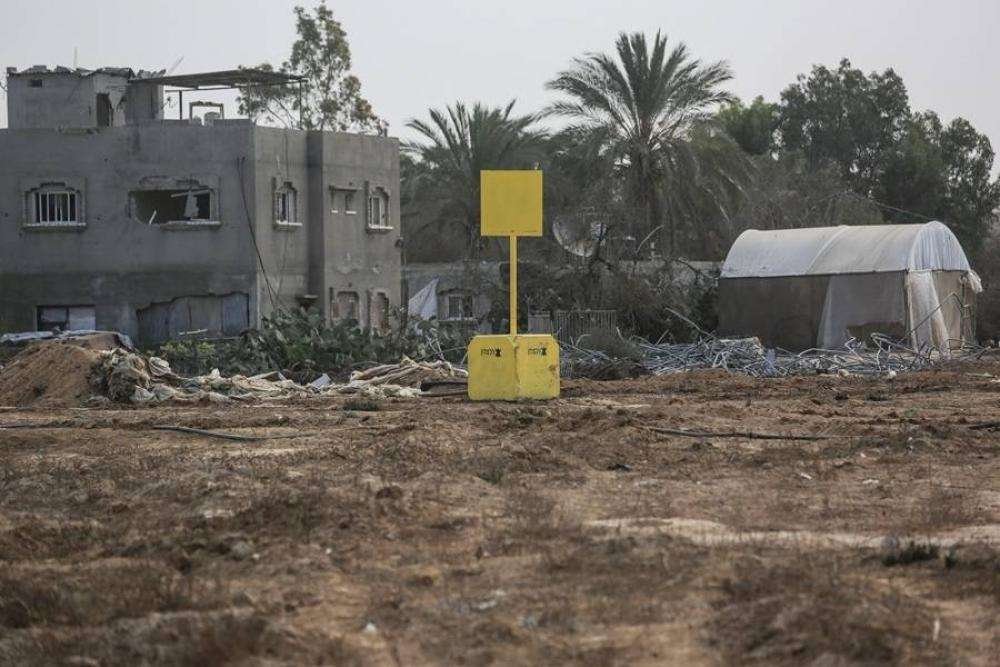
“This is probably the fourth or fifth time the occupation has expanded,” Mahmoud said. “The yellow line has moved again since last month. Each time, they advance about 120 to 150 meters into areas that are supposed to be under Palestinian control.” Mahmoud is the father of three children.
Ismail Al-Thawabta, head of Gaza’s Hamas-run Government Media Office, said Israeli forces have expanded their control east of Khan Younis five times since the ceasefire took effect, displacing at least 9,000 people. He told Reuters that on Monday, January 19, Israeli forces dropped evacuation leaflets in Bani Suheila as part of what he described as a systematic policy to intimidate civilians and impose forced displacement.
Al-Thawabta said the new evacuation orders affect around 3,000 people and have led to the displacement of entire residential blocks. He warned that these actions, which he said fall outside the ceasefire agreement, have caused severe humanitarian chaos, intensified pressure on already overcrowded shelter areas, and deepened the internal displacement crisis in the governorate.
The Israeli army has previously said it opened fire after identifying what it called “terrorists” crossing the yellow line and approaching its forces, describing this as a direct threat. It also said it continues to carry out airstrikes and targeted operations across Gaza, warning it views any attempts by armed factions to attack Israel with “grave seriousness.”
Future phases of the ceasefire agreement—whose details remain unresolved—are tied to a plan proposed by US President Donald Trump that includes the disarmament of Hamas, further Israeli withdrawals, and an internationally backed administration to oversee Gaza’s reconstruction.
Reports indicate that since the ceasefire took effect, more than 460 Palestinians and three Israeli soldiers have been killed, underscoring how fragile and incomplete the truce remains.