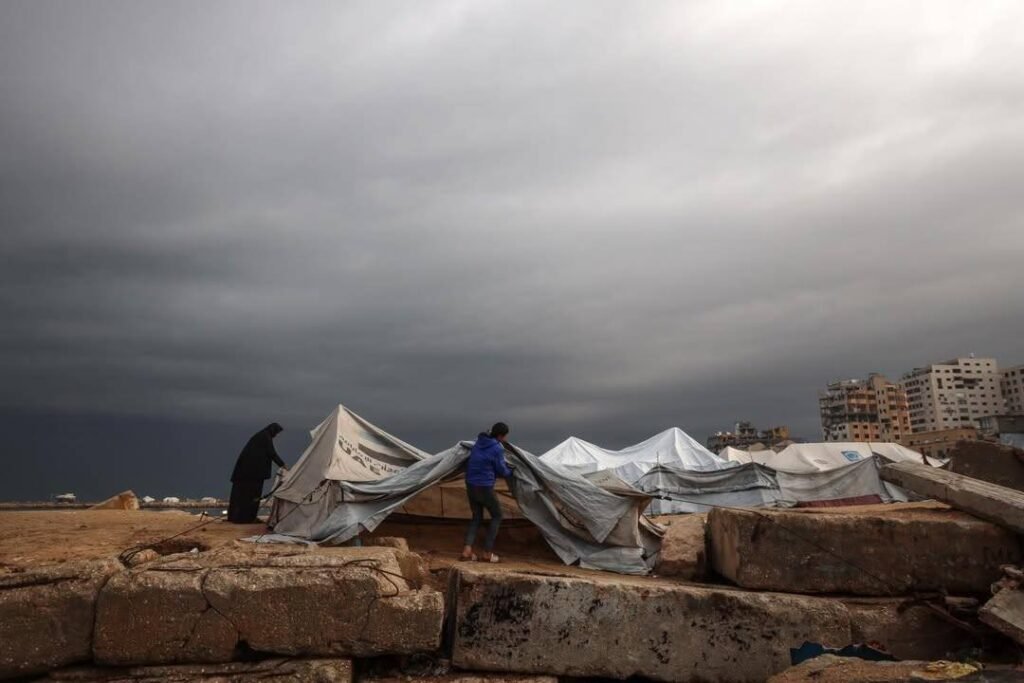
Gaza Herald — In a dusty alleyway of the Zeitoun neighborhood, southeast of Gaza City, Palestinian resident Jawad Badwan sits in front of what remains of his destroyed home, watching people pass by carrying small plastic containers as if they were carrying the fragments of their remaining lives.
At 45 years old, Badwan never imagined that one of Gaza City’s oldest and most historic neighborhoods would become a landscape of thirst. Nor did he think that something as basic as finding water would turn into a daily struggle, a small but exhausting battle against absence, neglect, and the devastation left behind by war.
Speaking with visible fatigue but unwavering determination, Badwan says the people of the neighborhood are living through an unbearable water crisis.
“Our suffering here is the severe lack of water,” he explains. “No official authority is coming to the neighborhood, even though this is one of the oldest and most densely populated areas of Gaza City.”
He gestures toward the eastern horizon, where what residents call the “yellow line” stretches across the area.
“We are living with deep pain and bitterness,” he says. “Water doesn’t reach us. Charity kitchens are absent. Even bread is difficult to find. The most basic rights of ordinary people are completely missing here.”
Community Efforts That Barely Help
Badwan explains that many residents are forced to walk long distances just to secure small amounts of water.
“Those who manage to bring water do it entirely on their own expense and through their own efforts,” he says.
Occasionally, water trucks arrive, but their supply is far from enough to serve the neighborhood’s population.
“Sometimes the neighborhood goes a week or more without a single drop,” he adds. “Young men then travel to distant desalination plants to fill small containers that hold only 10 or 15 liters.”
He pauses and smiles bitterly.
“That amount doesn’t last a family two days.”
As for charitable aid, Badwan says the neighborhood has largely been left out.
According to him, the only organization that has reached the area was the United Nations Relief and Works Agency, which distributed limited hygiene kits.
Other than that, he says, assistance has come mostly from individual volunteers who have been moving between neighborhoods since the war began, trying to help where they can.
“This neighborhood has been severely marginalized,” he says with a heavy sigh. “People here are suffering deeply. Many initiatives are announced, but on the ground, we see no real results.”
Residents Protest the Collapse of Basic Services
Frustration and desperation recently pushed dozens of residents into the streets.
Near the Salah al-Din al-Ayyubi Mosque intersection in eastern Zeitoun, Palestinians gathered among shattered buildings and cracked walls to hold a protest demanding urgent intervention.
The demonstrators called for immediate action to address what they described as a severe collapse in humanitarian conditions and basic services following the massive destruction caused by Israel’s ongoing war in Gaza.
Standing amid rubble and damaged homes, protesters raised banners demanding access to drinking water, the repair of sewage systems, the removal of debris and accumulated waste, and the fair and regular distribution of food and medical aid.
Once a lively district filled with markets, schools, and mosques, Zeitoun is now surrounded by devastation.
Its proximity to the so-called “yellow line,” an area frequently targeted by Israeli military operations, has left residents trapped in an impossible situation.
Aid organizations and service providers often hesitate to enter the area due to the security risks, leaving the population caught between a fragile ceasefire and a reality that bears no resemblance to peace.
Living on the Edge of the “Yellow Line”
Standing near the ruins of his home, 52-year-old Ibrahim al-Shamali points toward the east.
“We are in the Zeitoun neighborhood, one of the largest and most historic areas of Gaza City,” he says. “But because we are close to the yellow line, we have become one of the most marginalized and most targeted places.”
His voice carries the bitterness of someone who feels forgotten.
Al-Shamali calls on international institutions, humanitarian organizations, and service providers to remember the people living in the neighborhood and to look at their suffering with compassion.
“We are living in complete neglect,” he says. “No one checks on us. No one asks what we need.”
He stresses that drinking water is almost nonexistent and that the basic conditions required for a dignified life simply do not exist.
He urges local authorities and medical teams to establish field hospitals and mobile clinics to serve residents who currently have little or no access to healthcare.
But his demands go beyond drinking water.
“We also need water for washing and bathing,” he says. “Cleanliness is not a luxury. It is a basic health necessity.”
He pauses for a moment before continuing.
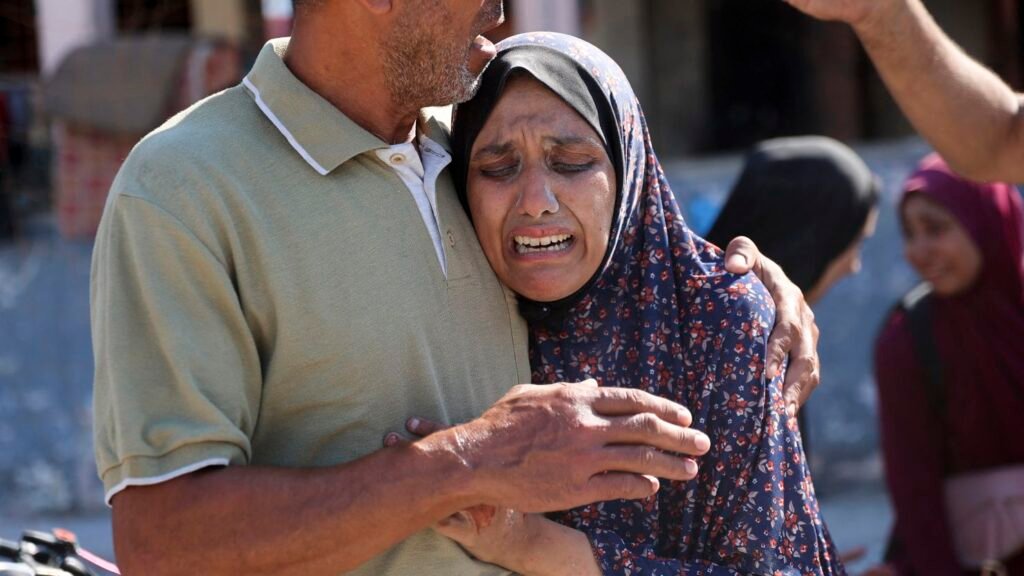
“Please look at our situation with humanity. Do not leave us forgotten. Here in this neighborhood, we feel completely abandoned.”
Then he adds quietly, “Even during the ceasefire, we don’t feel like we are living inside one.”
Bodies Still Trapped Beneath the Rubble
Mahmoud Basal, spokesperson for Gaza’s Civil Defense, says the Zeitoun neighborhood is among the areas most heavily devastated during Israel’s war on the Gaza Strip.
According to preliminary estimates, nearly 90 percent of the neighborhood’s buildings have been destroyed.
“These numbers are not just statistics,” Basal explains. “They represent homes that collapsed and families that lost the walls that once protected them.”
He says the infrastructure in the area has been almost completely shattered.
Garbage continues to accumulate in the streets, sewage systems have overflowed, and in some places the bodies of victims remain trapped beneath the rubble because rescue teams lack the equipment needed to recover them.
“What we are facing here is a compounded disaster,” Basal says. “It is a humanitarian, environmental, and public health crisis all at once.”
Many of the buildings that remain standing are structurally unsafe and could collapse at any moment, posing a constant danger to residents.
There have already been deaths caused by building collapses and by the harsh living conditions imposed by the war.
Basal calls on the international community and United Nations agencies to intervene urgently.
Reconstruction, he says, is essential to easing the suffering of the population. Yet for residents of Zeitoun, reconstruction still feels like a distant promise compared with the immediate crisis of missing water.
“We Remain Here Despite Everything”
Sixty-year-old Salim Daloul speaks with the voice of someone who feels responsible for the entire neighborhood.
“We are the people of resilient Zeitoun,” he says. “This neighborhood was destroyed over the heads of its residents. Yet we remain here. We are still standing on our land.”
Gesturing toward the shattered houses around him, he expresses deep frustration.
“It is painful to see international and local institutions ignoring the neighborhood,” he says. “We do not know whether this neglect is intentional or not, but the result is the same. We have been completely marginalized.”
Daloul estimates that roughly 200,000 people are still living in their homes in the area, despite the destruction.
Many aid programs, he says, focus on displacement camps or shelters, while residents who stayed in their damaged homes are often overlooked.
“Some people receive aid in camps,” he explains. “But those who remained in their homes, even after they were destroyed, are invisible to everyone.”
He calls for genuine compassion and concrete support for the people of the neighborhood, stressing that residents urgently need financial assistance, humanitarian aid, and basic services.
Daloul also suggests a simple solution for organizations that fear entering the area.
“If they are afraid to come into the neighborhood, they can deliver aid to a nearby point,” he says. “Residents will go there themselves to collect their shares.”
A Ceasefire That Feels Incomplete
The Zeitoun neighborhood remains one of the largest and most densely populated areas of Gaza City.
Today, its residents face overwhelming challenges as they struggle to survive amid destruction and a severe lack of resources.
What was once a vibrant community has become a place where survival itself is a daily test of resilience.
Over two years of Israel’s devastating war on Gaza, nearly 72,000 Palestinians have been killed and more than 172,000 injured, the majority of them women and children. Around 90 percent of Gaza’s civilian infrastructure has been damaged or destroyed.
While these numbers reflect the scale of devastation across the entire Gaza Strip, the impact in Zeitoun is even more severe due to its proximity to active conflict zones.
Although a ceasefire agreement has technically been in place since October 10, 2025, Israeli violations continue on a near-daily basis.
These violations have already resulted in the deaths of approximately 650 Palestinians since the ceasefire took effect.
At the same time, Israel continues to restrict the entry of humanitarian aid into Gaza, where roughly 2.4 million Palestinians live under catastrophic conditions, including around 1.5 million displaced people.
In Zeitoun, residents are not asking for much.
They want water to reach their homes.
They want a nearby medical point.
They want aid trucks to stop at the edge of their neighborhood.
Above all, they want their community to appear on the maps of humanitarian assistance, and not to remain forgotten at the margins of geography.
Between rubble and thirst, the neighborhood continues to tell its story in a voice that refuses to disappear.
Here, there are people.
Here, there is life that still deserves to be saved.