
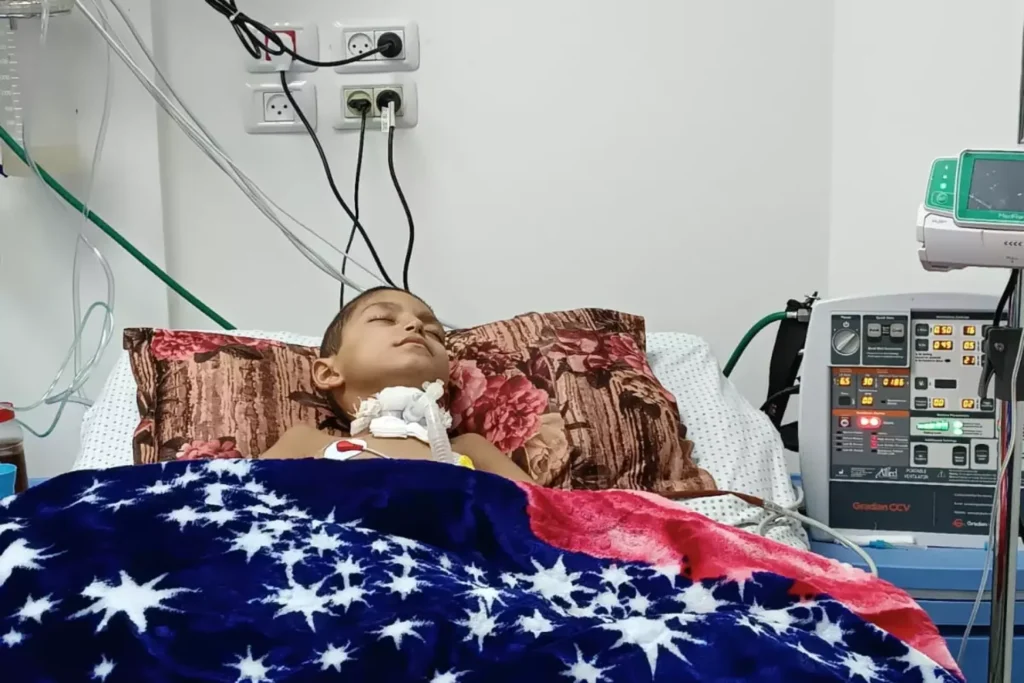
Gaza Herald_Inside the heavy silence of a pediatric intensive care unit, a small boy lies motionless on a hospital bed designed for adults. His name is not what matters here; his body tells the story better than any words could.
He is only ten years old, yet he appears as fragile as a severely malnourished infant. A plastic tube emerges from his throat, connecting him to a ventilator that keeps him alive. The machine hums steadily beside him, one of only three ventilators available in the entire unit, shared between critically ill children and newborn babies fighting for their first breaths.
Resources are scarce. The burden placed on these few machines is overwhelming, and at any moment, the fragile system could collapse.
The scene unfolds inside the Patient’s Friends Benevolent Society Hospital in Gaza City, in the northern part of the Gaza Strip. Here, humanitarian aid rarely reaches families easily. Hospitals operate under constant threat evacuation orders are issued repeatedly, while relentless bombardment echoes across the city day after day.
One of those devastating airstrikes brought this child to the hospital.
In a single instant, his life was completely altered. A piece of shrapnel tore through the air and struck his neck, shattering the third cervical vertebra as easily as fragile glass.
The diagnosis was devastating: quadriplegia.
Now the boy lies still, his eyes fixed on the stained ceiling tiles above him. He does not blink. He does not cry. The doctors caring for him cannot say for certain whether he fully understands what has happened to his body.
What they do know is this: he is trapped inside it.
A child imprisoned by his injury, in a place where the future offers little certainty, not today, and perhaps not tomorrow.
Fighting Medical Battles With Almost Nothing
This pediatric intensive care unit was never meant to be a long-term solution. In truth, it is barely a temporary one. The room functions more like a fragile waiting space as the clock continues to tick.
Each day, new patients arrive.
Newborn babies are struggling to breathe.
Young children suffering from severe infections and sepsis.
Others have been torn apart by shrapnel or crushed beneath collapsed buildings.
Every new case is a painful reminder of the same reality: there are not enough ventilators, not enough trained medical staff, and not enough supplies.
And perhaps most painfully, there is no longer enough hope.
What this child desperately needs is an urgent medical transfer to a specialized facility capable of managing such a complex condition, a place equipped with proper respiratory support, advanced rehabilitation, and long-term care for spinal injuries.
But in Gaza, medical transfers have become almost miraculous events.
And miracles rarely happen.
Evacuating patients outside the Gaza Strip, especially cases as complex as this one, has become an almost unreachable dream.
Meanwhile, the medical teams working here are fighting battles they know they may not win.
They suction the boy’s airway. They monitor his vital signs. They adjust the ventilator settings again and again. Yet every hour that this ventilator remains dedicated to this child raises a painful ethical dilemma.
It means another child may be left without one.
At any moment, a newborn suffering from respiratory distress could lose their chance to survive simply because no ventilator is available.
These are the impossible choices doctors in Gaza face every day.
In Gaza City today, only three ventilators are available for children who require intensive care. One of those three machines is currently sustaining the life of this paralyzed boy.
Before Israel’s war devastated Gaza’s healthcare system, Al-Shifa Hospital housed the largest neonatal intensive care unit in the entire Gaza Strip. It once contained fifty incubators and the full equipment necessary to care for premature babies and critically ill newborns.
That system no longer exists as it once did.
As for this boy, his struggle is only beginning, and he has already lost so much.
What kind of future awaits a child whose life now depends entirely on machines, in a place where the medical system itself is barely surviving?
Every steady beep of the ventilator echoes through the room like a reminder that somewhere, beyond the devastation, there must eventually be a way out of this darkness.
But until that day comes, one truth remains painfully clear.
In Gaza, it is always the children who pay the highest price.

