
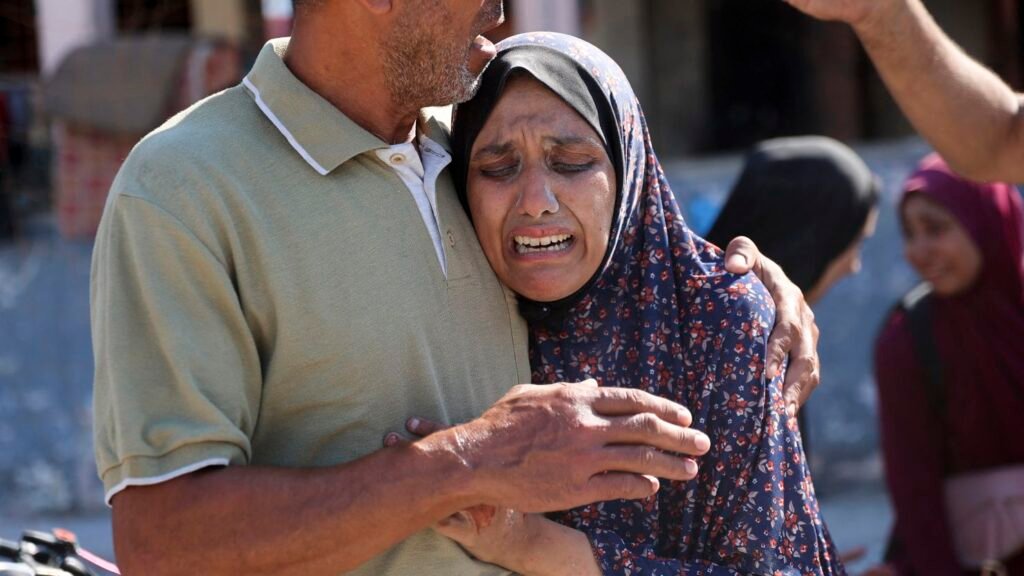
GAZA- In the shaded courtyard of Al-Nasr School in Gaza City, children once played under the watchful eye of Nour Abu Aisha, a young Palestinian volunteer who taught English and offered a fragile thread of normalcy through music and conversation. The school had been converted into a shelter for displaced families, a supposed sanctuary. But on August 4, 2024, it became the site of another massacre.
Nour survived the Israeli bombing of the school, one of many attacks on Gaza’s makeshift shelters. In a testimony published by Mondoweiss, she recounts the moments before and after the missile struck and the emotional wreckage that still lingers.
“When I saw the footage of the Al-Jarjawi massacre, I remembered what I had experienced myself in another school,” she wrote.
At Al-Nasr, Nour worked not only as a teacher but also as a support figure, trying to offer children a space to speak and to dream, even amid displacement, hunger, and fear. But what they told her was unlike the childhood dreams heard anywhere else in the world.
“I asked them what they wanted to be when they grew up,” Nour said.
“Five-year-old Aya al-Dalu told me, ‘When I grow up, I will eat rice with lots of meat.’”
That simple wish, to eat, revealed the brutal deprivation faced by Gaza’s children. By August 2024, Gaza’s north had been completely cut off. Meat was nonexistent, and water was scarce. Israeli forces declared that “whoever wants food, let them go to the south in peace,” a cruel message that left many families, especially mothers, stranded and starving.
“My nephew Omar, who was three, saw sardines for the first time and called them ‘snakes,’” Nour recalled. “Is there a child in this world who doesn’t know what fish or fruit looks like?”
On that August afternoon, after finishing a lesson, Nour stepped outside to the school’s garden, the melodies of Baligh Hamdi echoing in her mind, a brief mental escape.
Her students begged for a few more minutes of play. She agreed. Five minutes later, a missile struck the building next to the playground.
“That sound still echoes in my ears. I fell to the ground and screamed. I checked my body, afraid I’d lost something. Smoke filled the air. I couldn’t see my students,” she wrote.
“Some of them, their small, fragile bodies, were thrown into the sky.”
What followed was chaos. The school’s staff rushed to identify the dead and wounded. Nour ran, her face pale, her soul shattered. Her uncle picked her up in a car that soon became a lifeline for others too; they loaded wounded children into the backseat, including the daughters of a nurse buried under the rubble.
“We didn’t tell them that their mother was gone.”
More than two months passed before Nour found the strength to return to Al-Nasr School.
“I couldn’t believe I had survived while standing only 600 meters from where the missile hit,” she said.
“Even the principal said, ‘Nour, how did you survive so close to the missile, while students further away died? ”It’s a miracle.’”
But for every life spared, countless others were lost.
One of her students, Nour al-Din Makdad, came back to find nothing; his entire family had been killed while he had stepped out to buy something. He now spends his days clinging to their graves.
“The war changed him,” Nour wrote.
“What will he do now? How can he bear what the war has done to him?”
Nour Abu Aisha ends her account with a question that echoes far beyond the walls of Al-Nasr School:
“Did I survive so that I could tell you what happened in those moments?”
She survived, yes, to bear witness. To make sure we listen.

