Gaza Herald_ Behind glossy 3D renderings and promises of prosperity, the so-called plans for a “New Gaza” reveal an old and dangerous logic: managing Palestinian suffering without ending its cause. While international actors market futuristic cities and economic miracles, Gaza remains buried under rubble, siege, and occupation. Any vision for Gaza that bypasses Palestinian sovereignty and ignores Israeli responsibility for destruction is not a peace plan; it is a continuation of domination by softer means.
This contradiction lies at the heart of growing international debate over proposals advanced under the banner of “reconstruction” and “peace,” most notably the initiative promoted by Jared Kushner and his allies.
A Vision Detached from Reality
A recent in-depth report by the American network NBC News critically examined what has been branded as the “New Gaza” project, placing it under humanitarian, political, and security scrutiny. The report concluded that the proposal lacks even the minimum grounding in political and on-the-ground reality.
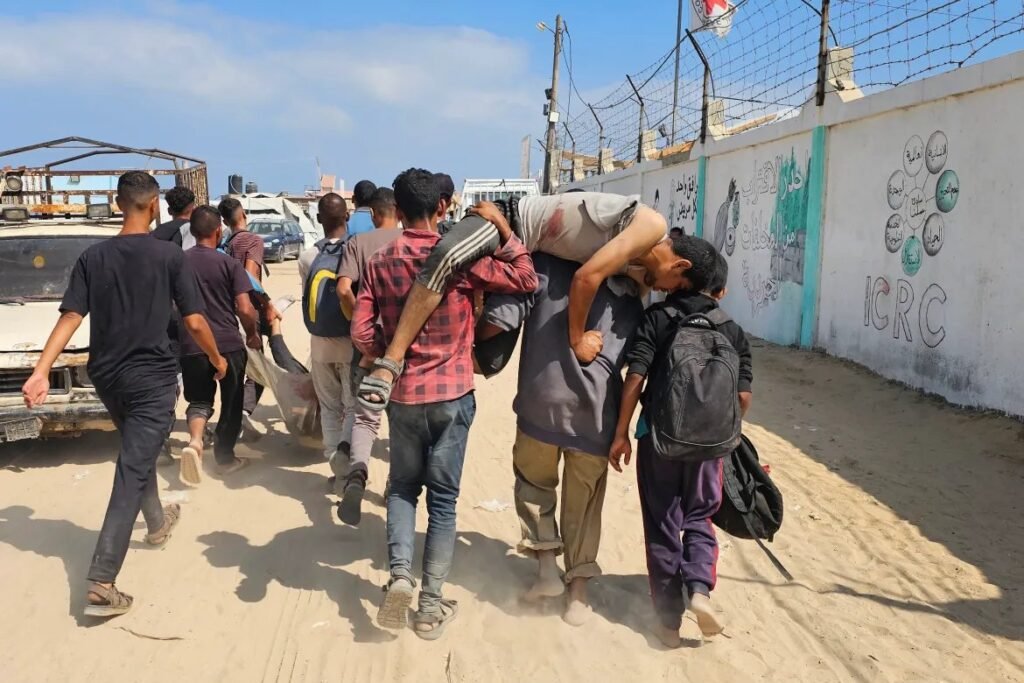
According to the analysis, Gaza today remains devastated after more than two years of sustained Israeli bombardment. Nearly two million Palestinians live under catastrophic conditions, most of them displaced into temporary shelters and tents, amid the near-total collapse of civilian infrastructure. At the same time, Israel continues to exercise control over nearly half of the Gaza Strip, entrenching the very conditions that make any genuine reconstruction impossible.
The report underscores a stark contrast between reality and the promotional imagery circulated by supporters of the plan. AI-generated maps and futuristic designs depict a gleaming coastal metropolis, a city that bears no resemblance to life under siege, military domination, and economic strangulation.
Palestinian Voices: “Where Is This Peace?”
NBC News cited the testimony of Ghassan Al-Tannani, a Palestinian who recently lost his brother in an Israeli airstrike. His words cut through the abstractions of policy debates with painful clarity:
“I want to understand where this so-called Global Peace Council is in Gaza. Where is it? We looked for it and found nothing.”
For many Palestinians, such plans feel not only unrealistic but insulting, visions drawn over the graves of their loved ones, without accountability or justice.
Others expressed deep concern that initiatives like “New Gaza” would ultimately entrench Israeli control under the language of development and investment, replacing overt military domination with economic and administrative tutelage.
Israeli Doubts and Legal Objections
Ironically, the plan also faces skepticism within Israel itself. NBC noted that elements of the proposal, including the construction of a port and airport, directly contradict decades of Israeli policy aimed at sealing Gaza off from the outside world.
International lawyer and conflict-resolution expert Nomi Bar-Yaacov described the proposed governing council for Gaza’s redevelopment as “entirely unrealistic,” arguing that Kushner views Gaza through the lens of a real-estate developer rather than a peace negotiator.
She further noted that Israel would likely oppose the construction of high-rise buildings near its military installations, as tall structures could be perceived as security threats, underscoring how even the plan’s architectural fantasies collapse under Israel’s security doctrine.
Billions Promised, Occupation Ignored
Kushner recently unveiled what he called the “master plan” for New Gaza at an international forum, outlining a four-phase project that includes a new port and airport, railways, highways, and more than $25 billion in investments by 2035.
The plan claims it would raise Gaza’s economy above $10 billion annually, increase average household income to $13,000, eliminate unemployment entirely, and construct over 100,000 housing units in what it terms “New Rafah,” alongside hundreds of schools, medical centers, and cultural facilities.
Kushner openly acknowledged that the project would involve “demolition followed by rebuilding,” presenting destruction as a necessary step toward hope, while failing to address who caused Gaza’s devastation in the first place.
The Core Issue: Occupation, Not Infrastructure
Political analyst Ahmad Al-Hila dismissed the proposal as fundamentally disconnected from the Palestinian reality.
“The problem in Gaza was never a lack of skyscrapers or ports,” he said. “It is the occupation, the siege, and the denial of Palestinians’ right to land and sovereignty. Any plan that ignores these facts, regardless of how impressive its numbers appear, will remain meaningless.”
Al-Hila warned that using artificial intelligence to beautify Gaza’s future cannot erase the lived reality of bombardment, arrests, and the systematic obstruction of reconstruction. “Rebuilding without ending occupation is not development,” he added. “It is the management of a permanent crisis.”
A Ceasefire Without Safety
Despite the announcement of a ceasefire in October 2025, Israel has continued killings, arrests, and restrictions on humanitarian aid. Hundreds of Palestinians have been killed since then, while food, shelter, and medical supplies remain tightly controlled.
Since October 2023, and with direct American backing, Israel has carried out a prolonged campaign of genocide in Gaza, killing more than 71,000 Palestinians and wounding over 171,000, the vast majority women and children, while destroying approximately 90 percent of civilian infrastructure.
Gaza Is Not a Blank Canvas
The visions marketed as “New Gaza” are not blueprints for liberation; they are exercises in denial. Gaza is not an empty plot of land awaiting investors, nor a humanitarian laboratory for political experimentation. It is a homeland, inhabited by a people who have endured siege, massacre, and dispossession, and who continue to demand freedom, not guardianship.
Any genuine future for Gaza must begin with ending the occupation, lifting the siege, ensuring accountability for war crimes, and recognizing the Palestinian people’s inalienable right to self-determination. Without justice, no amount of glass towers or digital renderings will ever rebuild Gaza, because the foundation of peace is not concrete, but freedom.