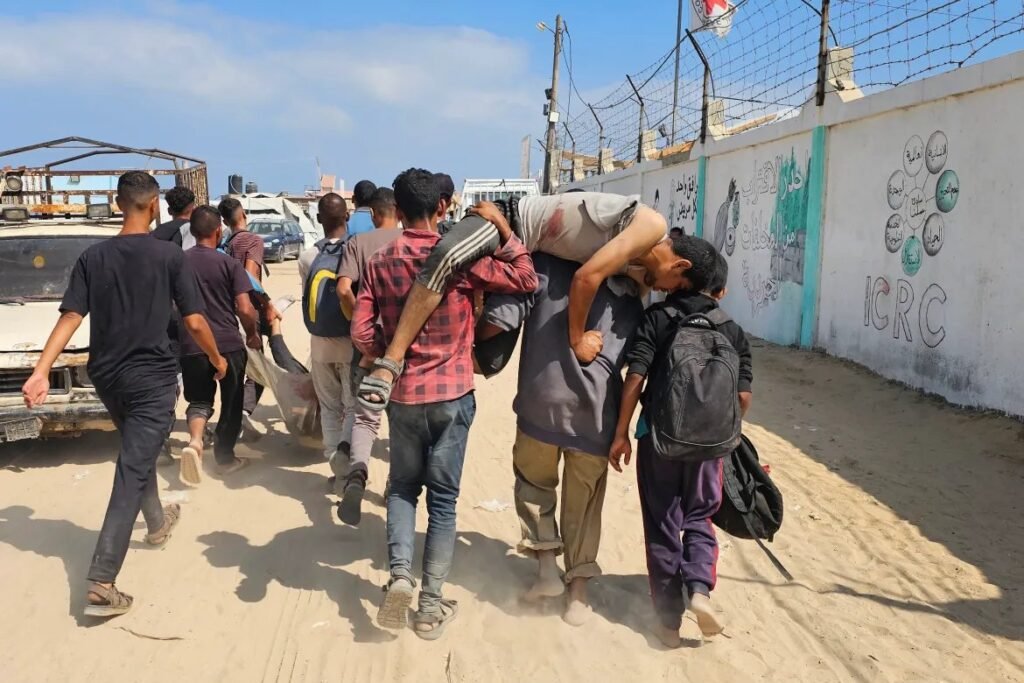
Gaza Herald _ Donald Trump’s so-called “Board of Peace” has less to do with peace than with power, money, and coercion. Despite grandiose rhetoric, the initiative has attracted little genuine international enthusiasm. Only a handful of countries have agreed to participate, while most governments appear wary of what looks like a costly, opaque scheme designed to bypass international institutions and centralize control over Gaza under U.S. dominance.
With a rumored price tag of one billion dollars for entry and no clear legal mandate, the project has raised alarm bells across diplomatic circles. Rather than fostering multilateral cooperation, the board appears to sideline the United Nations while consolidating authority among a small group loyal to Trump.
A Board Built on Denial and Ignorance
The executive body backing the initiative is dominated by figures who have either dismissed or outright denied the reality of genocide in Gaza. Senior U.S. officials, political insiders, financiers, and ideological allies form a tight inner circle united less by expertise than by shared contempt for Palestinian rights.
What is striking is not just their ideological alignment, but their lack of meaningful understanding of the region. Few have any grounding in Palestinian history, society, or politics. Gaza, in their vision, is not a living place with people and memory, but a problem to be managed, reshaped, or erased.
Tony Blair: Experience Without Accountability
The lone figure on the board who can claim experience in the Middle East is former British prime minister Tony Blair. Yet for many, his legacy is inseparable from the 2003 invasion of Iraq, a war launched on false premises that unleashed years of bloodshed and instability.
Blair’s presence has been carefully disowned by the British government. Officials have quietly emphasized that he speaks only for himself and holds no formal position. Behind the scenes, senior figures actively worked to block any perception that Blair represents British policy, reflecting deep institutional mistrust of his self-appointed diplomatic role.
Even as Britain’s current leadership avoids openly endorsing him, Blair continues to position himself as a global peacemaker — a claim that rings hollow for those who view his past interventions as catastrophic.
Window Dressing and Power Without Responsibility
Alongside the main executive board sits a secondary body misleadingly referred to as the Gaza Executive Board. While it includes regional figures from Turkey, Qatar, and Egypt who understand Gaza far better than Washington insiders, their role appears largely symbolic.
Real authority rests elsewhere. The structure is designed so that those with the least connection to Gaza wield the most power, while those with regional knowledge are relegated to advisory roles. Official statements about “effective governance” and “prosperity” are deliberately vague, offering no concrete commitments and masking an absence of accountability.
A Troubling Cast of Advisors
Further down the hierarchy lies an array of advisors whose recent records raise serious concerns. Some have played key roles in Israeli-backed aid mechanisms that have coincided with mass civilian casualties. Others are deeply entangled in settlement advocacy or security agendas hostile to Palestinian self-determination.
The proposed technocratic administration for Gaza is equally problematic. Palestinian factions were largely sidelined, leaving a body with minimal legitimacy on the ground. The individual assigned to oversee security has a history marked by exile, internal conflict, and unresolved accusations, making his return to Gaza both unlikely and destabilizing.
Ceasefire Demands Without Reciprocity
U.S. officials have framed the next phase of the ceasefire almost entirely as an obligation on Hamas, insisting on full demilitarization while threatening severe consequences for noncompliance. Absent from these statements is any acknowledgment of Israel’s obligations, including withdrawal from occupied areas or accountability for repeated ceasefire violations.
Since the agreement was announced, Israeli forces have continued advancing on the ground, occupying more than half of Gaza’s territory, while hundreds of Palestinians have been killed despite the supposed truce. This reality is erased in official narratives that declare the war over while Gaza continues to burn.
Gaza Lives in a Different Reality
Claims that the war has ended stand in grotesque contrast to life in Gaza. Airstrikes continue. Winter storms have flooded camps. Tens of thousands of tents have been destroyed. Food and reconstruction aid remain restricted, and movement through key border crossings is tightly controlled.
So severe is the situation that even the newly formed administrative committee cannot meet inside Gaza, instead convening in Cairo. This is not peace. It is managed devastation.
Blair’s Alternative Universe
Blair’s public statements suggest a worldview detached from Gaza’s lived reality — one in which genocide never occurred and resistance must be dismantled while occupation remains intact. This stance contradicts lessons he once understood elsewhere: armed movements do not disarm without political inclusion and meaningful power-sharing.
Yet Gaza is offered neither. Palestinians are expected to surrender under siege, without sovereignty, security, or guarantees. The word “Palestinian” itself is conspicuously absent from Blair’s rhetoric.
Trump’s Worldview: Power, Money, and Fear
Trump makes no pretense of caring about justice or human rights. His interest lies in control, branding, and profit. The “Board of Peace” resembles less a diplomatic initiative than a protection racket — a network of loyal enforcers designed to extract compliance and resources.
Trump does not govern like a fascist ideologue so much as a mafia boss, demanding loyalty and payment in exchange for temporary reprieve. Those who comply may be spared. Those who resist are punished.
Palestinians Will Not Be Intimidated
History offers a different lesson than the one Trump assumes. Palestinians have endured colonialism, exile, military rule, walls, demolitions, siege, and genocide , yet their national identity has only grown stronger.
No board devised in Washington will break that will. Palestinians are not Greenlanders to be bullied into submission. They are a people whose cause now resonates more deeply than ever, both among themselves and across the world.
This so-called Board of Peace will fade into irrelevance long before Palestinians do. And when history judges it, it will not be remembered as a failed peace effort , but as a cynical exercise in power that Palestinians refused to legitimize.