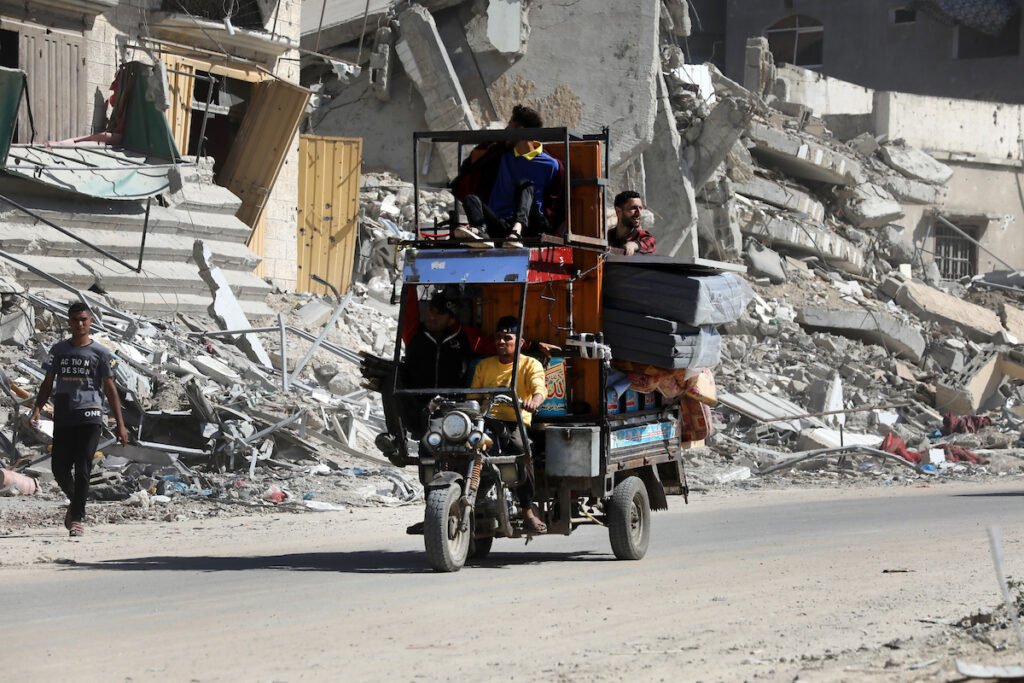
GazaHerald – For Palestinians who have endured nearly two years of war, displacement has become a cycle with nowhere to go. Israeli warplanes have turned high-rise buildings into rubble, flattened entire neighborhoods, and struck makeshift tents that were supposed to offer temporary refuge.
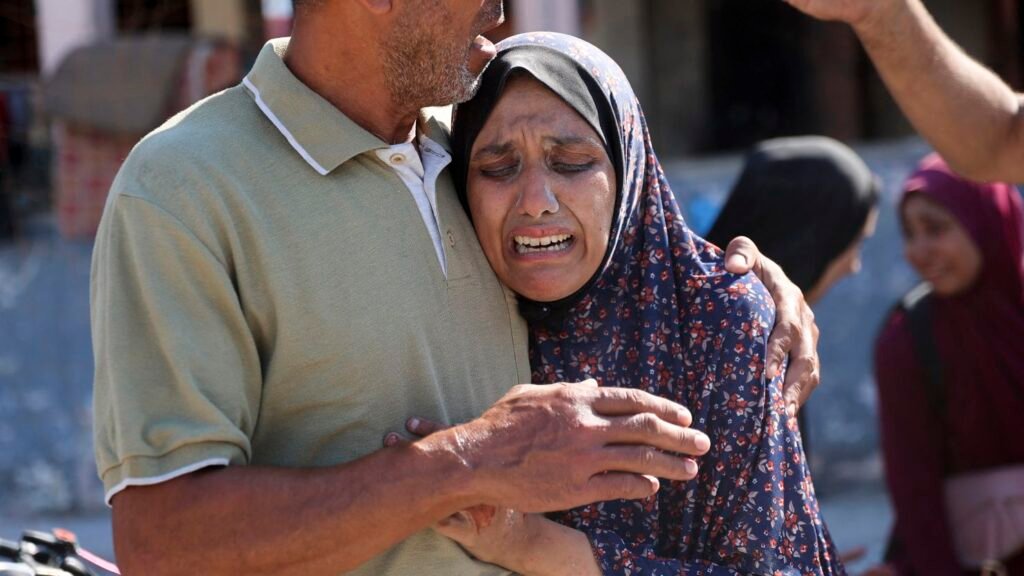
One woman, who had been forced from her home in Beit Lahiya after an Israeli evacuation threat, said she was living in a tent until a nearby tower was bombed. The blast destroyed her last shelter. “Now we no longer have a tent, and I have no money at all to get another one,” she said, her voice breaking.
The same fate haunts families who try to follow evacuation orders. Leaflets dropped over Gaza instruct residents to head south to so-called “safe zones” such as al-Mawasi. Yet, even there, bombs fall.
“Where can we go? We have no money, no tents, no house, no food. I have 15 family members; where am I supposed to take them?” asked Gaza City resident Mustafa al-Jamal, after witnessing those who fled to al-Mawasi come under fire.
For Ahmad Abu Jumah, who was sheltering in the Al-Moshata Tower, the order came with chilling precision: evacuate in ten minutes or die. An Israeli intelligence officer called him directly, refusing requests for more time to allow hundreds of displaced residents, among them children, the elderly, and people with disabilities, to gather their belongings and leave. In panic, Abu Jumah rushed to warn more than 76 families inside the 16-story tower, while others alerted those sheltering in the tents pitched around it. “We barely escaped with our lives,” he recounted, as thousands poured into the streets with nothing in their hands. The order coincided with Israeli Defense Minister Yisrael Katz’s vow that he had “begun to open the gates of hell in Gaza,” promising to intensify operations until Hamas surrendered. Within hours, yet another tower came crashing down.
Among those who fled was Maryam al-Barsh, who says this marked her eleventh displacement since the war began. Three weeks ago, she fled Jabalia after heavy bombardment. Days ago, she moved again after airstrikes expanded, finding fragile refuge in Al-Moshata Tower. When she heard the order to evacuate, she and 20 family members carried an elderly woman who could not walk down seven floors. “There was no time to take even the most basic things,” she said. That night, Maryam and her family slept in the ruins of a torn tent on Gaza’s beach.
Nowhere Left to Go
Residents and officials say the targeting of Gaza’s residential towers is not random but a deliberate strategy. According to Mahmoud Basal, spokesperson for the Civil Defense, Israel’s systematic destruction has left some neighborhoods, Zeitoun, At-Tuffah, Shujaiya, and Jabalia, at “100% destruction.”
Each tower, he explained, contains more than 60 apartments, meaning a single strike instantly renders over a thousand people homeless. The Israeli newspaper Yediot Aharonot recently reported that the army intends to demolish the remaining towers in Gaza City as part of a reoccupation plan.
Ismail Thawabta, Director General of Gaza’s Government Media Office, said the bombardment aims to “exert demographic and psychological pressure on the population, forcibly displace them, and reshape the control of the area.”
The scale of destruction is staggering. More than 268,000 housing units have been destroyed completely, 148,000 rendered uninhabitable, and 153,000 partially damaged, leaving over 290,000 Palestinian families homeless. With more than 90 percent of Gaza’s infrastructure gone, and nearly a million people once living in Gaza City alone, the vast majority now find themselves stripped of homes, belongings, and even the flimsy tents that once offered fragile shelter.
For the families still running from one bombardment to the next, the question remains painfully the same: “Where can we go?”