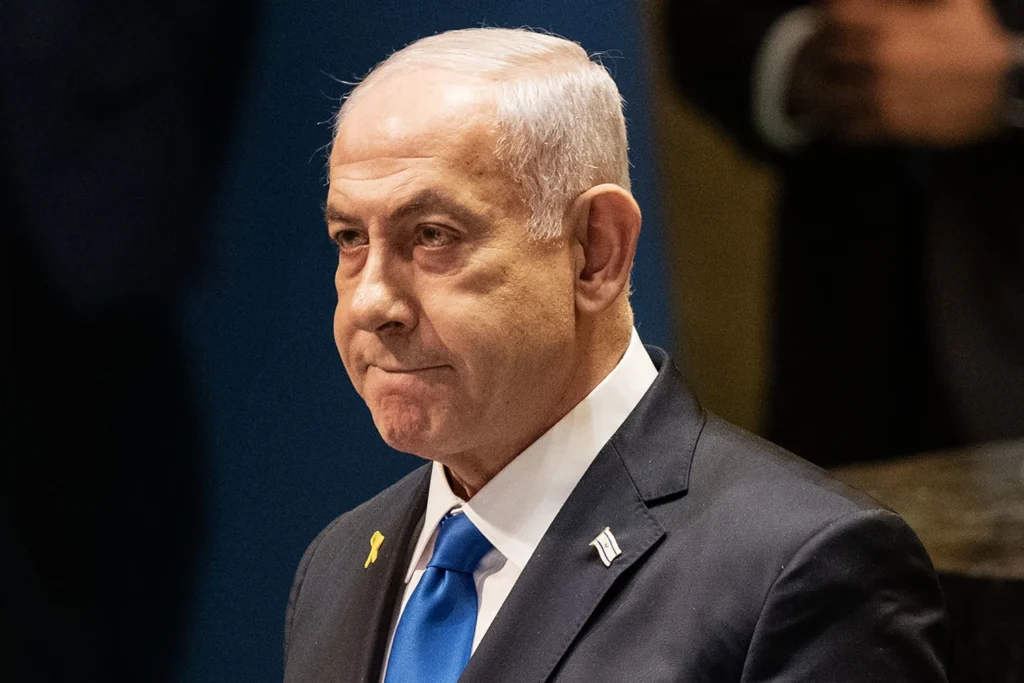
Gaza Herald_ Netanyahu’s inclusion in a US-led initiative for Gaza reconstruction sparks outrage, deepening fears that the so-called peace board will entrench impunity rather than deliver justice.
Israel’s internationally wanted Prime Minister Benjamin Netanyahu has formally accepted an invitation from US President Donald Trump to join what is being called the “Board of Peace” for Gaza — a move that has drawn widespread condemnation and intensified concerns over the credibility, legality, and moral standing of the initiative.
Netanyahu’s participation comes despite an outstanding arrest warrant issued by the International Criminal Court (ICC), accusing him of war crimes and crimes against humanity committed during Israel’s devastating military assault on Gaza. The announcement, made by Netanyahu’s office on Wednesday, has triggered sharp criticism from Palestinian leaders, human rights groups, and international observers who view his inclusion as a blatant act of political defiance against international law.
A Board Built on Impunity
The so-called Board of Peace was unveiled as part of phase two of the ceasefire framework between Israel and Hamas, following months of relentless Israeli bombardment that left Gaza in ruins, killed tens of thousands of Palestinians, and displaced nearly the entire population.
According to Trump, the board will oversee governance reform, regional diplomacy, reconstruction, investment strategies, and large-scale funding mechanisms in Gaza. However, Netanyahu’s presence, given his central role in authorizing the military campaign, has fueled skepticism over whether the initiative represents a genuine peace effort or a mechanism for consolidating political control under the guise of reconstruction.
Reporting from Qalandiya in the occupied West Bank, Al Jazeera correspondent Nida Ibrahim said Palestinians overwhelmingly see Netanyahu’s role as an obstacle to any meaningful political progress.
“Palestinians believe Netanyahu is not interested in ending the war or lifting the siege,” Ibrahim explained. “They see his participation as an attempt to enforce Israel’s military and political agenda, particularly by pushing for Hamas’s disarmament while refusing to withdraw Israeli forces from occupied areas.”
A Board of Indicted Leaders
Netanyahu is not the only controversial figure invited to join the board. Russian President Vladimir Putin, also wanted by the ICC over war crimes in Ukraine, received an invitation earlier this week. Belarusian President Alexander Lukashenko, a close Putin ally, was reportedly invited as well.
Their inclusion has reinforced perceptions that the board is less about peace and more about rehabilitating the international standing of leaders facing criminal accountability. The Kremlin has said it is reviewing the proposal, while Belarus has not publicly commented.
Israel’s own far-right Finance Minister Bezalel Smotrich criticized the initiative, calling instead for unilateral Israeli control over Gaza’s future, a statement that underscores internal divisions within Israel’s ruling coalition and highlights fears that Palestinians will be excluded from shaping their own destiny.
A Global Power Project
Trump has signaled ambitions far beyond Gaza, suggesting that the board could evolve into a global conflict-management body , possibly replacing the United Nations, which he has repeatedly attacked as ineffective.
Although Trump later backtracked, saying the UN should remain, his remarks fueled international concern. China quickly reaffirmed its support for the UN-centered global system, rejecting any parallel structures that undermine multilateral governance.
Some reports indicate that countries seeking permanent membership in the board must pay $1 billion, raising further questions about the initiative’s transparency, motivations, and economic priorities.
Who Has Joined —and Who Refused
Countries that have reportedly accepted invitations include the United Arab Emirates, Morocco, Vietnam, Belarus, Hungary, Kazakhstan, Argentina, Azerbaijan, and Kosovo. Others, including the United Kingdom and the European Union’s executive branch, say they have received invitations but have not yet responded.
Several nations have explicitly refused to participate. Sweden and Norway both announced their rejection, citing concerns over the board’s framework and legal legitimacy. Italy reportedly declined as well, arguing that participation would violate its constitutional commitment to international organizations founded on justice and equality among states.
The Executive Power Core
The executive committee of the board includes senior US officials and high-profile political and financial figures, among them Secretary of State Marco Rubio, Special Envoy Steve Witkoff, Jared Kushner, former British Prime Minister Tony Blair, World Bank President Ajay Banga, and billionaire investor Marc Rowan.
This composition has further fueled criticism that Gaza’s reconstruction is being transformed into a geopolitical and financial project dominated by elite interests, rather than a rights-based process led by Palestinians themselves.
A Peace Plan Without Justice
Human rights advocates argue that any initiative involving individuals accused of war crimes cannot credibly deliver peace. They stress that genuine reconstruction requires accountability, political self-determination, and an immediate end to the blockade, not international boards dominated by figures linked to destruction.
For Palestinians, Netanyahu’s appointment is seen not merely as insulting but as a chilling signal that the world’s most powerful governments are prepared to reward mass violence with political legitimacy.
As Gaza continues to struggle under the weight of devastation, displacement, and humanitarian collapse, many fear that this so-called Board of Peace may serve not as a pathway toward justice but as a new mechanism for entrenching injustice.