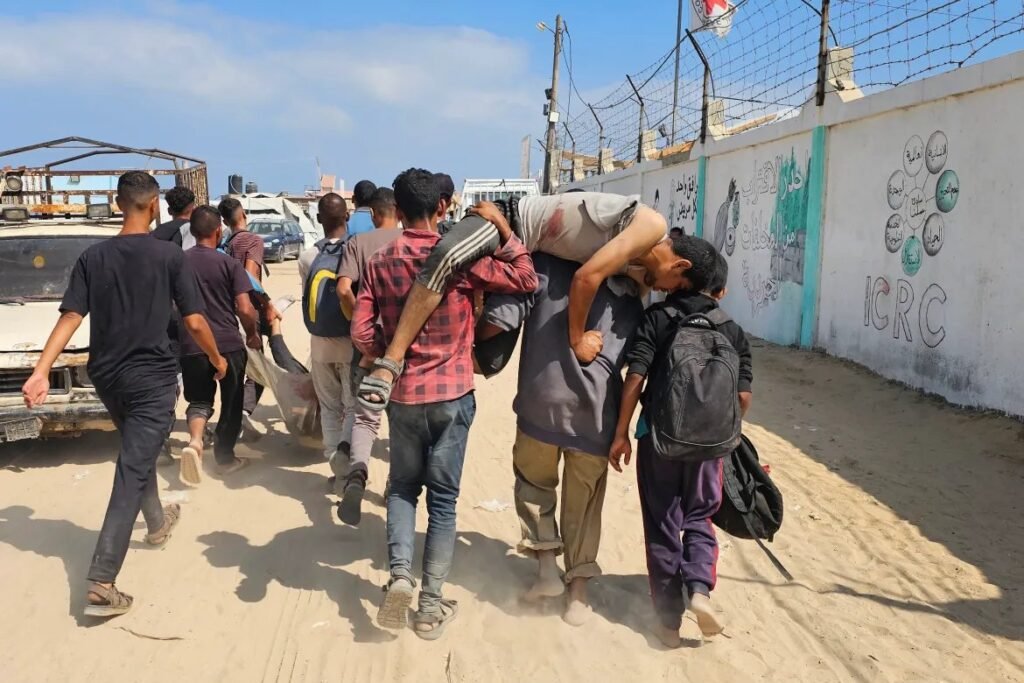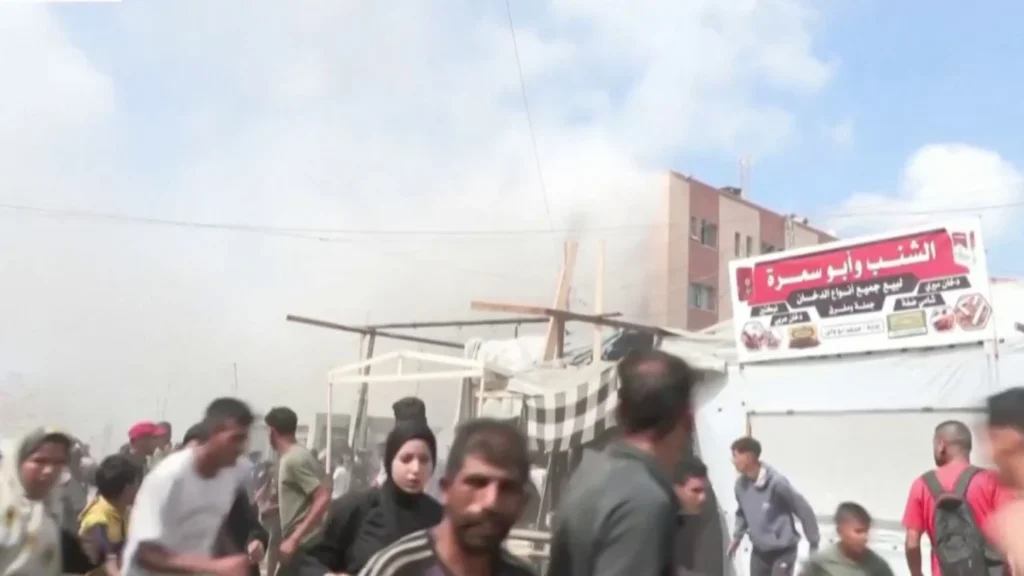
Gaza Herald- Israel is facing growing global outrage after back-to-back strikes on Nasser Hospital in Khan Younis earlier this week killed at least 22 people, including doctors, nurses, civil defense workers, and five Palestinian journalists. What initially appeared to be a two-strike incident has now been shown, through new video evidence obtained by CNN, to have been three separate blasts, with the second and third causing most of the casualties.
Timeline of the Attack
The first strike occurred just after 10 a.m. on Monday when a tank shell hit the exterior staircase of Nasser Hospital, southern Gaza’s largest remaining medical center. Reuters cameraman Hussam Al-Masri was filming from the balcony when the shell struck, killing him instantly and wounding others. His live feed went dark.
Nine minutes later, as first responders, health staff, and fellow journalists rushed to aid the victims and document the scene, the Israeli military hit the hospital again, not once, but twice, in near-simultaneous blasts. Known as a “double-tap” strike, this tactic deliberately targets rescuers who arrive after an initial attack. Frame-by-frame analysis confirms that two shells exploded almost simultaneously at the same spot on the hospital’s fourth-floor staircase.
Survivors described the attack as intentional. “Journalists, patients, nurses, and civil defense were on the stairs. We were directly targeted,” said Reuters contractor Hatem Omar, who was wounded.
Evidence of Deliberate Targeting
Weapons specialists who reviewed the footage concluded the shells were consistent with Israeli M339 multi-purpose tank rounds, known for their precision and fragmentation damage. Satellite imagery taken days before the strike showed more than a dozen Israeli combat vehicles, including tanks, stationed just over a mile northeast of Nasser Hospital the direction from which the shells came.
Analyst N.R. Jenzen-Jones noted that the simultaneous impacts suggested coordination between multiple tanks, not an accidental “target of opportunity.” “Modern tank guns are extremely precise,” he said, raising questions about Israel’s claim of a mistake.
Victims: Journalists and Medical Staff
The attack killed five journalists: Reuters cameraman Hussam Al-Masri; freelancers Mariam Abu Dagga and Moath Abu Taha, both contributors to Reuters and the Associated Press; independent journalist Ahmed Abu Aziz; and Al Jazeera cameraman Mohammad Salama.
Photos and footage show the staircase had long been used by journalists as a vantage point for live broadcasts and uploading material, since it offered a rare stable cell signal. Footage shared on social media weeks before the strike shows several of the same journalists working at the exact location where they were later killed.
Doctors described harrowing scenes inside the hospital. Blood soaked the stairwell floors where bodies were dragged inside after the attack. “For the past two years, we have lived under killing, destruction, and starvation,” said Salah Mansour, surgical department supervisor at Nasser Medical Complex. “Medical staff and hospitals are supposed to be granted the highest level of protection under international law. Instead, we are pleading for our lives.”
Israel killed 5 journalists in broad daylight. Footage confirms a drone watched as tank shells hit first the crew, then the medics.
The footage shows an Israeli drone circling Nasser Hospital 45 minutes before. pic.twitter.com/ocwndNdh5s
— Gaza Herald (@Gaza_Herald) August 28, 2025
Israel’s Shifting Narrative
Prime Minister Benjamin Netanyahu initially called the attack a “tragic mishap,” while the Israeli military later claimed the strikes targeted a “camera positioned by Hamas” and insisted six of those killed were “terrorists.” Yet Israel provided no evidence that Hamas operated from the balcony and did not explain how it distinguished an alleged Hamas camera from the press cameras openly used there for months.
A security source told CNN that IDF troops had been authorized to strike the camera using a drone, but instead fired two tank shells the second deliberately hitting the rescuers. This comment marks the only admission by an Israeli official that first responders may have been intentionally targeted, which, if proven, constitutes a war crime under international law.
Gaza health officials strongly rejected Israel’s claims, accusing the army of retroactively labeling random victims as “terrorists.” They pointed out that at least two of the people named by the IDF as militants had actually died in unrelated incidents elsewhere in Khan Younis.
International Condemnation
The attack sparked strong condemnation from international organizations, including the UN, Doctors Without Borders (MSF), and the Committee to Protect Journalists (CPJ). UN Secretary-General António Guterres demanded accountability, while CPJ denounced the killing of media workers as part of Israel’s broader assault on press freedom in Gaza.
Governments across the world, including Canada, Germany, Switzerland, Qatar, Saudi Arabia, and Kuwait, condemned the strikes, while Reuters and the Associated Press issued a rare joint letter demanding an explanation for why their journalists were killed in a location known to the IDF.
“This was not a mistake,” said one Palestinian commentator online. “It was a deliberate attempt to silence those documenting Israel’s crimes.”
A Pattern of Attacks on Gaza’s Health Sector
Nasser Hospital, already struggling under relentless bombardment, is the last major medical facility still operating in southern Gaza. Nearly all other hospitals have been forced to close due to Israeli attacks and siege conditions.
Humanitarian groups have warned that Gaza’s health system is collapsing under pressure. The strikes at Nasser not only killed journalists but also wiped out precious medical staff at a time when hospitals are overwhelmed with casualties and struggling with severe shortages of medicine, power, and fuel.
International law experts say the incident is a textbook example of a war crime. “Shelling a hospital staircase to eliminate a camera, and then hitting the rescuers, is extreme use of force that cannot be justified as proportionate,” said Hurst Hannum, professor emeritus of international law at Tufts University. “The burden is on Israel to prove this was necessary, and from the evidence, that claim looks far-fetched.”
As Israel continues to deny deliberately targeting civilians, new evidence is steadily dismantling its narrative. The revelation of a third strike at Nasser Hospital, backed by independent video analysis, adds to the growing body of proof that Israel is intentionally targeting journalists, medical workers, and civilians in Gaza.
For many Palestinians, the attack symbolizes Israel’s strategy of silencing witnesses to its atrocities while dismantling the very institutions, hospitals, press agencies, and civil defense units that keep society alive amid the siege.