Gaza Herald- Israeli Prime Minister Benjamin Netanyahu is facing intense criticism and widespread accusations of hypocrisy after publicly acknowledging the Armenian genocide during a podcast interview this week.
His comments, delivered casually in an exchange with right-wing media host Patrick Bet David, immediately triggered angry responses from Armenians, Palestinians, Turks, and critics worldwide, who accused him of exploiting history to cover up Israel’s ongoing war crimes in Gaza.
Netanyahu’s Remarks on the Podcast
The controversy began when Bet David, speaking on his widely followed PBD podcast, pressed Netanyahu about Israel’s reluctance to officially recognize the mass killings of Armenians under the Ottoman Empire between 1915 and 1917. Historians estimate that more than 1.5 million Armenians, along with hundreds of thousands of Assyrians and Greeks, were systematically killed or forced into death marches during World War I.
In response, Netanyahu said, “I think we have. I believe the Knesset passed a resolution to that effect,” seemingly referring to a 2016 statement issued by members of the Knesset’s Education, Culture and Sports Committee. That resolution, however, was symbolic, never adopted by the government, and lacked the weight of official recognition. When asked directly whether he personally recognized the killings as genocide, Netanyahu answered bluntly: “I just did.”
Online Backlash: “Hypocrisy at Its Peak”
Netanyahu’s offhand acknowledgment was quickly condemned online as insincere and opportunistic. Many social media users described it as “geographical opportunism,” an attempt to win political points abroad while ignoring Israel’s own conduct in Gaza.
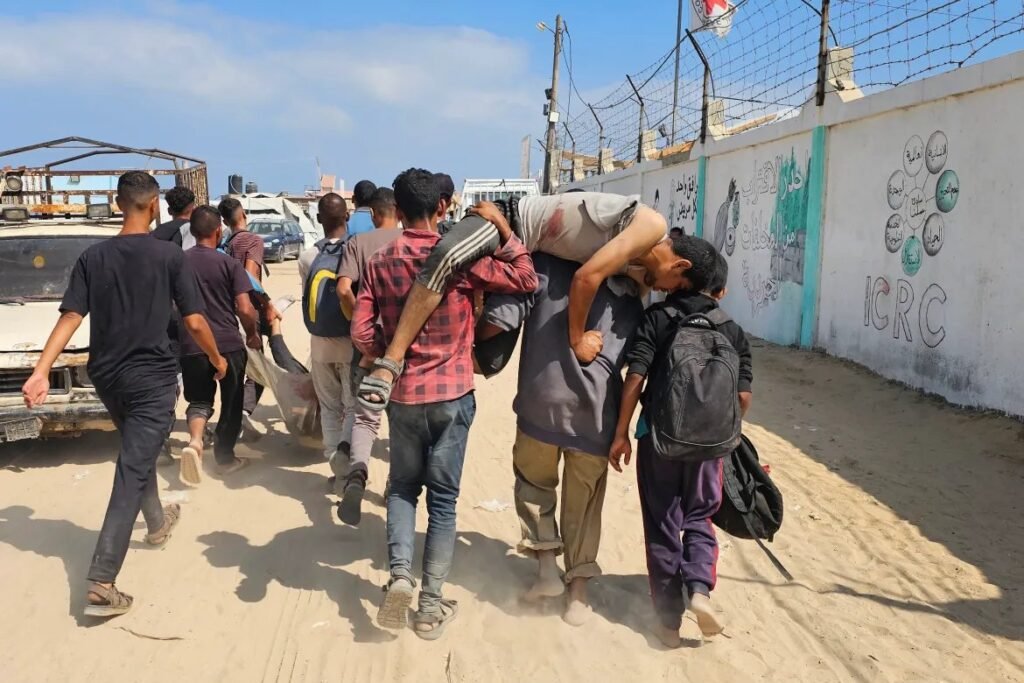
Palestinian activists in particular accused Netanyahu of staggering hypocrisy, pointing out that while he spoke of historical atrocities committed by the Ottomans, his own government is accused by human rights organizations and scholars of committing genocide in Gaza, where conservative estimates place the Palestinian death toll above 62,000 since October 2023.
Armenians on social media were equally outraged. Many accused Netanyahu of using their people’s suffering as “cover” to whitewash Israel’s bombardment of Gaza. Others highlighted Israel’s long-standing military alliance with Azerbaijan, which has carried out ethnic cleansing campaigns against Armenians in Nagorno-Karabakh (Artsakh). “You cannot recognize our genocide while arming the very state that commits ethnic cleansing against us today,” one Armenian commentator wrote.
Turkish Government Reaction
Turkey’s foreign ministry also weighed in, issuing a sharp rebuke of Netanyahu’s remarks. In a strongly worded statement, the ministry accused the Israeli leader of “exploiting past tragedies for political purposes.” It added: “Currently on trial for his role in the genocide against the Palestinian people, Netanyahu seeks to cover up his own crimes. We condemn and reject this declaration, which ignores both historical truth and legal reality.”
On Turkish social media, the anger was palpable. Many users criticized Netanyahu for daring to speak about Armenian history while directing what they called “genocidal warfare” against Palestinians. One person wrote, “Israel, which kills women and children in Gaza without hesitation, now slanders the Turkish nation as well!” Another said bluntly: “It is hard for me to take this war criminal seriously when he lectures us on history.” Others promised that Turkey would “continue to fight until Netanyahu and his criminal network are held accountable before international justice.”
Historical Context and Israel’s Stance
For decades, Israel has walked a careful line regarding the Armenian genocide, avoiding formal recognition out of deference to its diplomatic and military ties with Turkey and later Azerbaijan. Successive Israeli governments have stopped short of full acknowledgment, with motions in the Knesset either failing or being deliberately avoided.
Ankara itself maintains that while many Armenians perished during World War I, the deaths were not part of a coordinated campaign and therefore do not constitute genocide. This stance is echoed by several of Turkey’s close allies, including the United Kingdom, Pakistan, and Azerbaijan.
Meanwhile, 34 governments around the world, including the United States, France, Germany, and Canada, have officially recognized the massacres as genocide. Israel’s reluctance to do so has often been criticized as politically motivated, tied to its defense industry’s reliance on Turkish and Azerbaijani markets.
Linking History to Gaza
Netanyahu’s sudden acknowledgment comes at a time when Israel is under unprecedented international scrutiny for its actions in Gaza. Numerous human rights groups, UN experts, and international legal scholars have described Israel’s military campaign — marked by indiscriminate bombing, mass displacement, and starvation as constituting genocide. The International Court of Justice (ICJ) is currently investigating Israel’s conduct, while the International Criminal Court (ICC) is weighing arrest warrants against Israeli leaders.
For critics, Netanyahu’s comments about the Armenian genocide are not a genuine recognition of historical truth but rather an attempt to manipulate history to deflect attention from present-day atrocities. As one analyst on social media put it: “Netanyahu isn’t honoring the memory of Armenians, he’s weaponizing it to whitewash Israel’s crimes.”
In the end, Netanyahu’s four words, “I just did,” set off a firestorm far beyond what he likely expected. To many, they revealed not a statesman seeking justice for past atrocities, but a leader desperately grasping at historical narratives to shield himself from growing accusations of genocide in Gaza. The backlash from Armenians, Palestinians, Turks, and international observers alike suggests that far from gaining legitimacy, Netanyahu may have only deepened the perception of hypocrisy that surrounds his leadership.