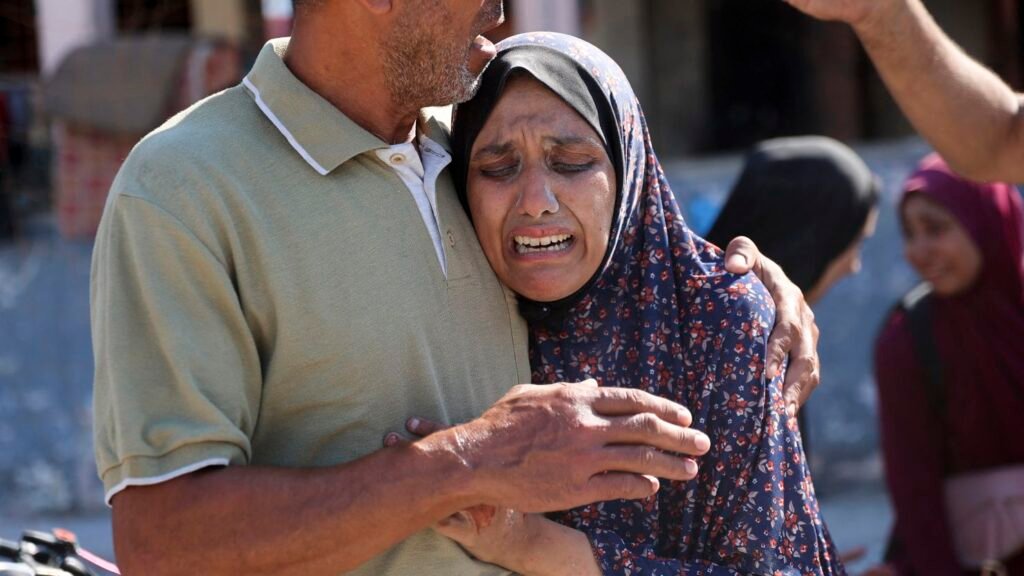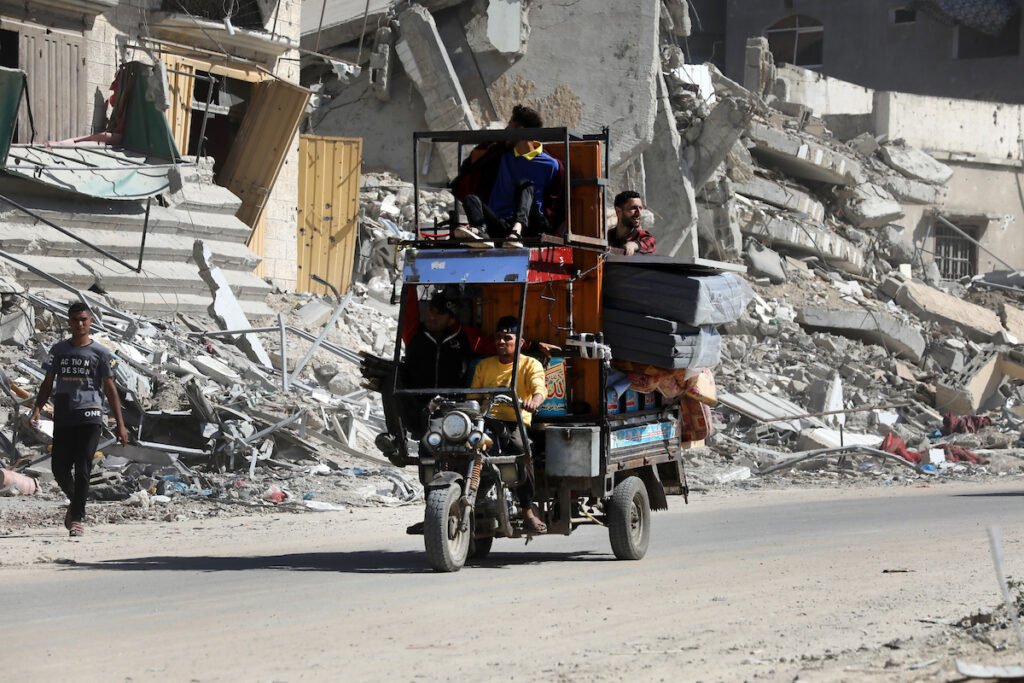
Gaza Herald- Thousands of Palestinian families are once again on the move after days of relentless Israeli airstrikes and artillery fire pounded Gaza City. The neighborhood of Zeitoun, once home to countless families seeking shelter, has been reduced to rubble as continuous bombardments forced residents to abandon what little they had left. Witnesses described scenes of panic as artillery shells fell without warning, destroying homes and scattering families into the streets.
According to the United Nations, Zeitoun, along with the neighborhoods of Sabra, Remal, and Tuffah, has been hit the hardest in recent days. On Sunday alone, seven people were killed when an Israeli strike targeted al-Ahli Arab Hospital, a place that had already become a sanctuary for the wounded. Families who had stayed behind, hoping the violence might pass, eventually joined the exodus as shelling intensified.
Palestinians describe the flight from Zeitoun as a journey of desperation: hungry, exhausted, and uprooted once again after 22 months of unrelenting war. “People left in waves, devastated and empty-handed,” reported journalist Hind Khoudary from central Gaza. “They had no food, no safety, only the will to survive.”
Forced Displacement Branded a “New Wave of Genocide”
Israel has openly announced plans to push deeper into Gaza City and displace its residents to the south. Prime Minister Benjamin Netanyahu, who faces war crimes charges at the International Criminal Court, claims civilians will be moved to so-called “safe zones.” Yet, those same areas have been bombed repeatedly, leaving Palestinians with nowhere secure to go.
The Gaza Ministry of Health reported that starvation claimed at least seven more lives within a single day, raising the total number of hunger-related deaths to 258 including 110 children. Nearly 90 percent of Gaza’s 2.4 million people are now displaced, most of them surviving in overcrowded shelters or on the streets with little access to food or clean water.
Hamas denounced Israel’s relocation plan as “a blatant deception” meant to mask what it called “a new wave of genocide.” Many Palestinians view the tents Israel offers displaced families as nothing more than props in a calculated effort to normalize ethnic cleansing.
The despair is palpable. Journalist Maram Humaid captured the mood in Gaza with a haunting message posted online: “There are no words to describe how people in Gaza feel right now. Fear, helplessness, and pain fill everyone as they face a new wave of displacement.” Families cling to WhatsApp groups where silent messages of sorrow echo the anguish of a people who feel abandoned by the world.
Starvation and a Collapsing Humanitarian System
As bombs fall, hunger tightens its grip on Gaza’s families. The United Nations warns that one in five children is malnourished. Long lines form outside charity kitchens, where displaced mothers and fathers wait for a small portion of lentils or rice often the only meal their children will eat that day.
“I came at six in the morning to get food for my children,” said Zeinab Nabahan, displaced from Jabalia refugee camp. “If I don’t get anything now, I have to return in the evening. My children are starving. They haven’t had bread or even breakfast.”
Also another resident, Tayseer Naim, described the ordeal of waiting hours for meager food aid: “Had it not been for God and charity kitchens, we wouldn’t survive. We suffer for a handful of rice or lentils.”
Humanitarian agencies warn that the crisis is worsening. The UN Relief and Works Agency (UNRWA) declared Gaza is facing a “man-made famine” caused by Israel’s systematic blockade. Juliette Touma, the agency’s communications director, condemned efforts to bypass the UN’s relief system with politically motivated alternatives backed by Israel and the United States. She warned that such moves bring “dehumanization, chaos, and death.”
The World Food Program further estimates that current supplies only meet 47 percent of Gaza’s urgent food needs, leaving half a million people on the brink of famine. Gaza’s Government Media Office has accused Israel of deliberately starving its population by blocking basic goods, from baby formula and nutritional supplements to meat and dairy products. Aid workers inside Gaza, meanwhile, say they are running out of resources to keep people alive.
Gaza on the Brink: “We Are Losing Our Collective Humanity”
Aid workers describe the situation in Gaza as a humanitarian system on the verge of collapse. Amjad Shawa, director of the Palestinian NGOs Network, told reporters that despite their best efforts, the scale of destruction and the blockade have made it nearly impossible to deliver enough food, medicine, or education to those in need. “We are part of the social fabric here,” he said. “We stay with the people, even as Israel threatens to destroy the rest of Gaza. But the humanitarian system is collapsing before our eyes.”
The stakes could not be higher. More than 40,000 infants are at risk of severe malnutrition, and over 100,000 other children and vulnerable patients face similar conditions. Rights groups describe Israel’s siege as a deliberate policy of “engineered starvation,” designed to break the Palestinian population through hunger and despair.
As the death toll rises to nearly 62,000 Palestinians killed since October 2023, many also warn that history is witnessing yet another atrocity unfold in real time. For Palestinians, displacement is not new; it is a recurring trauma stretching back to the Nakba of 1948. But today, the scale of suffering is reaching levels the United Nations calls catastrophic.
The words of UNRWA’s Juliette Touma capture the urgency of the moment: “We are very, very close to losing our collective humanity.” In Gaza, humanity is already hanging by a thread, as families are forced to choose between hunger and the constant threat of death from above.