GAZA Herald— A top-secret investigation has exposed the shadowy web of intelligence operatives, private financiers, and political influencers behind a controversial U.S. mercenary operation in the Gaza Strip.
At the center of the story is Safe Reach Solutions (SRS), a private military company that has deployed Arabic-speaking mercenaries to secure aid distribution centers for the Gaza Humanitarian Foundation (GHF). While framed as a humanitarian response, the operation has drawn intense scrutiny amid allegations of excessive force, deadly incidents, and links to high-level figures from the U.S. intelligence and financial elite.
Leading SRS is Phil Reilly, a former CIA officer with decades of experience across U.S. conflict zones, including Nicaragua, Afghanistan, and Iraq. Reilly previously served as deputy CIA station chief in Baghdad and played a central role in the early drone warfare program—a background that made him well-known among regional defense leaders.
Reilly was also a board member of Circinus, a defense and intelligence firm formerly owned by Elliott Broidy, a major Trump fundraiser and staunch supporter of Israel. During the Trump administration, Circinus received over $200 million in contracts from the United Arab Emirates, including during the 2017 Qatar-Gulf diplomatic crisis. Broidy later pleaded guilty to illegal lobbying activities and was pardoned by Donald Trump in 2021.
Israeli corporate filings show that Charles Africano, another figure involved in SRS, was also connected to Circinus until recently. Both men, along with other former U.S. defense officials, are now central to the day-to-day operations of SRS in Gaza.
Backing SRS financially is Ward McNally, a Chicago-based private equity magnate and heir to the Rand McNally publishing fortune. His firm, McNally Capital, has a growing portfolio in defense and intelligence firms, including Orbis and Quiet Professionals, both of which have government contracts and specializations in cybersecurity and open-source intelligence.
According to sources close to the operation, McNally viewed Gaza as a profitable frontier following Israel’s blockade of aid in late 2023. With support from Reilly, he helped establish SRS to replace traditional humanitarian networks like the UN with a privatized model for aid security.
Internal communications have revealed that SRS’s role extends beyond security. According to Yedioth Ahronoth, the firm has been tasked with military-grade intelligence operations, including operating checkpoints, collecting and analyzing visual data from surveillance cameras, Israeli drones, and satellites, and using that data to identify Hamas members and other armed individuals.
Despite such tasks, sources say SRS lacks the necessary infrastructure for full-spectrum intelligence gathering and is expected to rely heavily on information provided directly by the Israeli military. Investigative reporting by The New York Times and The Washington Post has further suggested that the food distribution effort in Gaza—where SRS plays a leading role—is effectively an Israeli-backed initiative, with efforts made to conceal that connection.
A company source told Yedioth Ahronoth, “Most of our personnel are former NSA or CIA staff, intelligence analysts, or ex-military operatives.” The company did not respond to inquiries about contractor pay. However, multiple international reports have stated that during the recent ceasefire in Gaza, SRS was paying contractors as much as $1,000 per day.
The plan mirrors past U.S. strategies, particularly post-invasion Iraq, where military contractors surged amid reconstruction efforts. “The Israelis especially wanted to replicate what the U.S. did in Iraq after 2003,” one source familiar with the planning said. “And Reilly, as the former CIA deputy chief in Baghdad, was the ideal contact.”
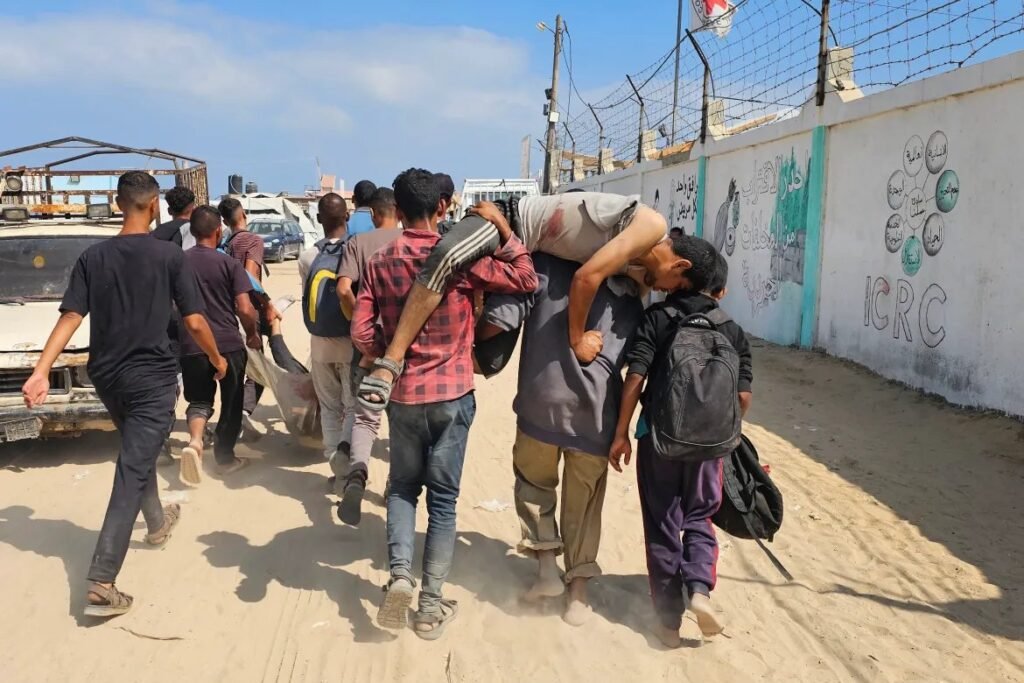
Since deployment, however, GHF’s Gaza operations have been marred by deadly chaos. Human rights groups have condemned the aid sites as “death traps,” with over 66 Palestinians killed near U.S.-backed distribution centers in a single day last month. While contractors anonymously admitted to live ammunition being used on civilians, SRS and GHF have denied serious incidents, blaming “vested interests” for trying to discredit their mission.
Meanwhile, the U.S. State Department has approved $30 million in funding for GHF, which could balloon to $1.8 billion annually. Critics argue this funding indirectly supports militarized aid operations in breach of international law.
As the war on Gaza continues—claiming over 56,000 Palestinian lives, mostly women and children—questions mount over who truly controls aid delivery, and whether war profiteering is being masked as humanitarian intervention.