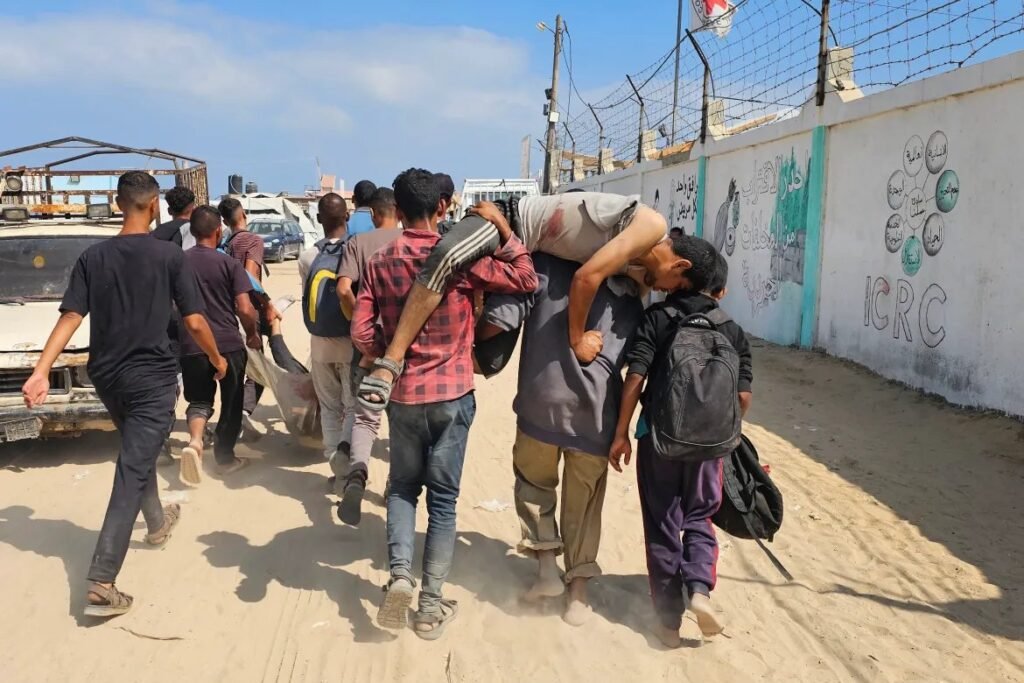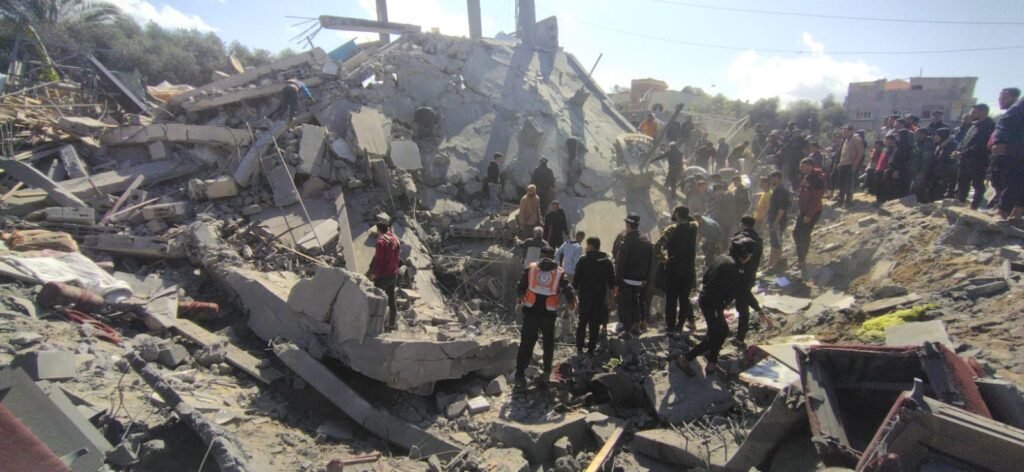
Gaza Herald– Negotiations over a potential ceasefire in Gaza have intensified as Israeli military operations continue to claim the lives of Palestinian civilians. The mounting death toll and destruction are raising doubts about whether a deal is truly within reach or simply another diplomatic delay.
In recent days, U.S. President Donald Trump announced that Israel had accepted the conditions for a 60-day ceasefire. The plan, if implemented, would open the door to broader negotiations aimed at ending the nearly 21-month-long Israeli war on the besieged Gaza Strip. In response, Hamas said it submitted a “positive reply” to the proposal, though with certain amendments. Despite calling those changes “unacceptable,” Israeli Prime Minister Benjamin Netanyahu sent negotiators to Doha to continue the talks.
Netanyahu is expected in Washington, D.C., on Monday, where Trump is reportedly hoping to finalize an agreement. Speaking to the press, Trump hinted that “there could be a Gaza deal next week,” though he acknowledged he had yet to review Hamas’s full response. Still, he described their willingness to engage as a good sign.
One of Hamas’s central demands is the dismantling of the Gaza Humanitarian Foundation (GHF), which it accuses of acting as an extension of Israeli policy under the guise of aid. Over 740 Palestinians have reportedly been killed at GHF food distribution points in recent weeks. Humanitarian organizations have accused Israeli forces of targeting unarmed civilians, and criticized the GHF for turning basic aid into a tool of political leverage. Aid workers say the organization restricts assistance unless it aligns with Israeli strategic goals.
The Palestinian group is also demanding a full Israeli military withdrawal from the areas it occupied after breaking the ceasefire earlier this year. In May, Israeli forces launched a new wave of ground offensives across Gaza, killing hundreds and expanding their control over large parts of the territory. The construction of militarized corridors — such as the Netzarim Corridor in the north and the Morag Corridor in the south — has further fractured the region and blocked the flow of civilians and aid.
Another critical demand is a system of international guarantees to ensure that Israel cannot simply resume its assaults after the ceasefire ends. In previous truces, including the one in January, Israel has unilaterally resumed attacks without provocation. This time, Palestinian factions want explicit assurances, particularly from the United States, that air raids and military incursions will not restart unless a final agreement is reached.
The original U.S.-backed proposal puts emphasis on resolving the issue of Israeli captives held in Gaza. Under the plan, Hamas would release 10 living captives and the bodies of 18 others in exchange for Palestinian prisoners held in Israeli jails. It also calls for international organizations such as the UN and the Red Cross to oversee the delivery of food and aid supplies throughout the Gaza Strip. A phased withdrawal of Israeli forces from certain areas is also included in the plan.
Despite having initially accepted the American proposal, Netanyahu has rejected Hamas’s revised terms and reiterated that the war will continue until all Israeli captives are freed and Hamas is dismantled. Many analysts consider this an unrealistic goal, arguing that Netanyahu is using the war to maintain political power and distract from his ongoing corruption trial.
Public opinion in Israel remains divided. Netanyahu continues to face sharp criticism over his failure to prevent the October 7, 2023, attack by Hamas, which killed over 1,100 people and resulted in the capture of around 250 individuals. His critics say prolonging the war serves his interests, allowing him to delay legal proceedings and strengthen his position among Israel’s far-right base. Ministers in his cabinet, such as Itamar Ben Gvir and Bezalel Smotrich, have publicly pushed for harsher measures, including increased military action and the blocking of aid into Gaza.
Netanyahu’s Political Dilemma
Prime Minister Benjamin Netanyahu finds himself with very limited political flexibility. The extreme right-wing ministers in his coalition have threatened to withdraw their support if any agreement is reached that does not ensure Israel’s continued occupation of the entire Gaza Strip. Netanyahu himself has repeatedly vowed not to halt the war until Hamas is completely dismantled—an objective that now leaves him little room to back down.
Behind closed doors, however, Netanyahu is fully aware that reality does not align with his ministers’ ideological ambitions. According to Israeli military and intelligence officials, the main strategic goal of weakening Hamas’s military capabilities has already been achieved. But they emphasize that the second objective—returning the remaining Israeli captives—can only be realized through a negotiated agreement, not continued warfare.
This internal tension was laid bare during a high-level cabinet meeting chaired by Netanyahu just before his departure to Washington. The meeting reportedly saw sharp exchanges between IDF Chief of Staff Eyal Zamir and hardline ministers who insist on rejecting any deal that falls short of total Hamas defeat and full occupation of Gaza. Zamir challenged them directly: “Do you want a military government in Gaza? Who will govern two million people?”
In Zamir’s view, the immediate priority should be a deal to secure the release of Israeli hostages, especially given that only around 20 out of 50 captives are believed to still be alive. He warned that further military operations would only increase the risk to their lives, while the strategic gains of continuing the offensive are increasingly uncertain.
Despite the rhetoric, Netanyahu does have political options if he chooses to pivot. Following Israel’s recent airstrikes on Iranian targets—which earned him an 82% approval rating in domestic polls—he may have enough public support to accept a compromise that was previously politically impossible. Retired Major General Israel Ziv, former head of the IDF’s Operations Directorate, noted: “Politically, Netanyahu will have no better opportunity than the one created by the successful operation against Iran. But that window will close.”
Even members of the opposition are offering him an exit ramp. Opposition leader Yair Lapid has pledged to provide Netanyahu with a political “safety net,” assuring a parliamentary majority in case far-right factions abandon the coalition over a ceasefire deal.
Humanitarian Situation on the Ground
Meanwhile, conditions for Palestinians continue to deteriorate. In Gaza, Israeli strikes remain relentless. In the past 24 hours alone, at least 138 Palestinians have been killed, according to health officials. The humanitarian crisis has deepened, with food, water, and medical supplies dwindling. In the occupied West Bank, the situation is no better. Israeli forces have stepped up home demolitions and raids, and settler violence has surged. Since October, over 1,000 Palestinians in the West Bank have been killed, while thousands of others face restrictions on movement and economic survival.
Is a Ceasefire Within Reach?
Despite efforts to reach a ceasefire, skepticism remains high. While Trump appears eager to secure a deal, many believe the real obstacle lies in Israel’s unwillingness to halt its military campaign. Regional experts argue that Israel’s strategy reflects a broader intention to depopulate Gaza, pushing Palestinians to either flee, starve, or die under bombardment.
Yet, in the face of overwhelming violence, Palestinians continue to demonstrate resilience. Their refusal to abandon the land, even under the harshest conditions, sends a clear message: they are not leaving. Whether this resilience will eventually lead to a political breakthrough remains uncertain — but for now, Gaza remains under fire, and peace remains elusive.
American Incentives
U.S. officials are reportedly seeking to persuade Netanyahu to accept a ceasefire by tying the end of the war in Gaza to the prospect of a broader diplomatic shift in the Middle East—one that could culminate in the formal normalization of relations between Israel and several Arab states. According to a Monday evening report by The New York Times titled “What’s at Stake in Netanyahu-Trump Meeting in Washington?”, this strategic incentive is designed to make a deal more politically viable for the Israeli prime minister.
Such a diplomatic breakthrough, the report argues, could help Netanyahu justify the ceasefire domestically, particularly given the fierce opposition from his far-right coalition partners, who categorically reject any agreement that allows Hamas to retain influence in Gaza.
Former senior Israeli military official Israel Ziv believes Netanyahu now has an opening to secure several high-profile regional achievements—including launching a new diplomatic track with Syria, reviving stalled normalization talks with Saudi Arabia, and recovering the remaining hostages. Together, these would represent substantial political victories ahead of any future election campaign.
Politically, Netanyahu’s position may also be insulated for the time being. If his right-wing coalition remains intact until July 27—when the Knesset enters its summer recess—he would remain in office at least until the legislative body reconvenes on October 19. Even if the government collapses afterward, Israeli law requires a minimum three-month period before elections can be held, effectively extending his tenure through the end of the year.