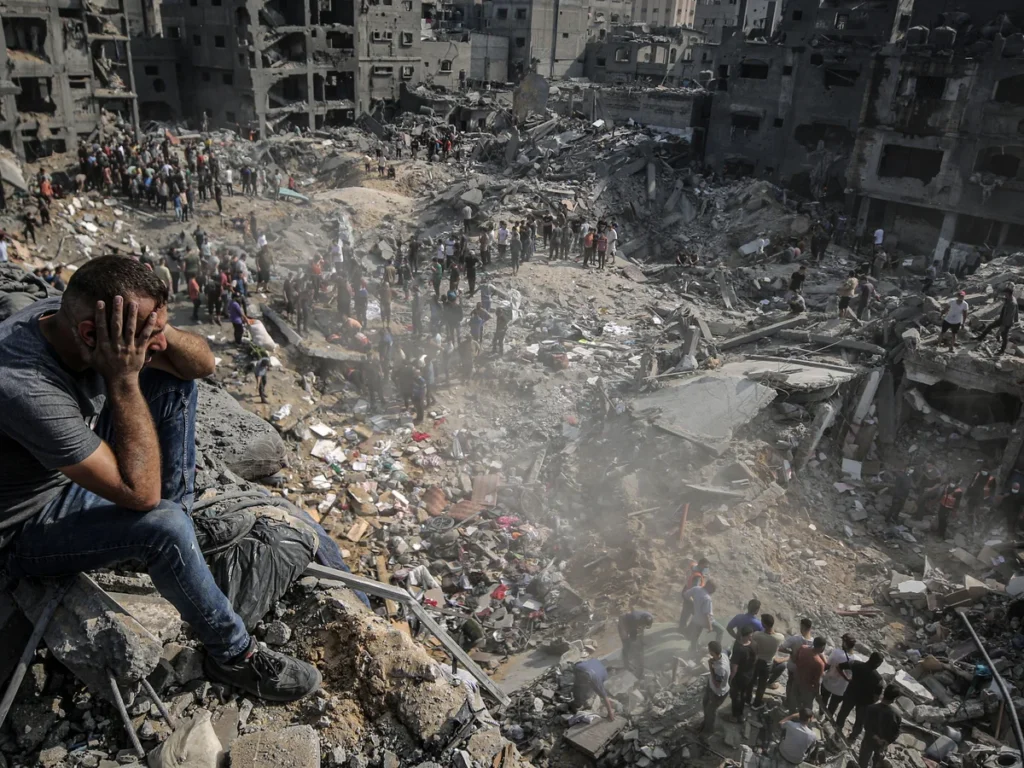
Gaza Herald- As the conflict in Gaza drags into its third year, the humanitarian crisis worsens beyond words. Families face starvation, children suffer unspeakable pain, and hope grows dim under an unyielding siege. While ceasefire talks and political rhetoric circulate, the reality on the ground tells a grimmer story—one of desperation, loss, and survival at all costs. This report offers an intimate look into the lives of those struggling to endure in Gaza’s darkest hours.
A Dangerous Journey for Aid
I recently witnessed firsthand the desperate reality faced by countless people in Gaza as they wait for aid — a heartbreaking scene that casts a dark shadow over any talk of ceasefires or peace. What once was a simple 20-minute journey from Deir el-Balah to Gaza City has become a dangerous and exhausting ordeal. With roads destroyed and vehicles banned, families rely on overcrowded donkey carts and tuk-tuks, constantly fearing sudden airstrikes or blocked routes,” said Mariam Humaid.
At the Netzarim Corridor, thousands of men, women, and children gather nightly near aid trucks, risking their lives in a frantic scramble for food. This is no orderly queue; it is a fierce struggle for survival where over 600 Palestinians have been killed waiting for aid, caught in gunfire from Israeli forces and private guards.
The faces of this suffering are many: women running alone toward trucks, men clutching knives to defend themselves from others driven to desperation, and children trailing behind with empty sacks that barely hold a few scraps. This collapse of social order reveals a community pushed to its breaking point, where hunger erodes dignity and hope.
Amidst the dust, darkness, and destruction, a faint spark of innocence endures. My own daughter looked up at the full moon, finding a fragile beauty amid the ruin — reminding me of the stark contrast between childhood innocence and the harshness surrounding them.
The Human Cost: Starvation, Suffering, and Silence
After more than twenty months of war, siege, and devastation, seeing the aid seekers’ ordeal up close made clear that this is not simply a shortage of resources — it is a human tragedy unfolding in silence. Until the world acts to end this blockade and establishes a lasting ceasefire, these perilous journeys for survival will continue, and too many lives will be lost in a battle they never chose, but are forced to fight every day.
The humanitarian crisis in Gaza is reaching heartbreaking depths, with children bearing the heaviest burden. UNICEF has revealed a devastating surge in acute malnutrition cases among Gaza’s youngest — between April and May, the number of children admitted to hospitals for life-threatening starvation rose by 50%. Of the thousands hospitalized, hundreds suffer from severe acute malnutrition, a condition that slowly and painfully destroys their bodies. Since February, this figure has more than doubled, a stark reminder that every day without adequate food and medical care brings more young lives to the brink of death.
Following a brief window of hope during a temporary ceasefire, aid access has once again been strangled. A new, restricted system forces desperate Palestinians to travel to just four aid points — only to face gunfire from Israeli forces and armed contractors. More than 600 Palestinians have been killed in their desperate attempts to reach life-saving food. The image of starving men, women, and children chasing aid trucks through dangerous checkpoints is a haunting symbol of a people pushed to the edge.
James Elder, UNICEF’s global spokesperson who recently returned from Gaza, paints a grim portrait of suffering: “I saw children with horrifying burns and shrapnel wounds, screaming in hospitals desperately short of pain relief and medical supplies. The unbearable stench of burning flesh and the cries of agony are etched into my memory. This is not just statistics — these are real children suffering terribly.”
Water — a basic human right — is now a political weapon. Since October 7, Gaza’s power supply has been cut, leaving vital water treatment plants in darkness. Without fuel to operate these plants, clean drinking water is vanishing. Elder warns that unless the blockade is lifted and electricity restored, children will not just starve — they will die of thirst.
Adding to the desperation is the collapse of Gaza’s healthcare infrastructure. Hospitals are overwhelmed with casualties, lacking essential medicines and supplies. Medical staff work tirelessly but are stretched to the breaking point. Many facilities rely on generators running on scarce fuel, and power outages make surgeries and treatments increasingly perilous. The lack of clean water and sanitation further endangers vulnerable patients, fueling outbreaks of disease.
Beyond the immediate dangers of hunger and injury, the psychological toll on Gaza’s population is profound. Families live in constant fear, children grow up amid trauma and loss, and hope for a better future diminishes daily. The mental health crisis, largely invisible on the world stage, threatens to leave a lasting scar on a generation robbed of normal childhoods.
This is more than a crisis. It is a man-made nightmare unfolding before the world’s eyes. The people of Gaza, especially their children, are trapped in a merciless siege where every day is a fight for survival against hunger, thirst, and violence. The urgent call from those witnessing this tragedy is clear: without immediate humanitarian relief and political will to end this blockade, the innocent will continue to suffer unimaginable loss.