
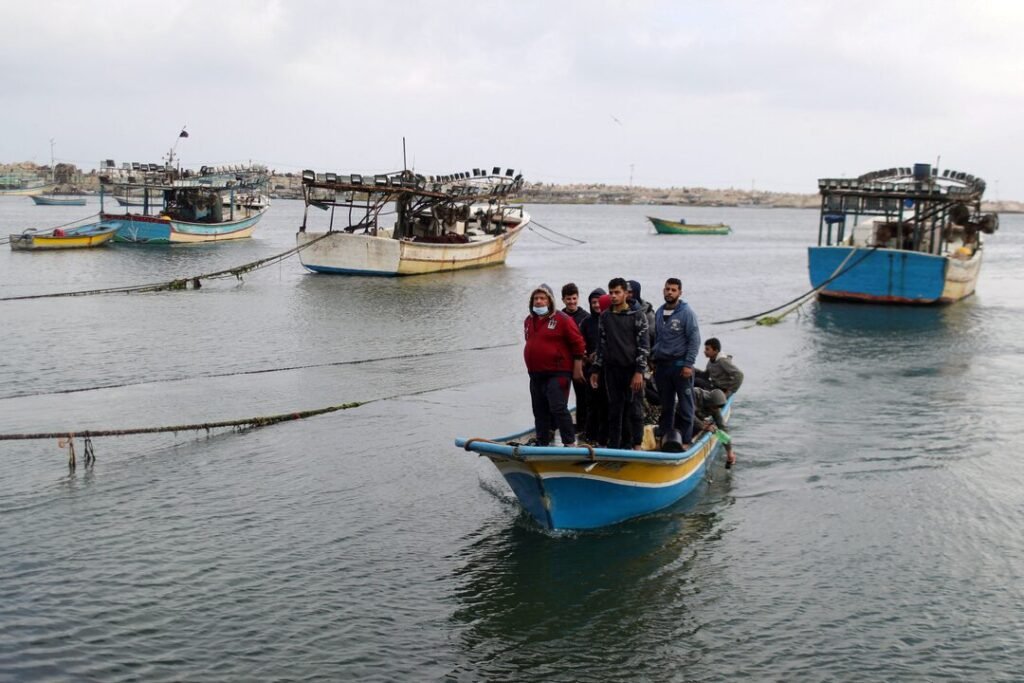
Gaza Herald — The sea in Gaza is no longer simply a place of work or a source of food and income. For Palestinian fishermen, it has become a zone of constant danger, where every attempt to earn a living can end in injury, arrest, the loss of a boat, or the destruction of the equipment they depend on to feed their families.
On Monday morning, three Palestinian fishermen were reportedly wounded by Israeli naval fire off the coast of Gaza City, adding to a long record of attacks that have made access to the sea itself a daily risk for workers in a profession that for decades served as a vital source of income and food for thousands of Palestinian families.
Among those wounded were 16-year-old Isa’id Mohammad Abu Rayala and 22-year-old Ibrahim Azzam Bakr, while a third fisherman was also injured during the attack on the boats.
The Palestinian Ministry of Agriculture condemned the shooting, describing it as an assault on fishermen’s right to work and earn a living, at a time when Gaza’s fishing sector is already facing a devastating decline caused by war, destruction, restrictions on access to the sea, and the repeated targeting of fishermen.
The latest incident comes against a broader backdrop of escalating pressure on Gaza’s fishing community. On September 1, Israeli naval forces detained 10 Palestinian fishermen off the coast of Al-Zawayda and Sheikh Ajlin after opening fire on their boats and transferring them to Ashdod port, according to the Union of Fishermen’s Committees.
A Profession Turned Into a Risk
Fishing has long been one of Gaza’s important economic and food-producing sectors. Before the war, thousands of Palestinians depended directly on fishing, while tens of thousands more benefited indirectly through fish trading, transportation, boat repair, equipment sales, and other activities connected to the industry.
Fish was also one of the important sources of protein available to Gaza’s population, particularly amid difficult economic conditions and the rising cost of meat and poultry.
But the war has devastated much of this system.
Fishing boats, port facilities, fish ponds, warehouses, repair workshops, and other infrastructure linked to the industry have suffered extensive damage, while access to the sea has been severely restricted and transformed into a perilous undertaking.
With boats and equipment destroyed and fishing grounds increasingly inaccessible, fishermen are no longer simply struggling to catch enough fish. They must first survive the journey itself.
A Sea That Once Fed Gaza
Before the war, Gaza’s fishing sector produced thousands of tons of fish each year and provided an important local source of food and income. Today, its productive capacity has collapsed, while fish prices have risen amid shrinking supplies, high operating costs, and the scarcity of fuel, boats, fishing nets, engines, and other essential equipment.
The collapse of fishing has therefore evolved from a labor crisis into part of Gaza’s wider food-security crisis.
When a fisherman cannot reach the sea, loses his boat, or can no longer afford to replace his nets, he does not simply lose his personal income. Local markets also lose a source of fresh food, while families become increasingly dependent on humanitarian assistance amid economic devastation and shortages.
The destruction of fishing, therefore, cannot be reduced to the loss of a traditional profession. It also affects Gaza’s ability to produce food locally, deepening dependence on aid at a time when the humanitarian crisis continues to intensify.
From Boats to Ruins
The war has inflicted enormous damage on Gaza’s fishing industry. A large portion of the sector’s assets have been destroyed or damaged, including fishing boats, port facilities, fish ponds, storage areas, repair workshops, and the infrastructure required to keep the industry functioning.
Gaza’s fishing port, which for decades served as a central hub for fishermen, was among the facilities affected by the destruction. With boats, ice-production facilities, storage areas, repair workshops, and fishing equipment damaged or destroyed, fishermen have lost the basic tools needed to return to work even when access to the sea is possible.
Some fishermen have tried to continue under extraordinarily difficult conditions, relying on small boats, damaged nets, and improvised equipment in the hope of catching enough fish to feed their families or sell in local markets.
But whatever income they manage to generate often bears little relation to the risks they take.
Even when a fisherman succeeds in reaching the sea, the possibility of gunfire, arrest, or the confiscation of his boat and equipment remains. Losing a boat can mean losing an entire livelihood.
Between Arrest and Gunfire
For years, Gaza’s fishermen have faced changing restrictions on fishing areas, along with incidents of gunfire, arrests, and boat confiscations.
The war has pushed those dangers to a far more severe level. Fishermen have repeatedly faced fire while attempting to reach their source of income, with others killed, wounded, detained, or deprived of their boats and equipment.
Recent incidents illustrate that the danger has not disappeared even under the current ceasefire framework. In September alone, Israeli naval forces detained fishermen off Gaza’s coast, while fishermen have continued to report attacks and restrictions as they attempt to work.
This has created a brutal contradiction: the sea is the place fishermen must reach in order to feed their families, yet it is also the place where they may lose their lives, their freedom, or the only means of earning an income.
The consequences extend far beyond the fisherman himself.
When a fisherman is detained, his family can suddenly lose its main source of income. When a boat is confiscated or destroyed, an entire household may lose its only means of work. And when fishing equipment is destroyed, restarting the profession can become nearly impossible amid high equipment costs and restrictions on the entry of materials needed for repairs.
The Sea That Became a Place of Fear
For generations of Gaza’s fishermen, fishing was not simply a job. It was a way of life passed from one generation to another.
Fishermen knew the sea, its seasons, its waters, and the places where they could earn enough to sustain their families. Their boats were workplaces, their nets were livelihoods, and the sea was one of the few resources Gaza could draw upon locally for both income and food.
Today, that relationship is being severed.
A fisherman heading out to sea no longer knows whether he will return with a boat full of fish, return empty-handed, be forced back toward the shore, or end his journey in detention or injury.
The fishing sector is therefore facing more than a temporary decline. Without conditions that allow fishermen to work safely and without the reconstruction of the boats, port facilities, equipment, and infrastructure destroyed during the war, the sector risks disappearing piece by piece.
Reviving fishing would require far more than a temporary permission to enter the water. It would require rebuilding the sector’s infrastructure, replacing destroyed boats and equipment, providing nets and engines, restoring repair facilities, and ensuring that fishermen can reach the sea without turning every fishing trip into a threat to their lives.
For Gaza’s fishermen, the goal is no longer simply to go to sea in search of a better catch.
They are risking their lives for the most basic ability to feed their families.
And as attacks, arrests, and restrictions continue, the sea remains both a source of food and livelihood and a source of fear and danger.
That makes Gaza’s fishing sector one of the clearest examples of the territory’s wider economic and humanitarian collapse: an industry that once produced food and sustained families has been reduced to a struggle simply to survive.

