
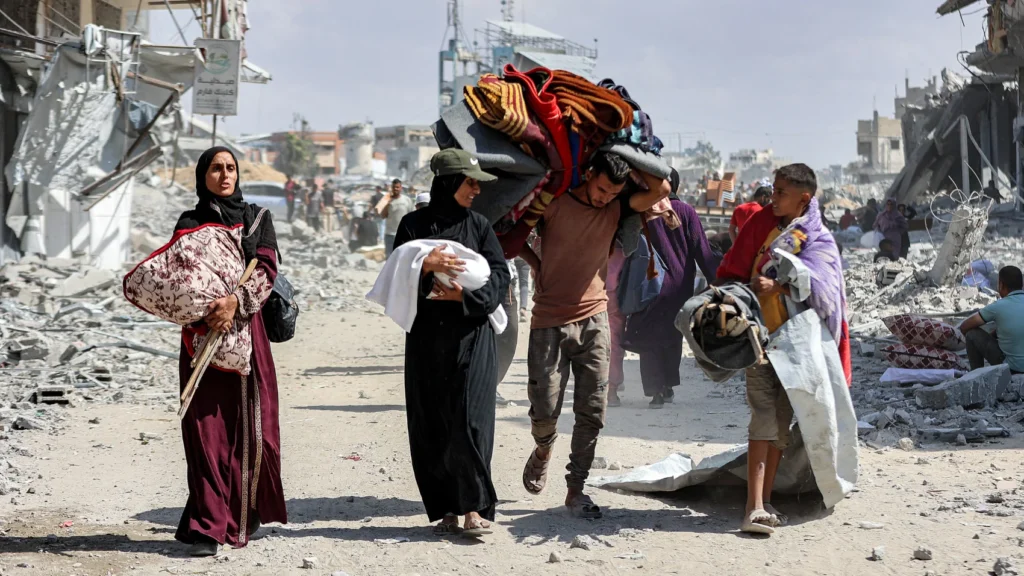
Gaza Herald — Khawla Bint Al-Azwar School in eastern Deir al-Balah was not the home of the Ghaliya family, but it was the last place they believed could protect their children. After their home in Beit Lahia, northern Gaza, was destroyed, the family left the area in May and headed south in search of shelter. A few weeks later, an artillery shell struck the room where the children were sleeping, killing three-year-old Saadi and injuring three of his siblings.
The family had not come to Deir al-Balah in search of a better life. It was looking for a place it believed would be less dangerous. The school, which housed dozens of displaced families, appeared to be an unavoidable option amid the destruction of homes and the shortage of places to seek refuge.
But shortly after midnight on Sunday, the assumption that had brought the family there collapsed.
Saadi’s father, Abdullah Ghaliya, said the sound of a heavy object striking the wall suddenly woke the family. Stones began flying, the room filled with dust, and the children’s screams rose through the building.
The father had undergone a medical procedure the day earlier as part of treatment for an injury sustained during the war in Beit Lahia, leaving him unable to move easily. From his bed, he saw a large artillery shell rolling inside the room before he began shouting for help from other displaced people in the school.
Several residents rushed to the room, but the shell had struck Saadi directly. The child was found covered in blood, while three of his siblings were injured. The family remained surrounded by dust, rubble, and fear, with another unexploded shell still inside the school.
According to eyewitness Nael al-Kilani, displaced residents hurried to remove the injured from the room, while fear continued to grip the school over the possibility that the shell could explode.
A School Without Protection
Saadi’s death exposes another dimension of displacement in Gaza, where schools and public buildings have become shelters for families who have lost their homes, but cannot necessarily provide the protection those families are seeking.
The families arriving at these locations often have no real alternatives. Some flee after their homes are destroyed. Others move from one place to another as bombardment expands. Many are eventually forced to remain in overcrowded buildings, even after those locations themselves come under threat.
Saadi’s father said the family believed that staying at the school would give them a chance to move if danger emerged, particularly because safe places for displacement had become so scarce. But the shell reached the room where the children were sleeping, killing one of them and injuring three others.
The danger was not entirely new to the school, according to al-Kilani, who said that shelling or threats had reached the area more than once. Yet the families remained because they had nowhere else to go.
The tragedy, therefore, does not end with the bombardment itself. It extends to the question facing displaced families afterward: Where can they go?
Displacement From One Danger to Another
The Ghaliya family had left Beit Lahia after their home was destroyed, hoping to find a place in Deir al-Balah where their children would be protected. But moving south did not end the danger. It brought them into another space of uncertainty and insecurity.
Abdullah said he is now even more afraid for his children, but he cannot return to northern Gaza. He also lacks the ability to move his belongings and prepare another place to live. There appears to be no safe location where the family can seek refuge.
The father’s injury has made the situation even more difficult. Unable to move easily and still requiring treatment and care, he was left to search for another shelter after losing his son and seeing three of his children wounded.
But leaving the school is not a simple decision for displaced families. Relocating requires transportation, an alternative place to stay, and the ability to carry belongings. It also requires some assurance that the new location will not be more dangerous than the one they are leaving.
Amid the destruction of residential neighborhoods, overcrowded shelters, and repeated attacks or threats against displacement sites, movement itself has become a burden that many families cannot afford.
A Child Who Was Waiting for a Bicycle
Saadi was one of the children who should have been able to sleep at the school away from the bombardment. That night, he ate dinner with his family, drank tea, and went to sleep in his usual place, unaware that it would be his last night.
Before his death, he had repeatedly asked his father for a small bicycle. Abdullah would answer him each time: “Of course. I’ll get you the bicycle.”
It was a simple promise between a father and his child. But after Saadi’s death, it became the last trace of an ordinary conversation between them.
The bicycle was more than a toy in his father’s memory. It represented the kind of life a three-year-old should have been able to live: asking for something small, waiting for it, and going to sleep believing his father would return to him the next morning.
But Saadi never woke up.
While his siblings were carried out of the room injured, his father was left facing a loss he could barely comprehend and a promise no child remained to await.
Nowhere Else to Go
After the bombardment, most of the families did not leave the school, despite the fear that had taken hold among the displaced. Their decision to stay was not evidence that the building was safe, but rather a reflection of the absence of alternatives.
Al-Kilani said families simply had nowhere else to go, noting that danger had reached the school before, but residents remained because they could not find another shelter.
Saadi’s story, therefore, does not end with the shell that killed him.
Behind the child who was waiting for a bicycle stands a family uprooted from its home in Beit Lahia, an injured father who cannot move easily, siblings carried out of the room wounded, and dozens of families who remained in the school despite their fear because leaving itself requires somewhere to go.
In Gaza, displacement does not necessarily mean reaching safety. It may mean moving from one known danger to another, without any guarantee that the next destination will be less cruel.
Inside Khawla Bint Al-Azwar School, a small room remains a witness to the night a family lost its child, while the question continues to confront displaced civilians: If home is no longer safe and school is no longer safe, where can they seek shelter?

