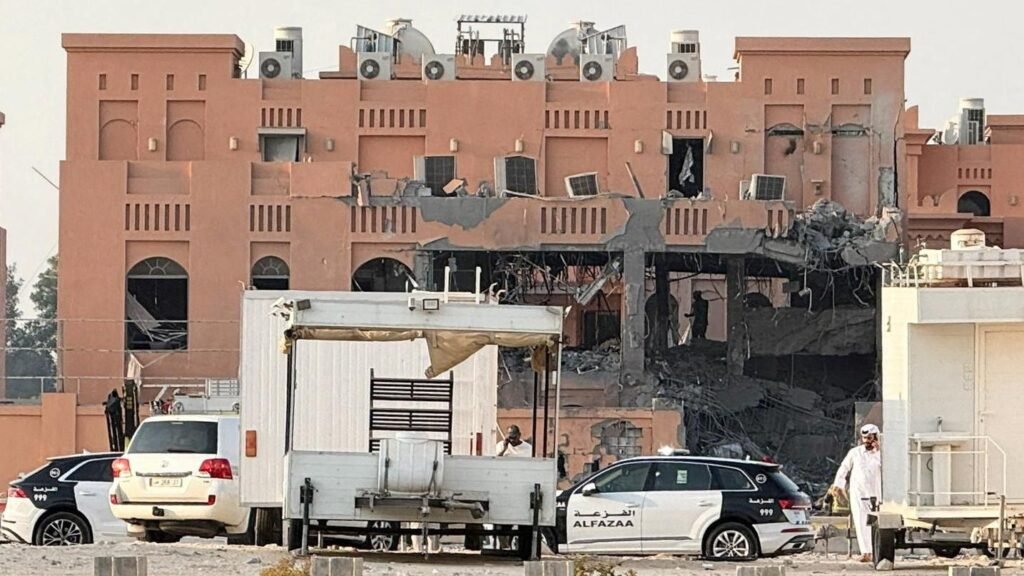
Gaza Herald- One year ago, on September 9, 2025, Israeli weapons struck Doha. The intended targets were Hamas leaders gathered in the capital of Qatar, a country serving as one of the principal mediators in negotiations to end the war in Gaza and secure the release of Israeli captives and Palestinian prisoners.
A year later, the importance of that attack extends far beyond whether Israel succeeded or failed in killing the men it targeted.
The deeper significance lies in what Israel chose to attack.
It attacked negotiators in the territory of a mediator while negotiations were underway.
That should have shattered one of the most persistent assumptions surrounding the Gaza war: that Israel’s government was fundamentally seeking a negotiated peace but simply lacked a willing Palestinian partner.
The Doha strike suggested something very different.
Israel was not merely attacking Hamas. It was attacking the architecture through which an agreement with Hamas could be reached.
That distinction matters.
Wars do not end because enemies suddenly trust one another. They end because channels exist through which enemies who may despise each other can communicate, negotiate, exchange prisoners, establish guarantees and eventually stop shooting.
Qatar was one of those channels.
Yet Israel launched a military strike inside the territory of the mediator while members of the opposing negotiating delegation were there.
The United Nations understood the significance immediately. Secretary-General António Guterres condemned the attack as a violation of Qatar’s sovereignty and said parties should be working toward a permanent ceasefire rather than destroying its prospects. UN High Commissioner for Human Rights Volker Türk subsequently called the strike an assault on regional peace and a blow against the integrity of mediation and negotiation itself.
That is the central lesson of September 9.
You cannot claim to pursue diplomacy while bombing the table around which diplomacy is supposed to take place.
Israel did not simply target people. It targeted the negotiating process.
Peace negotiations are not meetings between friends. They exist because people who are fighting one another need a mechanism to stop.
If participation in negotiations offers no protection from assassination at the very moment negotiations are underway, then what message is being sent to any adversary considering diplomacy?
The message is devastatingly simple: entering negotiations may simply make you easier to locate.
That is not merely a Palestinian problem. It threatens the basic logic of mediation everywhere.
Why would a mediator invite representatives of warring parties onto its territory if one party believes it retains the right to bomb the other delegation there? Why would political representatives leave secure locations to attend negotiations if doing so could expose them to assassination?
Once that principle becomes acceptable, diplomacy itself becomes dangerous.
And when diplomacy becomes dangerous, war becomes easier to continue.
Doha was not an isolated contradiction
The Doha attack becomes even more revealing when viewed alongside Israel’s broader policies toward the Palestinian question.
For decades, Israeli governments have told the world that peace requires negotiations.
At the same time, settlements have continued expanding across the occupied West Bank.
Palestinian territory has become increasingly fragmented. Settlement infrastructure has expanded. Palestinian communities have faced displacement. The territorial foundations on which a viable Palestinian state would have to be built have steadily eroded.
Israel therefore demands negotiations over a future Palestinian state while transforming the land on which that state would exist.
It speaks about peace while expanding settlements.
It speaks about a two-state solution while policies on the ground make territorial separation increasingly difficult.
It speaks about diplomacy while striking negotiators in the capital of a mediator.
These are not unrelated contradictions. Together they reveal a deeper political problem.
Israel appears increasingly willing to accept negotiations only when negotiations do not meaningfully constrain Israeli power.
That is not a peace process.
It is management of the conflict on Israeli terms.
If every Palestinian interlocutor is eliminated, who is supposed to negotiate?
There is another contradiction that Israel’s allies rarely confront seriously.
Israel has spent years weakening, delegitimizing, arresting, isolating or militarily targeting different centers of Palestinian political power.
“Israel has sought to isolate Hamas politically and exclude it from any future Palestinian political or negotiating framework.
The Palestinian Authority is treated as weak and unreliable.
Palestinian political institutions are marginalized.
International recognition of Palestinian statehood is opposed.
Diplomatic pressure is resisted.
And political leaders on the opposing side can become military targets.
Eventually an unavoidable question emerges: Who exactly does Israel expect to negotiate with?
A peace process requires an interlocutor.
One cannot systematically destroy the political space available to the other side and then complain that no credible partner for peace exists.
If every Palestinian actor powerful enough to negotiate is treated exclusively as a target, while every Palestinian institution weak enough not to threaten Israel is denied meaningful sovereignty, the result is not a failed peace process.
It is a political system structured to prevent one from emerging.
The attack on Qatar crossed another line
The Doha strike also expanded the problem beyond Palestine.
Qatar was not merely hosting Hamas officials. It was acting as a mediator alongside Egypt and the United States in negotiations intended to produce a ceasefire and hostage-release agreement.
Israel therefore attacked inside the territory of a state working with Washington to facilitate negotiations in which Israel itself was participating.
That was an extraordinary message to every mediator in the region.
It suggested that mediation does not necessarily protect the mediator’s territory, the negotiating process or the people invited to participate in it.
The international reaction reflected that danger.
The UN described the strike as a violation of Qatari sovereignty and a threat to the mechanisms used for diplomacy and conflict resolution. Arab and Islamic states similarly warned that attacking a principal mediator undermined efforts to end the war.
The issue was therefore never simply Qatar versus Israel.
The question was whether negotiation itself still had rules.
The world cannot demand negotiations while tolerating attacks on negotiation
Western governments frequently repeat the same formula: there must be diplomacy, there must be negotiations, the hostages must be released, Gaza needs a ceasefire and ultimately Israelis and Palestinians must return to a political process.
But those words become meaningless if governments impose no meaningful consequences when the infrastructure of diplomacy is attacked.
A mediator cannot be treated as useful when carrying Israeli messages to Hamas and expendable when Israel decides to strike Hamas officials on the mediator’s soil.
Negotiators cannot be expected to discuss ceasefire proposals while wondering whether the meeting itself has become a target.
And Palestinians cannot indefinitely be told that their future depends on negotiations while the physical territory over which they are supposed to negotiate continues shrinking.
Peace cannot survive as a slogan.
It requires rules.
It requires mediators whose sovereignty is respected.
It requires negotiating delegations that can actually attend negotiations.
It requires agreements that can be implemented.
And it requires a political horizon in which negotiations produce something other than another round of war.