
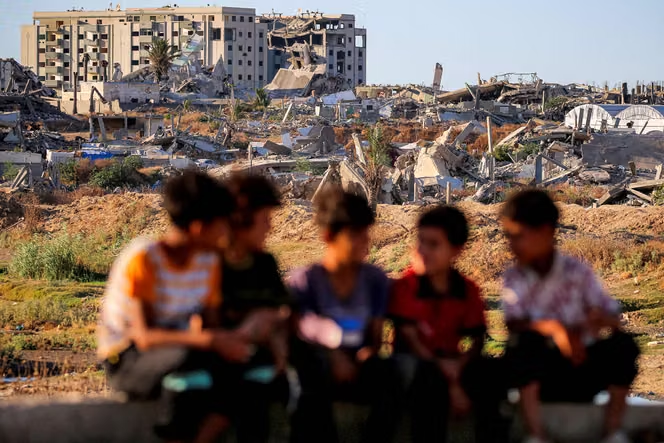
Gaza Herald _ More than three years of genocide have transformed schools, universities and kindergartens into symbols of a generation deprived of classrooms, teachers and a normal childhood.
On the International Day to Protect Education from Attack, September 9, Gaza’s education system enters another academic year under conditions that bear little resemblance to a conventional return to school.
Across the Gaza Strip, hundreds of thousands of children face another year in which classrooms have been replaced by tents, destroyed buildings, displacement sites and temporary learning spaces. The destruction has extended from kindergartens and primary schools to universities, while the killing and displacement of students and educators has inflicted losses that cannot be measured in buildings alone.
The crisis has left Gaza confronting a question that extends far beyond whether schools can reopen: what happens to a generation whose education, development and future have been repeatedly interrupted?
What the Data Shows
The scale of the educational collapse is reflected in figures compiled by Palestinian education authorities and humanitarian organizations.
According to figures provided by Gaza’s education sector, approximately 90 percent of schools have been damaged or destroyed, while around 80 percent have been rendered out of service. Approximately 55 percent of the remaining educational spaces are reportedly operating from tents.
The human toll is equally severe. More than 19,000 students have reportedly been killed and more than 28,000 injured. At least 801 members of educational personnel have also been killed, while more than 100,000 students face serious difficulties returning to classrooms.
The destruction has extended into higher education. Approximately 95 percent of higher-education institutions have sustained damage, while 195 university buildings have been rendered out of service. At least 1,375 university students and 246 members of university personnel have been killed.
These figures are consistent with the broader picture documented by international organizations. UNICEF reported in May 2026 that nearly 98 percent of school buildings in Gaza had been damaged, with more than 93 percent requiring major rehabilitation or complete reconstruction. It also estimated that around 700,000 children aged 4–17 had missed formal in-person schooling for almost three consecutive school years. (UNICEF)
The World Bank, United Nations and European Union’s 2026 Gaza Rapid Damage and Needs Assessment likewise identified education among the sectors hardest hit by the conflict, describing damage to nearly all schools. (UNSCO)
Human Toll and a Shrinking Student Population
The prolonged hostilities have fundamentally altered the demographic trajectory of Gaza’s school-age population.
Data from the Palestinian Ministry of Education and Higher Education’s May 2026 report, The Educational Status in Gaza (2023–2026): Statistical Reality, Diagnosis of Collapse, Field Response, records more than 20,051 school-age students killed.
The report also records the deaths of 769 ministry officials and staff members and 532 teachers across public, UNRWA and private school systems.
According to the Government Data Center, 19,886 students were forced to leave Gaza during the conflict.
Before the war, student enrollment had been increasing naturally, rising from 609,751 students in 2022–2023 to 627,617 in 2023–2024. Enrollment had been projected to reach 665,769 by 2026–2027.
Instead, after accounting for casualties, injuries, detentions and emigration, the revised projection for 2026–2027 stands at 625,832 students — a cumulative demographic loss of 39,937 students.
The implications reach beyond the classroom. Every child lost, displaced or forced out of the education system represents a disruption to Gaza’s future demographic and professional structure.
Schools Reduced to Ruins and Tents
Before the aggression, Gaza had 584 school facilities: 309 public schools, 182 UNRWA schools, 70 private schools and 23 special education schools.
The May 2026 Ministry report documents extensive destruction across every category.
Among public schools, 55 facilities were completely destroyed, 12 partially destroyed, eight severely damaged, 50 moderately damaged and 59 lightly damaged.
Private education suffered similar losses, with 30 facilities completely destroyed, 26 partially destroyed, 11 severely damaged, two moderately damaged and one lightly damaged.
Special education facilities were also heavily affected, with 11 completely destroyed, six partially destroyed, two severely damaged and four lightly damaged.
The destruction extends beyond classrooms. Forty-two of 46 administrative buildings were completely destroyed, while hundreds of thousands of desks and tables and thousands of blackboards, computers, printers, copiers, smart boards and other educational resources were lost.
As a result, the physical concept of a school has itself changed.
In some areas, tents and makeshift structures have replaced permanent buildings. Gaza Herald reported earlier this month that approximately 80 percent of schools were out of service and around 55 percent of remaining educational spaces consisted of tents or plastic sheeting. (Gaza Herald)
For children returning to education, this means that even where learning continues, it often does so without the basic physical environment that traditionally defines a school.
A Generation Outside the Classroom
The destruction of educational infrastructure brought formal schooling to a near standstill.
Approximately 609,751 students were deprived of formal schooling, including 295,106 public-school students, 293,703 UNRWA students and 20,942 students in private schools.
Some educational activity has since resumed through temporary learning spaces. OCHA reported in September 2026 that 22 Education Cluster partners were operating 359 temporary learning spaces across Gaza in preparation for the new academic year. (ochaopt.org)
But temporary learning cannot simply replace a functioning education system.
UNICEF reported that approximately 420,000 children still had no face-to-face learning at the time of its April 2026 assessment. It also identified shortages of learning materials, teachers and safe spaces as major barriers to restoring education. (UNICEF)
The disruption has also dramatically reduced the amount of instructional time available to children.
Annual school days fell from approximately 200 in 2022–2023 to only 60 in 2025–2026, while weekly classroom hours dropped from 30 to 12.
For children who have already spent years outside conventional classrooms, every additional interruption compounds the learning gap.
The Forgotten Beginning: Early Childhood
The educational crisis begins before primary school.
Gaza had 619 kindergartens before the war, serving approximately 65,969 young children. The destruction and disruption rendered the sector non-operational.
For young children, early education is not merely preparation for later schooling. It provides structured opportunities for language acquisition, social interaction, cognitive development and emotional development.
The loss of these spaces therefore creates consequences that may emerge years after the destruction itself.
Universities: Losing the Next Generation of Professionals
The collapse has not stopped at primary and secondary education.
Approximately 95 percent of Gaza’s higher-education institutions have reportedly been damaged. A total of 195 university buildings have been rendered out of service.
At least 1,375 university students have been killed, alongside 246 university personnel.
The destruction of universities carries a long-term consequence: Gaza is losing not only places where students study, but institutions responsible for producing teachers, doctors, engineers, researchers, lawyers and other professionals needed for reconstruction.
A society attempting to rebuild after massive destruction will require an educated workforce. Yet the institutions responsible for educating that workforce have themselves been devastated.
What Recovery Would Require
Rebuilding Gaza’s education system will require far more than reconstructing school walls.
It will require restoring classrooms and universities, replacing educational equipment, rebuilding administrative systems, supplying textbooks and learning materials, recruiting and supporting teachers, and creating safe transportation routes and learning environments.
It will also require addressing the consequences of prolonged educational interruption.
OCHA reported that education partners were supporting hundreds of thousands of children through temporary learning spaces during 2026, but persistent insecurity, limited safe spaces, funding shortages and the continued use of some school buildings as shelters remained major obstacles. (ochaopt.org)
The physical reconstruction challenge is enormous. But the human challenge may be even greater.
Children who have spent years witnessing displacement, death and destruction cannot simply be returned to classrooms and expected to resume their education as though nothing happened.
They need psychological support, accelerated learning programs and sustained educational continuity.
A Future at Risk
Gaza’s educational crisis is ultimately a crisis of the future.
The numbers tell the story: tens of thousands of students killed or injured; hundreds of educational workers killed; the overwhelming majority of schools damaged or destroyed; universities rendered unusable; kindergartens shut down; and hundreds of thousands of children deprived of ordinary classroom education.
Yet the consequences cannot be fully captured by statistics.
A destroyed classroom can be rebuilt. A university can eventually be reconstructed. Desks and computers can be replaced.
But years of childhood, lost learning and the deaths of students and teachers cannot be restored.
For Gaza’s children, the question is no longer simply when school will reopen.
It is whether the world will allow an entire generation to emerge from the ruins without the education it needs to rebuild what was destroyed.

