Gaza Herald – Gaza has finally begun burying some of its dead. But for families who waited years to recover their loved ones from beneath the rubble, burial cannot mean the end of the story.
As the remains of victims are brought to the surface and laid to rest, another question remains buried beneath the ruins: What happened to them, and who will be held accountable?
Gaza may have buried its victims, but it must not bury their right to justice.
For more than two years, the families of dozens of Palestinians in Gaza’s Zeitoun neighborhood have lived with painful uncertainty, knowing that their relatives were beneath the rubble but unable to reach them amid the continuing Israeli assault, destruction and blockade.
This week, that wait finally ended for more than 100 victims.
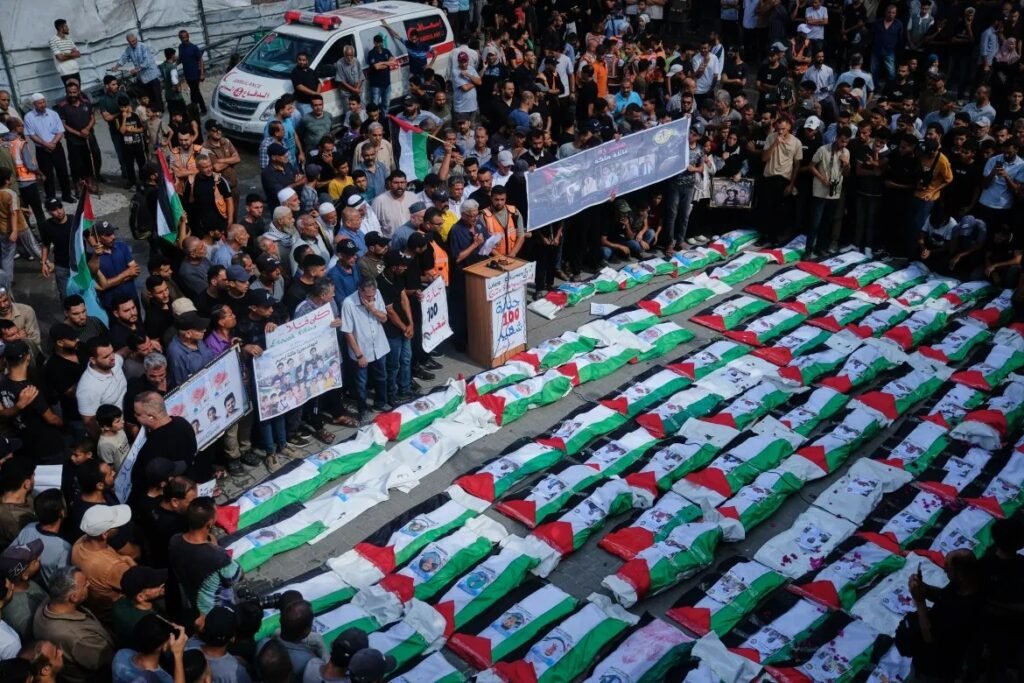
Near the Imam al-Shafi’i Mosque in southeastern Gaza City, rows of remains wrapped in Palestinian flags were laid before grieving relatives, bringing families face to face with loved ones whose bodies had remained trapped beneath concrete and twisted rebar since 2024.
The scenes marked the end of an agonizing wait for some families while exposing the scale of Gaza’s continuing recovery crisis, as Civil Defense crews struggle to reach thousands of people believed to remain beneath destroyed buildings.
For the families, recovering the remains means more than identifying the dead. It means finally being able to honor them, mourn them and, after years of forced waiting, give them a dignified burial.
Among those waiting was Maryam Hassan al-Balawi, who stood before the remains of her family alongside her daughter, Malak, the only survivor among her children.
For more than two years, Balawi returned repeatedly to the ruins of her home, unable to fulfill her late husband’s final wish that she bury him with her own hands.
Her long wait ended when civil defense crews finally reached the site.
In one of the deadliest attacks documented during the recovery operation, 32 members of the Rahim family were killed inside their home in a single Israeli strike on February 19, 2024. More than 15 were children and 10 were women. Only one young girl survived.
“These are not numbers. Look at their names—men, women, children, elderly people,” said Jadallah Rahim, a relative of the 32 victims recovered in Zeitoun.
His words capture what casualty figures cannot: Behind every recovered body is a Palestinian family that has spent months or years waiting for the chance to find, identify and bury a loved one.
A Recovery Operation Fighting Rubble and Blockade
The recovery effort has been severely hindered by the continuing blockade and restrictions on equipment entering Gaza.
Civil Defense teams are attempting to excavate destroyed buildings with worn-out equipment and only a fraction of the heavy machinery required to remove reinforced concrete and massive quantities of debris.
Restrictions on the entry of heavy excavators, specialized equipment and fuel continue to limit the ability of first responders to reach those buried beneath the ruins.
During the first phase of the recovery operation, launched in November 2025, teams cleared 54 structures and recovered 333 sets of remains, while 226 people remained trapped at the targeted sites.
The second phase, under way since July 2026, covers 147 targeted structures. Approximately 100 sets of remains have been recovered in Zeitoun alone, while more than 1,070 people are believed to remain beneath the rubble at the sites covered by the operation.
For Civil Defense crews, every recovery can mean clearing tons of collapsed concrete and twisted metal with extremely limited resources.
The shortage of specialized machinery determines not only how quickly bodies can be recovered, but how long families must continue waiting to learn the fate of their relatives.
The Dead Beneath the Rubble
Leaving thousands of bodies inaccessible beneath Gaza’s ruins also raises serious questions under international humanitarian law.
Rule 114 of customary international humanitarian law requires parties to a conflict to endeavor to facilitate the return of the remains of the deceased upon request and to return their personal effects. Other protections governing the dead require parties to take measures to search for, collect and respectfully handle the remains of those killed during armed conflict.
Restrictions that prevent recovery teams from obtaining equipment necessary to reach bodies can therefore have serious humanitarian and legal consequences.
Beyond delaying burial, the inability to recover remains can obstruct identification and the preservation of potential forensic evidence that may be relevant to future investigations into alleged violations of international law.
For families, the consequences are immediate.
Relatives are forced to return repeatedly to the ruins of destroyed homes knowing that parents, children, siblings or spouses may still lie beneath them. The inability to retrieve and bury the dead prolongs grief and denies families the dignity of laying their loved ones to rest.
A Funeral, but Not an Ending
Sunday’s mass funeral procession at Al-Ahli cemetery finally gave families in Zeitoun something they had been denied for years: the opportunity to bury their relatives with dignity.
But the crisis extends far beyond Zeitoun.
More than 10,000 Palestinians across the Gaza Strip are believed to remain missing beneath destroyed buildings and infrastructure. Civil Defense teams and human rights organizations continue to call for the immediate entry of heavy engineering machinery, forensic equipment and fuel so that recovery operations can continue.
For some families, years of waiting have finally ended with a grave bearing the name of someone they loved.
For thousands of others, there is still no grave.
Their relatives remain somewhere beneath Gaza’s ruins, while families wait for machinery capable of reaching them.
Recovering the dead is therefore not merely a humanitarian task. It is part of preserving evidence, establishing what happened, identifying victims and protecting the possibility of future accountability.
A burial can bring a family a measure of closure.
It cannot close the case.
Gaza may finally be burying some of those who remained beneath its ruins for years. But the recovery of their bodies must not become the burial of the evidence surrounding their deaths.
The dead have a right to dignity.
Their families have a right to answers.
And Gaza’s victims have a right to justice.