
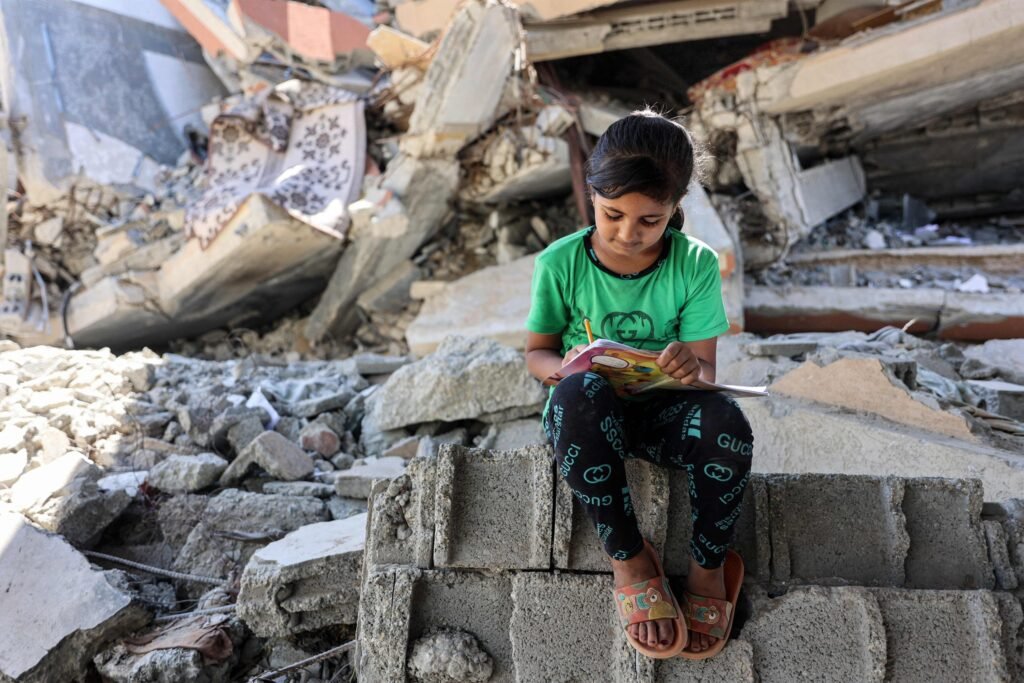
Gaza Herad — A new school year is approaching in Gaza, but for hundreds of thousands of children, there will be no familiar classroom to return to, no intact schoolyard and, in many cases, no school building at all. After nearly three years of disrupted education, Gaza is preparing to bring children back to learning through temporary education points, makeshift schools and virtual classrooms, an attempt to restore schooling while much of the system that once sustained it lies in ruins.
The scale of the challenge is staggering. About 700,000 children between the ages of 4 and 17 in Gaza have missed nearly three consecutive years of formal, in-person education, according to UNICEF. At the same time, approximately 98% of school buildings have been damaged, with more than 93% requiring major rehabilitation or complete reconstruction.
For Gaza’s children, the question is therefore no longer simply when school will reopen.
It is what a school year looks like when the schools themselves are gone.
A Return to Learning, But Not to Normal
Palestinian education authorities are preparing for students in Gaza to begin the 2026–27 academic year on September 19, following the return of administrative and educational staff on September 16.
The plan calls for approximately 700 in-person education points and 25 temporary schools across Gaza. Around 541,000 students are expected to be served, while virtual education will remain an option for children unable to reach in-person learning locations.
For thousands of students, education will therefore take place somewhere very different from the classrooms they once knew.
Around 70,000 children inside Gaza are expected to rely on virtual learning because they cannot access in-person education, while another approximately 20,000 Gaza students outside the Strip are expected to participate remotely.
The numbers reveal an education system attempting to function without the physical infrastructure on which it was built.
Nearly Three Years of Lost Classrooms
The disruption is not measured only in damaged buildings.
For an entire generation of children, years that should have been spent moving from one grade to the next have instead been marked by displacement, destruction and interrupted schooling.
UNICEF estimates that approximately 700,000 children have missed nearly three consecutive academic years of formal, in-person education. The loss creates a problem that cannot simply be solved by reopening a classroom: children must also confront the learning they missed.
That is why education authorities and humanitarian organizations have increasingly turned to accelerated-learning programs, designed to help children recover basic skills and address accumulated learning gaps.
One pilot program was operating in six schools in Gaza, focusing on fundamental Arabic and mathematics skills.
But recovering lost education is only one part of the challenge.
The Rubble Between Children and School
Even where temporary education spaces can be established, reaching them remains a challenge.
UNICEF estimates that approximately 60 million tons of rubble obstruct roads across Gaza, while the debris may also contain unexploded ordnance.
That means the destruction of a school does not end at its walls.
The roads leading to alternative learning spaces can also become barriers, particularly for children who have already spent years displaced from their homes and communities.
The physical environment surrounding education has itself become part of the crisis.
When a School Is More Than a Building
The destruction of Gaza’s schools has also removed spaces that served purposes beyond academic instruction.
Schools provided children with opportunities to interact with peers, receive psychosocial support and access a degree of stability in an environment otherwise marked by profound disruption.
Their loss therefore represents more than the loss of classrooms and desks.
It means the disappearance of spaces in which children could learn, socialize and experience something resembling an ordinary childhood.
And for children returning to education after years of interruption, rebuilding that sense of normalcy may be as difficult as rebuilding the buildings themselves.
Teaching With What Remains
Yet amid the destruction, efforts to restore education have continued.
During the first half of 2026, education partners provided structured learning to approximately 435,000 children, including about 9,300 children with disabilities, through 610 temporary learning spaces. Around 344,000 children also received learning materials.
The arrival of school supplies has itself become part of the recovery effort. UNICEF reported that School-in-a-Box kits began reaching Gaza in January 2026 after prolonged difficulties in bringing educational materials into the Strip. In June, an additional 3,784 educational kits entered Gaza, although significant gaps remained.
The effort demonstrates the difference between reopening education and rebuilding an education system.
A notebook can replace a missing notebook.
A temporary learning space can replace a classroom for a period.
But neither can immediately replace the school system that children have lost.
The Students Who Refused to Lose Their Future
Perhaps nowhere is this contradiction clearer than in Gaza’s high-school examinations.
Despite the collapse of much of the education infrastructure, approximately 37,000 students registered for the 2026 Tawjihi secondary-school examinations. About 31,000 participated on the first day, while later reporting indicated that approximately 98% of registered students ultimately managed to participate.
The examinations were conducted electronically, creating another obstacle for students living amid damaged infrastructure and unreliable access to electricity and internet services. Around 6,000 students initially faced difficulties involving devices, connectivity or the ability to charge them.
Still, they sat for their exams.
In a territory where classrooms have been destroyed, students were attempting to preserve the final stages of an education that war had repeatedly interrupted.
A School Year Begins With a Question
The coming academic year will therefore represent a significant test, not simply of whether children can return to learning, but of whether an education system operating through temporary spaces and remote instruction can begin repairing three years of disruption.
The immediate numbers are encouraging: hundreds of thousands of children are being targeted for education, hundreds of temporary learning spaces are operating, and new programs are attempting to address accumulated learning gaps.
But the physical reality remains stark.
Most school buildings are damaged. Hundreds of thousands of children have lost years of formal education. Millions of tons of rubble remain across Gaza. And thousands of students must study without the infrastructure generations before them took for granted.
Gaza is preparing to start another school year.
But its children are not returning to the schools they left behind.
They are returning to what remains of education, and trying to rebuild a future from there.

