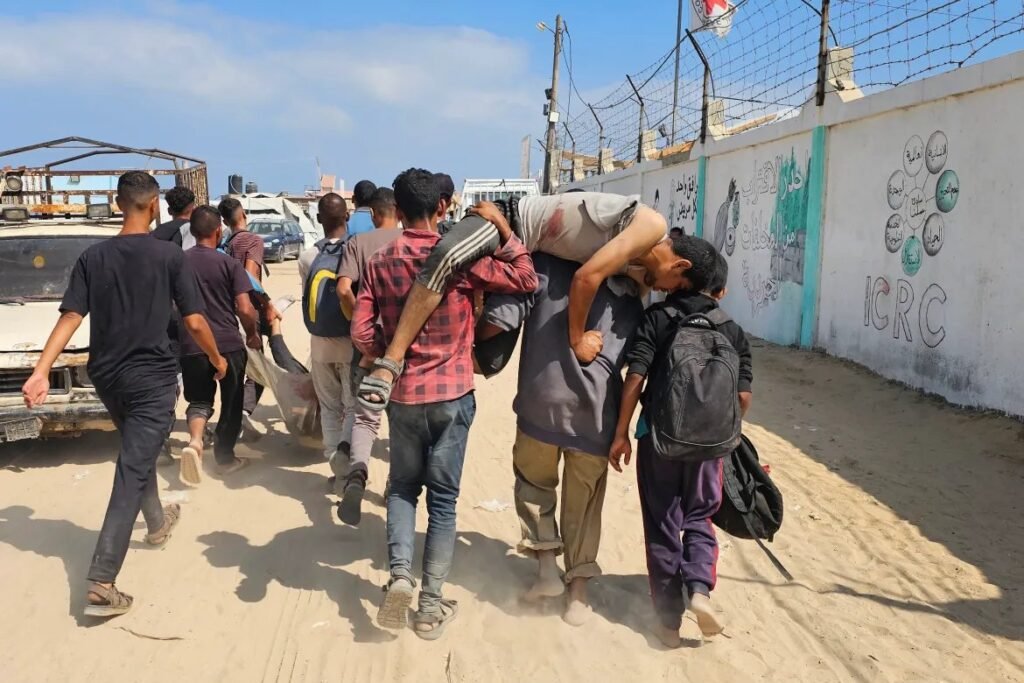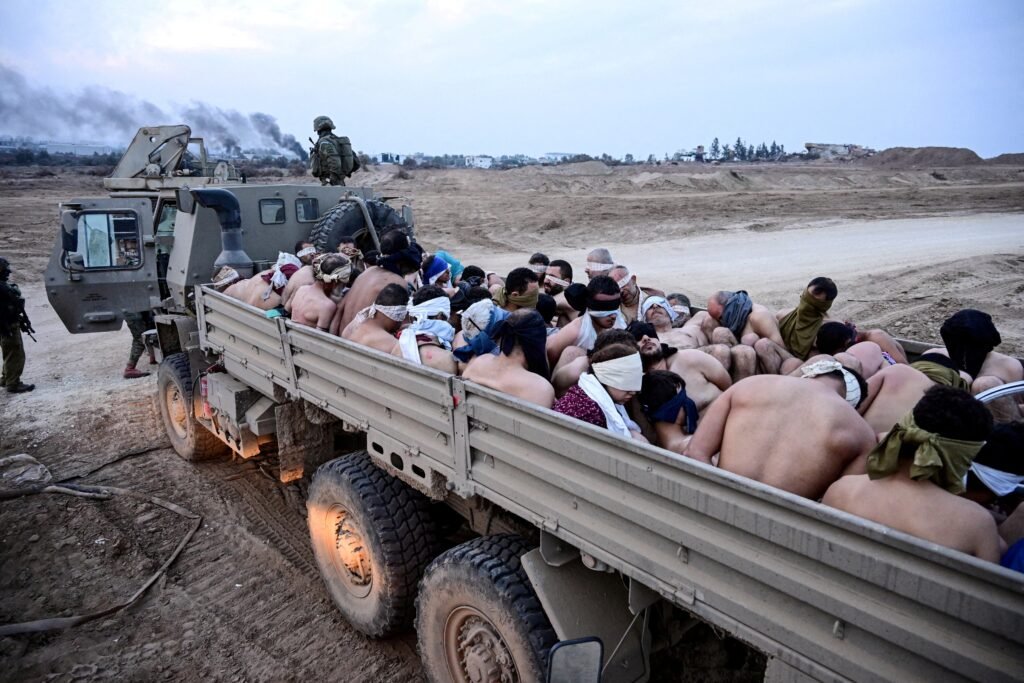
Gaza Herald- What unfolds across Palestine today is not a collection of isolated developments, but a single evolving structure of domination. Whether inside prisons or across the Gaza Strip, the logic is consistent: fragmentation, containment, and the gradual reshaping of Palestinian life under permanent coercion.
At its core, the detainee issue exposes the architecture of this system with brutal clarity.
Thousands of Palestinians are held in a detention regime that operates outside meaningful legal accountability, through administrative detention, secret evidence, mass kidnapping, and prolonged isolation. The scale alone signals that this is not a conventional “security policy,” but a method of collective control that reaches deep into society itself. Families are not only separated from their loved ones; they are absorbed into a prolonged state of suspension, where life is organized around waiting, uncertainty, and enforced absence.
Inside this system, prisons function less as correctional spaces and more as instruments of political engineering. The deprivation of medical care, restrictions on education, and the normalization of solitary confinement reflect a broader attempt to break continuity, of identity, of organization, and of collective resilience. Yet despite these conditions, prisoners have consistently transformed incarceration into a space of political endurance, maintaining forms of organization and resistance that defy the logic of isolation imposed upon them.
This is where the connection becomes undeniable. The same logic of fragmentation appears outside the prison walls, particularly in Gaza, where emerging political and security proposals point toward a deeper restructuring of the territory itself. The idea being circulated, whether framed as administrative reform, reconstruction management, or international oversight, centers on the creation of segmented zones, with varying degrees of access, control, and livability.
In practice, such models risk producing a divided geography: one part subjected to tightly controlled “recovery” under conditional security arrangements, and another left under sustained pressure, destruction, and deprivation. This is not reconstruction in any meaningful sense. It is the management of collapse, an attempt to reorganize a population under constraint rather than restore its sovereignty.
The danger of this approach lies not only in its physical consequences but in its political intent. Conditioning rebuilding on disarmament, or linking basic humanitarian recovery to security compliance, transforms essential human needs into instruments of leverage. It shifts the terrain from post-conflict recovery to ongoing structural coercion.
What emerges is a broader pattern: governance without sovereignty, order without freedom, and administration without representation. These are not neutral technocratic adjustments; they are political decisions that reshape who controls space, movement, and future possibility.
For Palestinians, whether in detention or under siege, the underlying reality is shared. It is a reality in which everyday life is continuously negotiated under imposed legal, military, and geographic boundaries.
Yet it is also a reality that has repeatedly failed to achieve its intended outcome. Despite decades of imprisonment policies and repeated cycles of destruction and reconstruction under constraint, Palestinian society has not been reduced to fragmentation. Instead, it has continuously reconstituted itself, socially, politically, and symbolically.
This resilience is precisely what such systems attempt to manage and ultimately contain. But containment is not resolution. And restructuring under coercion is not peace.
Any future framed around divided geography or conditional recovery will remain unstable as long as it avoids the fundamental question at the center of the conflict: the denial of Palestinian self-determination. Without addressing that, every administrative model, no matter how sophisticated, remains an extension of the same logic that produced the crisis in the first place.
The Palestinian experience, in prisons and in Gaza alike, continues to demonstrate a simple truth: control can be imposed on space, but not indefinitely on will.