
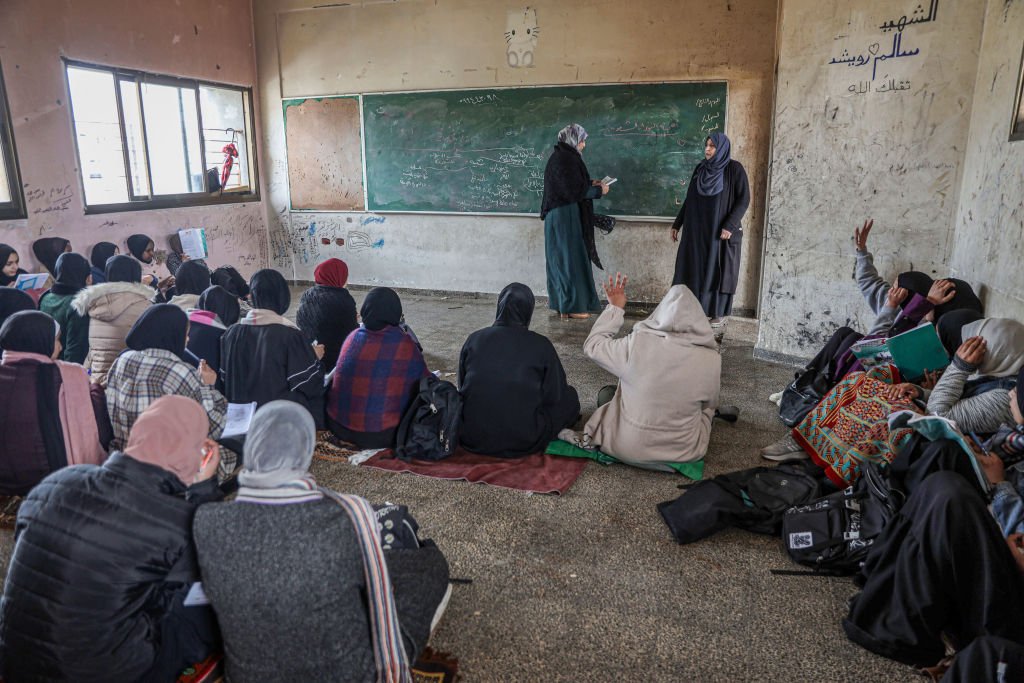
Gaza Herald – Across Gaza and the West Bank, nearly 1.53 million Palestinian students are facing an unprecedented educational crisis, as Israel’s genocidal war, poverty, and prolonged institutional disruption converge to undermine their right to learning.
Representing roughly a quarter of the Palestinian population, this generation now stands at the edge of a deepening educational collapse, with experts warning of long-term consequences that could reshape the social and economic future of Palestinian society.
In Gaza, the impact has been catastrophic. Since the outbreak of war in October 2023, formal education has come to a near-total halt. Hundreds of schools have been destroyed, while many of the remaining buildings have been converted into shelters for displaced families. As a result, around 700,000 students have been deprived of consistent access to education for more than two years. Attempts to revive learning through makeshift “education points” in tents offer only limited relief, typically a few hours of instruction per week, often without textbooks or structured curricula. For many children, especially those above primary levels, even these minimal opportunities remain out of reach.
The consequences are stark and deeply concerning. Children who were once high-performing students are now struggling with basic literacy and numeracy skills. Cases of functional illiteracy are rising, with some children unable to read, write, or perform simple arithmetic despite being formally promoted to higher grades. This “automatic promotion” policy, while administratively necessary, has exacerbated the learning gap, leaving students academically unprepared and psychologically disengaged. Educators also report increased behavioral challenges, including withdrawal, anxiety, and resistance to learning, reflecting the broader trauma of war.
In the West Bank, although the context differs, the outcome is similarly troubling. Ongoing financial crises within the Palestinian Authority have led to irregular school operations for nearly two years. Teacher strikes, reduced school days, and a shift to remote learning have significantly disrupted the academic calendar.
In some cases, students have received less than one-third of the standard instructional time, contributing to a substantial “learning loss” that continues to accumulate without a clear recovery plan.
Families are increasingly forced to compensate for systemic shortcomings. Parents attempt to supervise remote learning or seek private tutoring when financially possible, further widening inequality between those who can afford supplementary education and those who cannot. Meanwhile, many children, particularly in Gaza, are pushed into survival roles, helping secure food and water for their families instead of attending school.
Despite efforts by educational authorities and international organizations to mitigate the damage, current interventions fall far short of addressing the scale of the crisis. Without sustained and coordinated action, there is a growing risk of producing a “lost generation,” one deprived not only of education but of the foundational skills necessary for future stability, employment, and civic participation.

