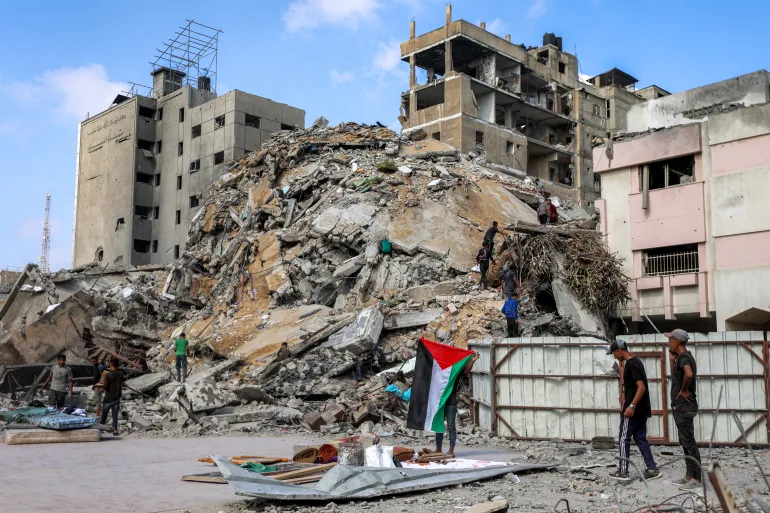
Gaza Herald_ A new academic study has revealed the massive and largely ignored environmental damage caused by Israel’s genocidal war on Gaza, estimating that the conflict has generated roughly 33 million metric tons of carbon dioxide equivalent (CO₂e). The findings draw attention to the climate consequences of modern warfare, an impact that is rarely acknowledged alongside the immense human devastation inflicted on Palestinians.
To better understand the scale of these emissions, researchers note that 33 million tons of carbon dioxide is roughly comparable to:
• the total national emissions of Jordan in 2024
• the annual emissions produced by about 7.6 million gasoline-powered cars
• the amount of carbon absorbed by more than 33 million acres of forest in a single year
The study was published in the scientific journal One Earth and was carried out by a team of researchers from several institutions, including Lancaster University and Queen Mary University of London, which led the research. The analysis offers one of the most detailed examinations to date of the environmental footprint of the war, examining emissions generated by military activity, the destruction of infrastructure, and the substantial carbon costs associated with rebuilding Gaza after the devastation.
The research expands on earlier studies that examined emissions during the initial months of the conflict. According to the findings, active military operations alone produced more than 1.3 million tons of CO₂e, with emissions stemming from heavy artillery, rockets, aerial bombardment, and other military equipment used during Israel’s assault on the Gaza Strip.
Beyond the immediate emissions from warfare, the study also considers the environmental impact of constructing military and defensive infrastructure during the conflict. At the same time, the researchers point to the enormous carbon footprint that will result from rebuilding Gaza’s shattered roads, homes, hospitals, and essential services after widespread destruction.
Dr. Benjamin Neimark of Queen Mary University of London, the lead author of the study, emphasized that wars bring far more than humanitarian suffering and economic damage.
“Armed conflicts cause immense humanitarian and economic harm, but their environmental consequences are rarely measured,” he explained. “Our research demonstrates that wars generate significant greenhouse gas emissions, not only through military operations but also through the reconstruction that follows.”
Dr. Frederick Otu-Larbi, a co-author from Lancaster University and the University of Energy and Natural Resources in Ghana, stressed that understanding the environmental cost of war is essential to grasp the drivers of climate change fully.
“Recognizing the environmental impact of conflict is crucial if we want an accurate picture of global emissions,” he said. “Greater transparency around military emissions would help ensure that these impacts are no longer ignored.”
Another co-author, Dr. Reuben Larbi of Lancaster University, described the environmental damage caused by war as both massive and largely invisible.
“The environmental cost of armed conflict is enormous but often overlooked,” he noted. “By measuring the carbon emissions associated with war, we make this hidden impact visible and underscore the urgent need for comprehensive efforts to reduce emissions across all sectors.”
The researchers highlight a critical gap in global climate governance: military emissions are largely excluded from international climate reporting systems. As a result, the environmental damage caused by wars is often absent from official global climate accounting.
Because of this lack of transparency, the study calls for stronger international mechanisms to ensure military emissions are properly reported and tracked. The researchers specifically urge greater transparency under frameworks such as the United Nations Framework Convention on Climate Change (UNFCCC).
The research was led by Queen Mary University of London and conducted in collaboration with scholars from Lancaster University, the University of Energy and Natural Resources in Ghana, the Climate and Community Project, the Conflict and Environment Observatory, and the Initiative on Greenhouse Gas Accounting of War.
Together, the findings shed light on a rarely discussed dimension of Israel’s war on Gaza: beyond the human catastrophe, the conflict is also leaving behind a massive environmental and climate footprint whose consequences will be felt long after the bombs fall silent.