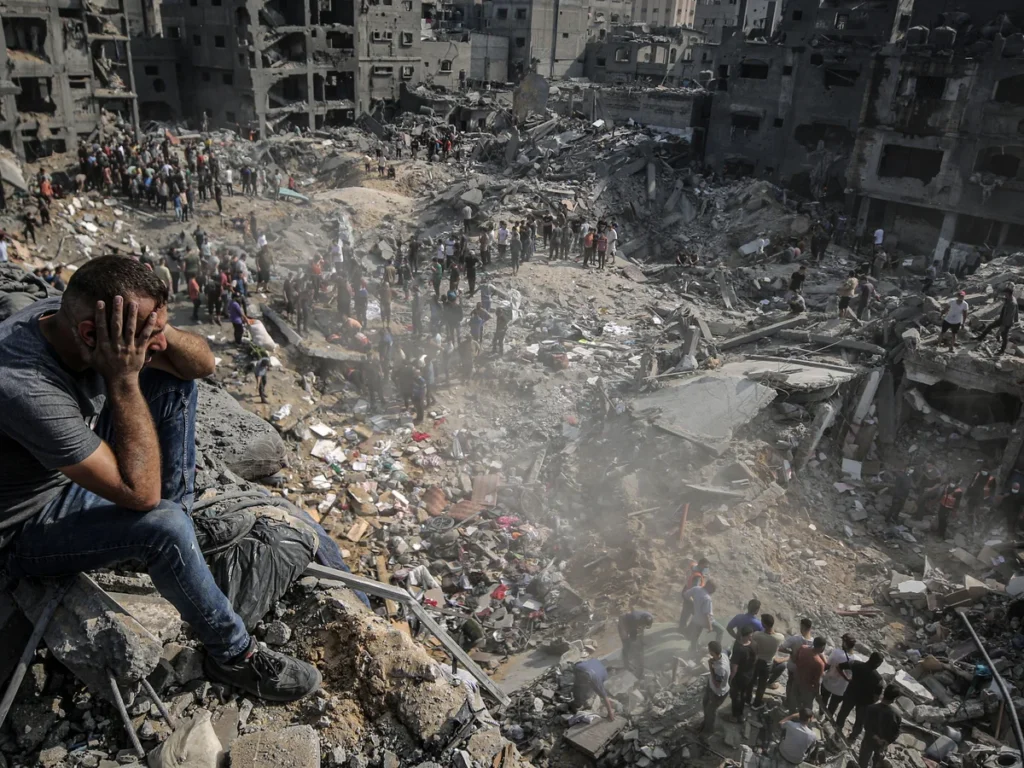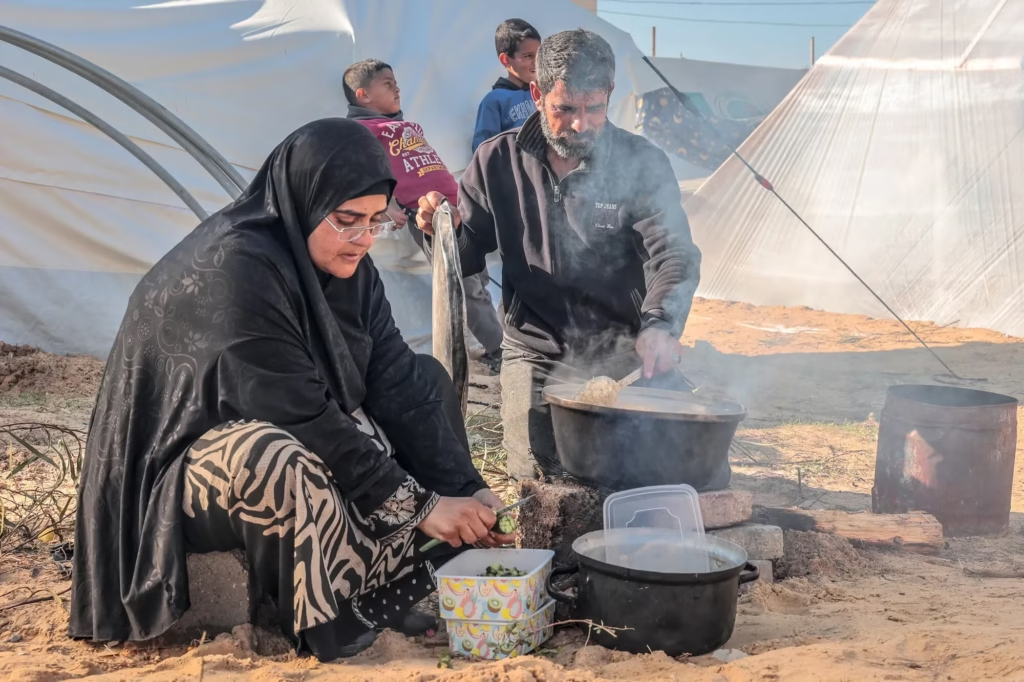
Gaza Herald_Food prices across the Gaza Strip are rapidly climbing once again as border closures and regional tensions intensify shortages in a territory already devastated by Israel’s war and dependent on fragile humanitarian and commercial supply routes.
In recent days, residents have rushed to local markets to purchase whatever food they can still afford, fearing that essential goods may soon disappear altogether. Traders and shoppers alike say prices have spiked dramatically within a short period, while several staple products have either become scarce or vanished entirely from store shelves.
Reporting from Gaza City, journalists described how the latest regional escalation involving the United States, Israel, and Iran is already being felt most immediately and painfully for Palestinians: shrinking supplies and restricted access at Gaza’s crossings.
In many markets, families are scrambling to secure basic groceries before stocks run out. The fear among residents is that what remains available today may not be there tomorrow.
Gaza’s economy and food supply remain almost entirely dependent on crossings with Israel and Egypt. Nearly all food, fuel, medicine, and other basic goods enter the besieged enclave by truck. Whenever those crossings close or operate under tight restrictions, the consequences quickly ripple across markets, hospitals, and water systems.
Israel shut Gaza’s border crossings on February 28, coinciding with Israeli and American strikes against Iran. The closure halted humanitarian aid deliveries and blocked the movement of patients needing urgent medical evacuation.
Although Israeli authorities later reopened the Karem Abu Salem crossing, known in Israel as Kerem Shalom, for what they described as the “gradual entry” of humanitarian aid, access has remained severely limited. Meanwhile, the Rafah crossing with Egypt continues to stay closed, leaving humanitarian organizations warning that current aid levels fall far short of Gaza’s needs.
According to Hanan Balkhy, the World Health Organization’s regional director for the Eastern Mediterranean, only about 200 aid trucks are currently entering Gaza each day, far below the roughly 600 trucks required daily to sustain the territory’s population. She also noted that around 18,000 patients, including wounded children and people suffering from chronic illnesses, remain trapped in Gaza while waiting for medical evacuation.
Staple Foods Disappear as Prices Skyrocket
On the ground, the impact of the tightening blockade is immediately visible in Gaza’s markets.
The price of fresh vegetables has soared dramatically. Tomatoes that sold for roughly $1.50 per kilogram just weeks ago now cost nearly $4, while cucumbers and potatoes have also seen steep price increases. For many families already impoverished by months of war, these prices place basic fresh food far beyond their reach.
Residents say they are increasingly unable to afford fruits and vegetables, as inflation driven by the regional war and border restrictions pushes essential goods out of reach.
Traders and market vendors describe a consistent pattern across Gaza City: fewer trucks entering the territory, goods selling out quickly, and prices rising across nearly all food categories.
In some areas, essential products such as cooking oil, flour, and canned foods have already disappeared from store shelves.
The United Nations humanitarian coordination office, OCHA, warned earlier this month that the closure of crossings amid the regional escalation has already triggered widespread price increases for both food and non-food items across Gaza. According to the agency, the limited number of aid trucks currently entering the enclave is insufficient to restock markets, causing many products to sell out within days.
The latest shortages mark a troubling reversal from a brief period of improvement only weeks earlier. In February, the World Food Programme reported that food availability had slightly improved and prices had begun to stabilize during the ceasefire period.
However, the agency now says that renewed border restrictions have once again pushed food prices sharply upward. Even after limited crossings reopened, the cost of basic food items remains extremely high.
Humanitarian System Under Increasing Strain
The consequences extend far beyond food markets. Aid organizations warn that the ongoing restrictions are placing enormous pressure on Gaza’s entire humanitarian system.
According to OCHA, limited fuel supplies are now being rationed across the territory. As a result, humanitarian groups have been forced to suspend some waste collection services that rely on vehicles and reduce water production in several areas.
Hospitals and primary healthcare centers have also activated emergency contingency measures in response to the worsening shortages.
Despite a brief improvement late last year, Gaza’s broader food security situation remains extremely fragile. The Integrated Food Security Phase Classification (IPC), the global system used by the United Nations to monitor hunger crises, reported in December that Gaza was no longer experiencing famine conditions after aid deliveries increased during the ceasefire.
However, experts warned at the time that any renewed conflict or disruption of aid could quickly reverse those fragile gains.
The World Food Programme has now issued similar warnings, stating that Gaza’s limited progress could collapse if humanitarian access is not sustained. While the reopening of Karem Abu Salem may provide some relief, the agency cautioned that without reliable humanitarian corridors, it may soon be forced to reduce food rations for large numbers of people.
With access still severely restricted, families across Gaza are once again facing deep uncertainty about whether the most necessities, food, water, and medicine, will remain available in the days ahead.