
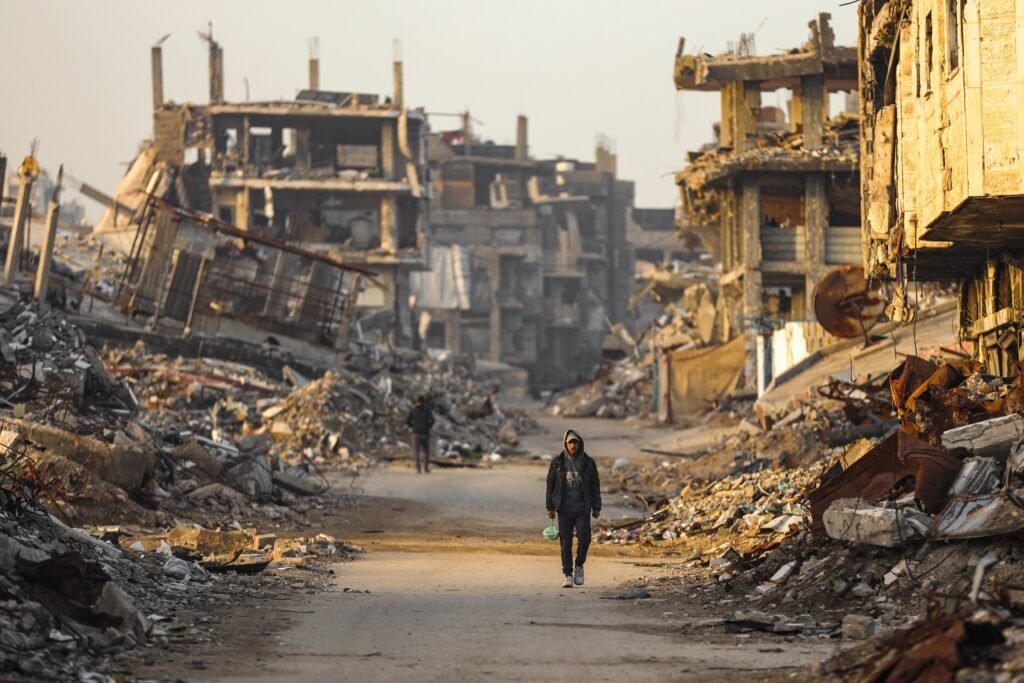
Gaza Herald _Israel’s ongoing war in Gaza has devastated not only homes and infrastructure but also the economic aspirations of an entire generation. Across the besieged enclave, thousands of young people and small business owners who once built their lives around steady work and modest projects now face a starkly different reality. Jobs have disappeared, businesses have collapsed, and financial independence has been replaced by uncertainty, fear, and long hours spent waiting in humanitarian aid lines for food, water, or basic supplies.
A Generation Trapped Between Unemployment and Survival
For many young Palestinians, daily life has become a relentless struggle to endure.
Moataz Fayad, 29, says he wakes up every morning unsure how he will make it through the day. Finding work that matches his education and experience has become nearly impossible, especially after Israel’s bombardment destroyed much of Gaza’s educational and cultural infrastructure and halted training programs that once offered professional development.
“At first I couldn’t believe how quickly everything collapsed,” Fayad explains. Before the war, he supervised training programs at an educational institution and led a relatively stable life, supported by a regular income and a structured work routine. That stability allowed him to plan for the future and provide for his family.
Today, that life has vanished. Fayad now survives through occasional humanitarian aid and short-term work opportunities that pay barely enough to cover daily necessities. “Every day has become a fight to survive,” he says.
His routine reflects the broader reality faced by thousands of Gaza’s unemployed youth. Each morning, he searches for temporary work or stands in long aid lines hoping to obtain small quantities of food or supplies. Whatever he manages to bring home must be carefully rationed to last another day.
Depending on aid has taken a heavy emotional toll. Fayad says the experience of relying on charity intensifies the feelings of powerlessness and frustration many Palestinians have endured since the war began.
He often thinks about the life he once had, his job, his ambitions, and the small dreams he postponed because he believed the future was secure. Now, he says, even basic stability feels out of reach.
“Sometimes I feel overwhelmed thinking about the future,” he admits. “Living day to day without certainty, depending on aid and fearing what tomorrow may bring, creates a psychological struggle that can be as exhausting as the economic hardship itself.”
Small Businesses Wiped Out by War
The destruction has also erased countless small businesses that once formed the backbone of Gaza’s local economy.
Ghadir Al-Kharoubi, 43, previously ran a daycare center in Gaza City’s Shujaiya neighborhood. Years of dedication and investment went into building a safe and supportive environment for children, but the war destroyed both her project and her home.
“Everything I worked for disappeared in an instant,” she says.
Now she spends her days searching for a place to reopen the daycare, but the widespread destruction of buildings and soaring rental prices have made that dream nearly impossible.
“I walk around looking for any affordable space,” she explains. “Sometimes I divide what little savings I have left just to cover basic household needs.”
By evening, she returns home exhausted and discouraged. The project that once brought joy to children and security to her family has become a distant hope.
Rajab Abu Zeid, 32, faces a similar fate. He stands today in front of the remains of the building where his electronics and mobile accessories shop once operated before Israeli bombardment reduced it to rubble.
“At first, the shock of losing everything was overwhelming,” he recalls. Years of effort spent building his small business and earning customers’ trust disappeared overnight.
Now he spends his days searching for temporary jobs or buying small quantities of goods from other traders to resell for modest profits. The closure of crossings and the inability to import products have made it nearly impossible to rebuild his former business.
“All I can do now is wait and hope tomorrow brings some kind of opportunity,” he says.
An Economy Forced Into Collapse
Economic experts say Gaza’s current reality represents a form of “forced reverse development.” Israel’s war has destroyed productive assets and key infrastructure across the territory, pushing the economy beyond stagnation into structural collapse.
Without reconstruction efforts or investment mechanisms, the situation has worsened. Inflation, the breakdown of the financial system, and declining purchasing power have transformed Gaza into an aid-dependent economy that relies almost entirely on external assistance.
Analysts warn that if this vacuum continues, Gaza risks long-term economic dependency and the near impossibility of restoring employment or sustainable growth.
Rebuilding Gaza’s Economic Foundations
Dr. Samir Abu Modallala, an economist at Al-Azhar University in Gaza, says economic recovery is no longer a distant goal but an urgent humanitarian necessity.
Gaza’s economy had already been weakened by years of blockade since 2007, and the current war has compounded those challenges dramatically. According to Abu Modallala, recovery requires a comprehensive approach that addresses the structural roots of economic collapse rather than temporary fixes.
He stresses that rebuilding essential infrastructure, such as electricity networks, water systems, sanitation, roads, and healthcare facilities, must be the priority. Without reliable services, productive economic activity cannot resume.
Reconstruction itself could also help stimulate economic recovery by creating jobs in construction and related industries while providing housing for thousands of displaced families.
Supporting small and medium-sized enterprises will also be crucial. These businesses represent the core of Gaza’s local economy and can provide faster income opportunities for struggling families. However, assistance should include more than financial support; it must also involve business incubators, tax incentives, credit guarantees, and access to external markets through digital platforms.
Addressing the territory’s severe unemployment crisis, particularly among young people and recent graduates, will require job programs tied to reconstruction projects, expanded vocational training, and the development of digital sectors capable of operating beyond Gaza’s physical restrictions.
Abu Modallala also highlights the importance of rebuilding Gaza’s healthcare and education systems. Restoring hospitals and medical centers is essential for community stability, while repairing schools and universities is a long-term investment in human capital.
Ultimately, he argues, Gaza’s economic recovery cannot be measured solely in financial figures or construction projects. It must be understood as a broader political and humanitarian process that combines rebuilding infrastructure with restoring dignity, opportunity, and hope.
Without a clear strategy, transparent funding, and a stable political environment, reconstruction efforts may remain stalled, leaving Gaza’s economy trapped under blockade and locked in a cycle of hardship with little prospect for real recovery.

