
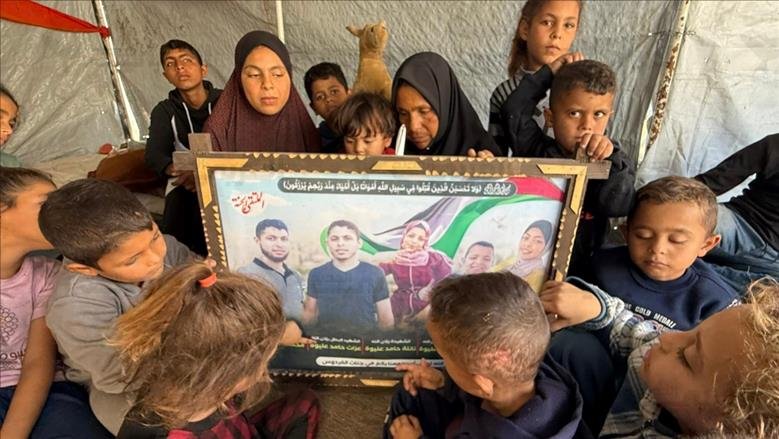
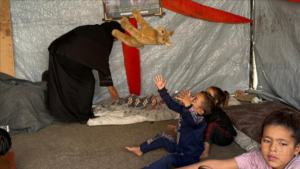
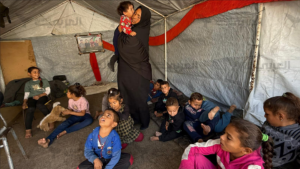
Gaza Herald_ In a torn tent on the shores of Gaza, steam rises from a small pot of boiling water placed over a fragile flame. Around it sit dozens of children with tired faces and empty stomachs, waiting for a meal that may not come. At the center of this heartbreaking scene stands Reda Aliwa, a grandmother in her sixties, displaced from the Shujaiya neighborhood of Gaza City after Israeli bombardment destroyed her home. Today, she carries an unimaginable burden: caring for 36 grandchildren who were orphaned when Israel’s war killed their parents.
Neighbors call her Umm Mohammed, a name that now reflects both deep loss and extraordinary responsibility. Within just days last September, she lost five of her children, killed in separate attacks that tore her family apart. Others survived but with severe injuries. The result was a devastating legacy: dozens of children were suddenly left without the protection of their parents.
The oldest grandchild is seventeen. The youngest is only a few months old. Each of her children left behind large families—ten children from one son, five from another, and many more from her daughters. Today, every one of them depends entirely on their grandmother for survival.
Hunger, Grief, and a Grandmother’s Desperate Strength
 Life inside the tent is a daily struggle for food, dignity, and hope. Umm Mohammed’s husband is elderly and seriously ill with heart disease and spinal problems, leaving him unable to work or help provide for the family. That responsibility has fallen entirely on her shoulders.
Every morning, she walks through the streets searching for charity kitchens or food distributions, hoping to bring back anything for the children. Often she returns with little or nothing. Some days, the children survive on nothing more than a piece of dry bread.
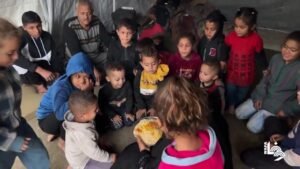
When she has no food at all, she resorts to a painful trick to comfort them. She fills a metal pot with water, places it on the fire, and pretends to cook a meal while sitting nearby with a spoon. The children watch and wait, believing dinner is on its way.
“I keep the pot boiling for hours,” she says, “until I’m sure the children have fallen asleep.”
Once the tent is quiet, she extinguishes the fire and removes the empty pot. The next morning, when the children ask about the food, she tells them it spoiled while they slept.
“At that moment,” she says softly, “I wish the earth would open and swallow me because I can’t feed them. But God does not forget the orphan.”
The hardest questions come from the children themselves. Every day they ask about their mothers and fathers.
“What can I tell them?” she says. “Even now, I still imagine my children will come back to visit me. I cannot accept that they are gone forever, leaving behind children who still don’t understand what death means.”
Gaza’s Growing Orphan Crisis
 Umm Mohammed’s story reflects a much wider tragedy unfolding across Gaza. According to Palestinian statistics, the Israeli assault has created one of the largest orphan crises in modern history.
More than 39,000 children in Gaza have lost one or both parents since the war began. Among them, nearly 17,000 children have lost both parents, leaving them completely alone.
At the same time, the war has taken a devastating toll on children themselves. Nearly 18,000 Palestinian children have been killed, including hundreds of infants. Many others have died in displacement tents from cold, hunger, and malnutrition.
Humanitarian reports warn that almost the entire population of Gaza, around 1.95 million people, faces severe food insecurity. Tens of thousands of young children are expected to suffer acute malnutrition, with the most severe cases threatening their lives.
 Officials say the total number of orphaned children in Gaza may now reach 57,000, many of whom lost entire families in the bombardment. Aid groups warn that Gaza urgently needs orphan care centers and sustained support for the families struggling to protect these children.
For Umm Mohammed, however, these numbers are not statistics; they are the faces of the children crowded inside her fragile tent by the sea. Every day, she fights to keep them fed, safe, and comforted in a world that has taken almost everything from them.
Yet even amid unimaginable loss, she continues to endure, carrying the weight of an entire family and holding on to the fragile hope that the children left behind by war will one day know a life beyond hunger and grief.

