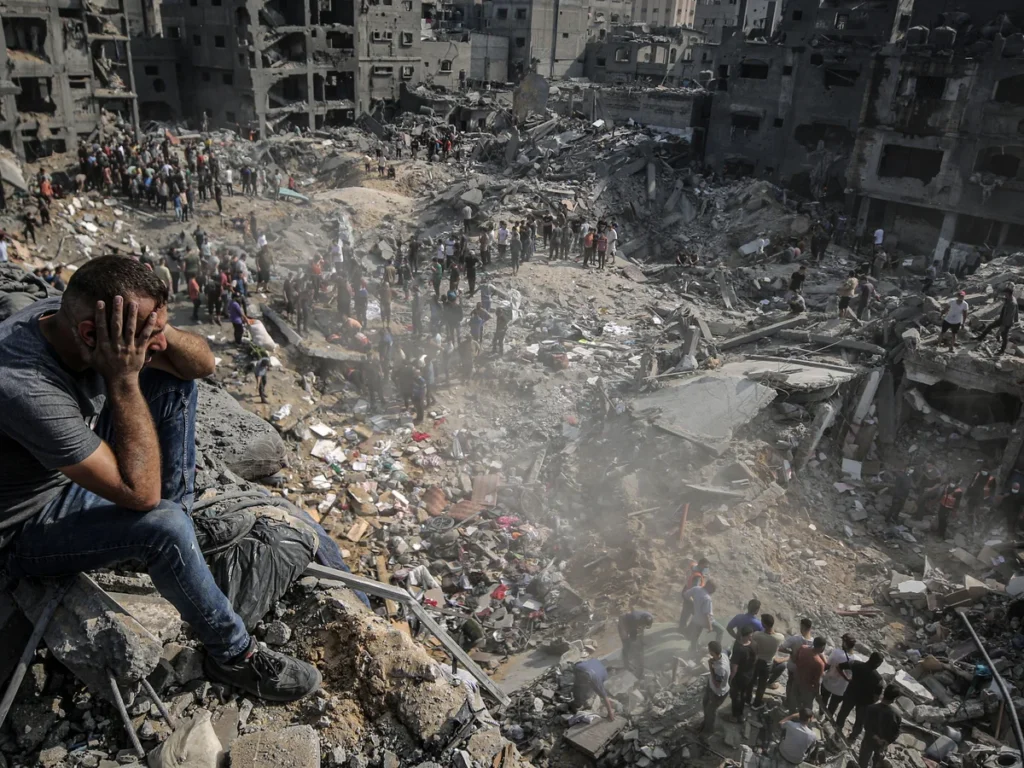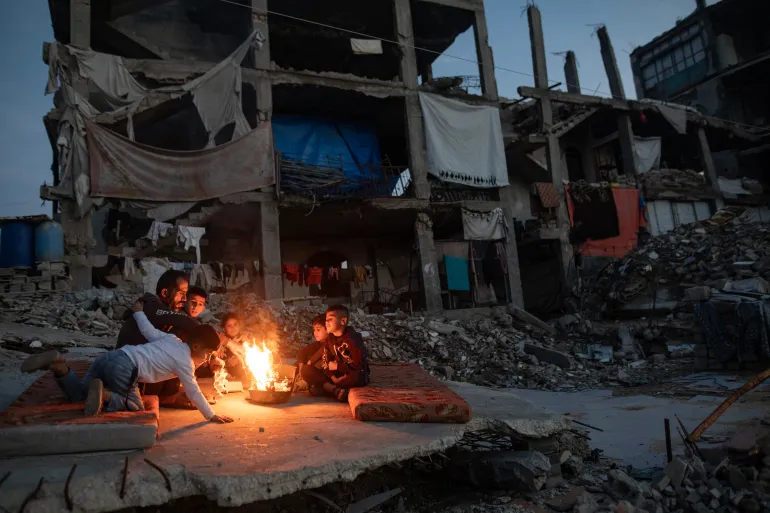
Gaza Herald- Government employees in Gaza are entering Ramadan under some of the harshest conditions in their history, facing deep financial hardship, irregular salaries, and mounting economic pressure after years of blockade and devastating war.
This group, which has formed the backbone of Gaza’s ministries, hospitals, police forces, and essential public services, has continued working despite direct threats, infrastructure destruction, and the loss of colleagues and family members. Yet today, many who once belonged to the middle class have been pushed into poverty, struggling daily to secure food and basic necessities.
Falling Below the Poverty Line
Hafez Abu Rweida, 44, an administrative employee at Gaza’s Ministry of Health, said he never left his workplace throughout months of war, despite the direct risks and targeting of the healthcare system.
“We worked under exceptional conditions, severe shortages of resources, doubled workloads, and irregular salaries. Sometimes we didn’t know when or how much we would be paid, but we never abandoned our duties,” he said.
He explained that the crisis extends beyond the workplace into every aspect of daily life.
“The soaring prices caused by war and blockade have made providing basic needs for our families a daily challenge. Bread, oil, milk, and even essential items for children have become unaffordable.”
As Ramadan approaches, he says priorities have shifted drastically.
“We no longer think about Ramadan traditions or celebrations. Our only concern is securing a modest meal to satisfy our children’s hunger. Employees who were once considered middle class are now fighting simply to remain above the poverty line.”
Ramadan Under Hardship and Humiliation
Amal Abu Toha, another government employee, says this will be the third consecutive Ramadan marked by deprivation and uncertainty.
Her salary, paid roughly every fifty days, lasts only a few days.
“For the third year in a row, Ramadan arrives with hardship, hunger, and humiliation. We haven’t bought lanterns, sweets, or anything for our children. We depend entirely on community kitchens that distribute food to displaced families.”
She noted that Gaza’s government employees, numbering around 45,000, have faced years of salary reductions due to the ongoing blockade, leaving thousands of families unable to meet even their most basic needs.
“Everything has become a luxury. Every meal is a struggle for survival.”
Economic Collapse and Salary Crisis
Economist Ahmed Abu Qamar described Gaza’s salary crisis as unprecedented, especially as Ramadan approaches.
He explained that Gaza faces a severe economic paradox: incomes are sharply declining while prices continue to rise due to widespread destruction of productive sectors.
Government employees now receive partial payments—roughly 1,000 shekels ($270) at irregular intervals—far below the estimated 3,000 shekels needed monthly for basic living expenses.
With unemployment nearing 80% and much of Gaza’s economy destroyed, government salaries—even reduced ones—remain one of the few remaining sources of cash circulating in the local economy.
Abu Qamar described the situation as a form of “developmental collapse,” with Gaza’s economy losing roughly 70% of its operational capacity. The decline has paralyzed markets, weakened purchasing power, and deepened poverty across nearly all sectors.
A Ramadan of Survival, Not Celebration
For thousands of government employees in Gaza, Ramadan no longer represents celebration or tradition. Instead, it is marked by anxiety, uncertainty, and daily struggle , a time when survival itself has become the primary goal.