
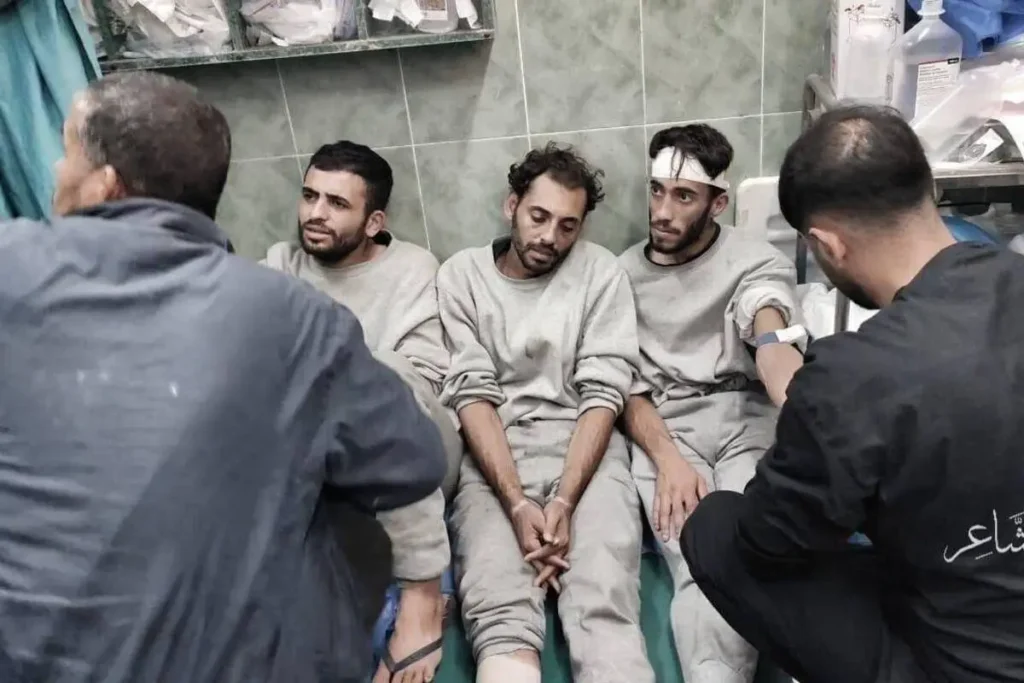
Gaza Herald- Palestinian prisoners who were recently freed and returned to Gaza have described brutal mistreatment inside Israeli military facilities and prisons. Their testimonies, collected through extended interviews, highlight patterns of systematic abuse that reinforce growing evidence of misconduct in Israel’s detention system.
One of them, Mohammad Abu Tawileh, a 36-year-old mechanic, recalled being attacked with corrosive chemicals and set ablaze by soldiers. “I twisted and rolled around like an animal trying to put out the fire that spread from my neck down to my legs,” he said.
The men we interviewed were all detained in Gaza during the months following the October 2023 attacks, when Hamas and other groups killed about 1,200 people in Israel and captured 251. They were held under Israel’s Unlawful Combatants Law, which allows indefinite detention without charge for those considered a potential security threat. Although they were interrogated about alleged Hamas ties, tunnels, and hostages, they were not linked to the October 7 attackssomething Israel itself had required for their eventual release under a recent ceasefire deal.
Methods of Abuse and Humiliation
Each of the men described being stripped naked, blindfolded, cuffed, and beaten from the moment of arrest. Some said they were subjected to electric shocks, dog intimidation, freezing rooms, sleep deprivation, and denial of medical care, while others reported witnessing detainees dying in custody. One man said he saw sexual abuse inside Ketziot prison, where guards forced detainees to perform degrading acts on one another. Another said his nails were ripped out during interrogations.
Abu Tawileh provided one of the most disturbing accounts. Soldiers, he said, forced his head into a pot filled with cleaning chemicals, punched him until his eye was injured, and then ignited his back with an air freshener and lighter. He was left with burns, welts, and permanent eye damage. Medical professionals who treated him in Gaza confirmed chemical burns and vision loss consistent with his testimony. Lawyers and doctors who examined other detainees also confirmed untreated injuries, infections, and malnutrition.
The torture, survivors said, was relentless. They were held in stress positions for hours, beaten with batons on sensitive areas such as the head and genitals, and threatened with castration. Some were shackled naked to hospital beds and forced to wear nappies instead of being given access to toilets. Others described being spat on, insulted, and made to listen to recordings threatening to harm their children. The use of dogs was common, with detainees bitten, scratched, or terrorized whenever they were moved between barracks and interrogation rooms.
Denial and Deflection by Israeli Authorities
The Israel Defense Forces (IDF) and the Israel Prison Service (IPS) were given the chance to respond in detail to these allegations. Instead, they issued general statements dismissing the claims. The IDF rejected accusations of systematic abuse, saying that while some complaints would be examined, others lacked detail. It added that inappropriate actions by detention staff were taken seriously and, when proven, resulted in disciplinary or criminal investigations. The IPS denied any knowledge of abuse inside its facilities, claiming, “[a]s far as we know, no such events have occurred under IPS responsibility.”
Legal experts strongly disputed these denials. Dr. Lawrence Hill-Cawthorne, co-director of the Centre for International Law at the University of Bristol, said the treatment described was “entirely inconsistent with both international and Israeli law” and that several of the practices, including chemical burns, electrocution, severe beatings, and stress positions, clearly meet the legal threshold of torture.
Human rights organizations and UN investigators have corroborated similar accounts. Reports from B’Tselem and the United Nations detail Palestinians being stripped, deprived of food and sleep, burned with cigarettes, sexually assaulted, and terrorized with dogs. A UN report also said threats of rape were used as a “standard operating procedure.” Israel, in response, categorically rejected these findings as “unfounded allegations.”
A Systemic Pattern of Abuse
The five detainees we interviewed were among nearly 1,900 Palestinians released earlier this year in exchange for 33 Israeli hostages, both living and dead. Their experiences reveal a consistent pattern: arrest in Gaza, transfer to military barracks such as Sde Teiman, interrogation under torture, relocation to prisons like Ketziot or Megiddo, and eventual release. At each stage, they said, abuse continued.
Others freed under the same deal echoed these accounts. Some described starvation, disease, and extreme weight loss, with detainees losing up to 30kg due to lack of food. Meals were sometimes left outside cages to be eaten first by cats and birds. Access to water was limited to an hour a day, and soap was rationed to a spoonful a week. Infections such as scabies and open boils went untreated. Prisoners said guards told them, “As long as you have a pulse, you are fine. When your pulse is gone, we will treat you.”
Child Prisoners Tortured!
Children were not spared. One detainee, Ahmed Abu Seif, was arrested on his 17th birthday and taken to Megiddo prison, where he said guards pulled out his nails and repeatedly sprayed tear gas into cells. “There was no consideration of us being children. They treated us as if we were militants of 7 October,” he said.
Several detainees also reported witnessing deaths in custody, caused either by severe beatings or medical neglect. According to the Palestinian Prisoners Society, at least 63 Palestinians, 40 of them from Gaza, have died in Israeli detention since October 2023. Israeli authorities acknowledged deaths but said investigations were opened in each case.
Even on the day of release, detainees said the abuse did not stop. They were handcuffed tightly, forced to march with arms above their heads, and threatened with missiles if they ever cooperated with Hamas again. Only once transferred to Red Cross buses did they feel “safe.” Some returned to Gaza emaciated, with visible scars, burns, and untreated infections. Doctors at Gaza’s European Hospital confirmed cases of extreme malnutrition and torture-related injuries.
For survivors, freedom brought little relief. Many remain physically and emotionally scarred. Abu Tawileh said his burns, eye damage, and constant pain prevent him from resuming work. Ahmed, the teenager, said he now wishes to leave Gaza entirely: “Because of what we saw in detention and the fear of bombs over our heads, we wished for death but couldn’t find it.”

