
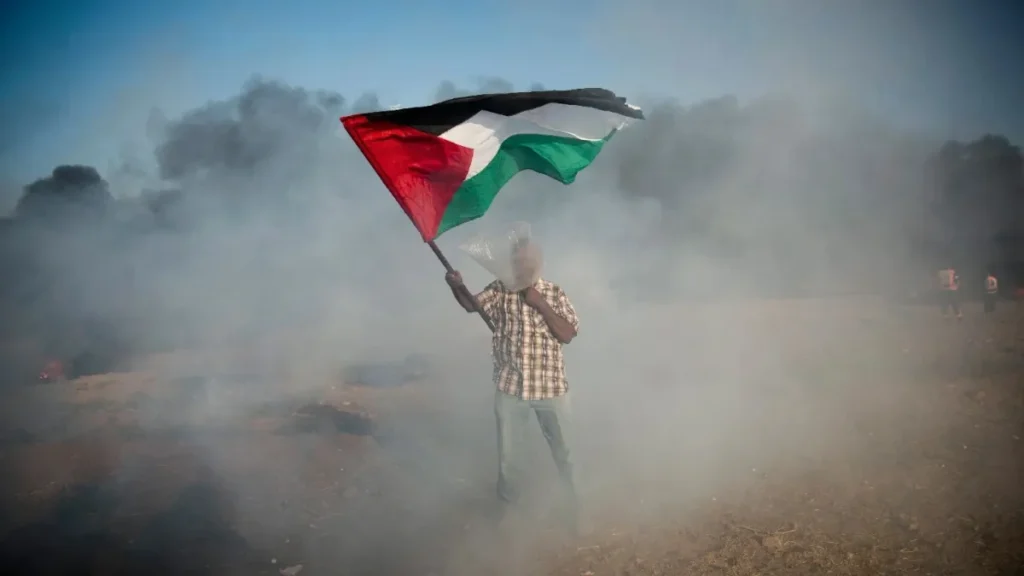
Gaza Herald — A new poll has laid bare a deep generational divide in U.S. attitudes toward Israel’s war on Gaza, with young voters expressing unprecedented support for Hamas in the face of what many describe as Israel’s genocidal campaign. The findings come as Israel’s assault on Gaza, marked by mass killings and the destruction of civilian infrastructure, enters its second year and continues to reshape global opinion.
A survey conducted by The Harris Poll and HarrisX on August 20–21 among 2,025 registered voters asked respondents directly: “In the Israel-Hamas conflict, do you support more Israel or more Hamas?”
Results showed that 60 percent of voters aged 18–24 sided more with Hamas than with Israel. This sharp contrast stood out against older demographics, where support for Israel grew steadily with age: 65 percent among those 25–34, 70 percent among ages 35–44, 74 percent for 45–54, 84 percent for 55–64, and as high as 89 percent among voters over 65.
Half of all respondents said they believe Israel is committing genocide in Gaza, while a majority (51 percent) indicated that criticism of Israel is primarily driven by human rights concerns for Palestinians, not antisemitism. However, the survey did not measure broader support for Palestinians as a people, even though Israeli officials frequently conflate Hamas with the entire population of Gaza.
These findings reflect a significant generational realignment in U.S. public opinion, surfacing as Israel’s military assault on Gaza enters its second year.
Other polls reinforce this shift. A recent Quinnipiac University survey revealed that 60 percent of Americans oppose U.S. military aid to Israel, with only 32 percent backing further support. Likewise, Pew Research data from May found that 53 percent of Americans now hold an unfavorable view of Israel an increase from 42 percent in March 2022, before the October 7, 2023 escalation.
Meanwhile, conditions in Gaza remain catastrophic. Since the breakdown of a brief ceasefire on March 18, Israeli forces have escalated bombardments, killing tens of thousands and leaving much of the enclave in ruins. More than 63,000 Palestinians have been killed since October 2023, over 160,000 wounded, and at least 10,000 remain buried under rubble.
The siege has also manufactured a famine, taking the lives of hundreds mainly children and putting hundreds of thousands at risk of starvation. These atrocities have prompted widespread condemnation from international human rights groups and governments alike.
Israel is currently facing legal scrutiny at the highest levels. The International Court of Justice is examining the genocide case, while the International Criminal Court has issued arrest warrants for Prime Minister Benjamin Netanyahu and former Defense Minister Yoav Gallant over alleged war crimes in Gaza.
Yet despite the ongoing bloodshed dominating global headlines, only 2 percent of Harris Poll respondents named Gaza as a top personal concern, highlighting the disconnect between the magnitude of the humanitarian crisis and its place in U.S. domestic priorities.
The polling data underscores a profound shift in American opinion, particularly among younger generations who are increasingly rejecting Washington’s traditional pro-Israel stance. As Gaza suffers one of the worst humanitarian catastrophes of the century, the growing gap between public sentiment and U.S. foreign policy could become a defining issue in the years ahead reshaping debates not only about the war on Gaza, but also about America’s role in global human rights and accountability.

