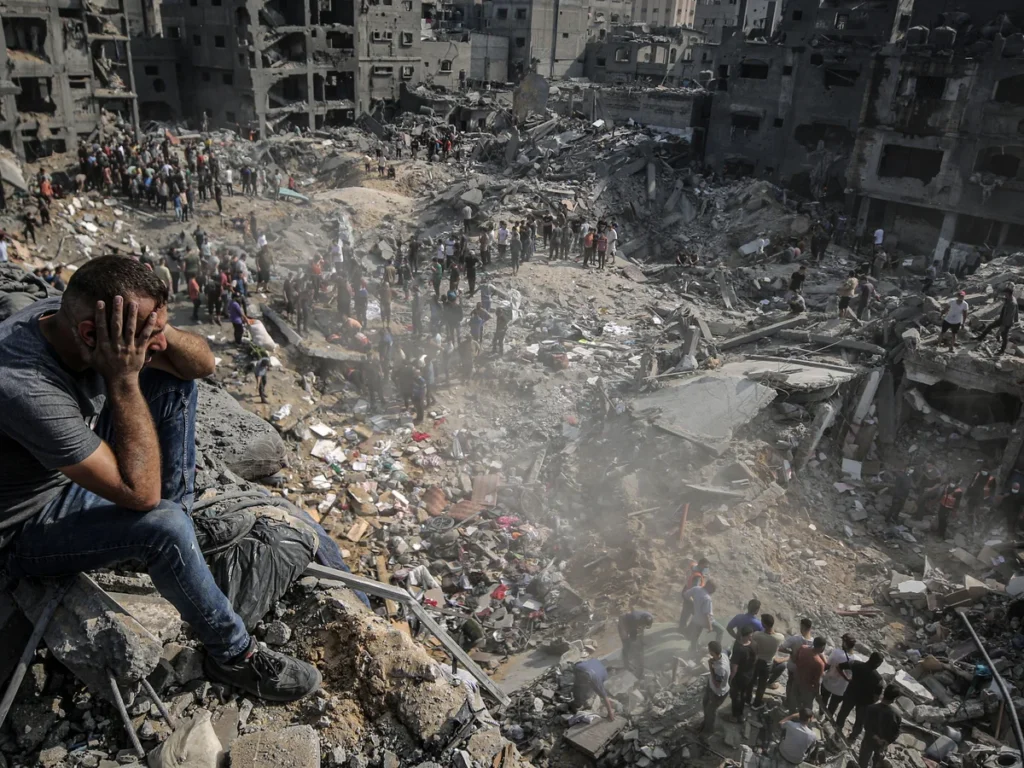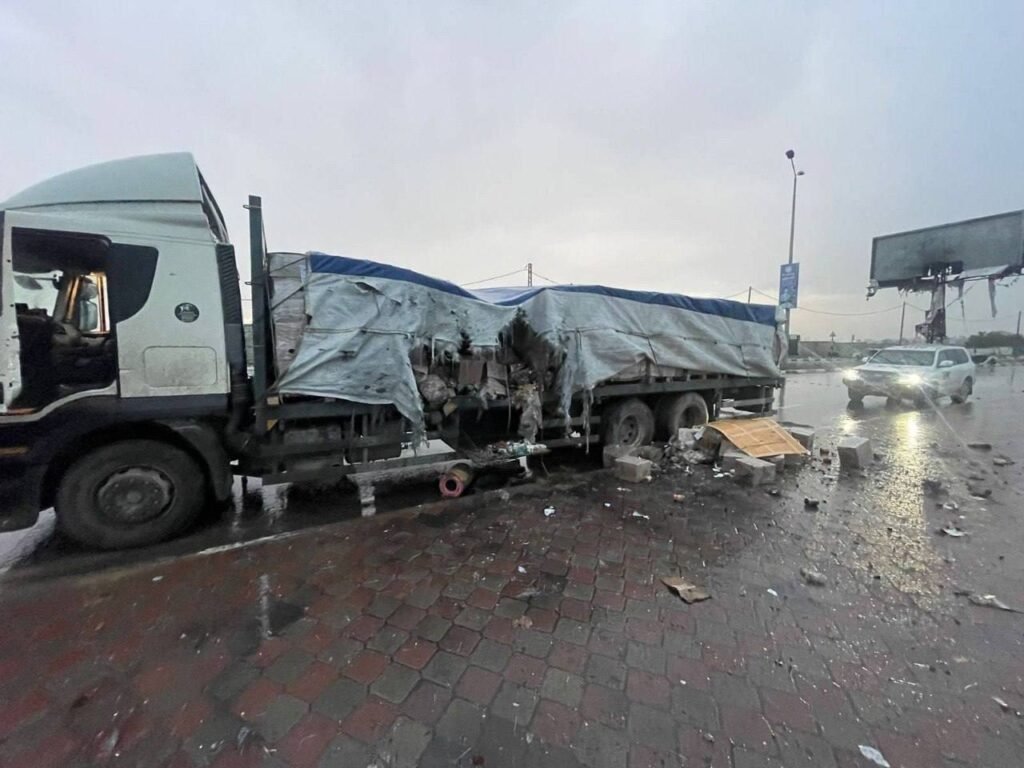
Gaza Herald _ The Government Media Office in Gaza has sharply criticized the global response to the deepening humanitarian crisis, revealing that only 73 aid trucks entered the enclave on Tuesday, a fraction of the 600 trucks per day humanitarian agencies deem essential.
In an official statement, the office described the current aid flow as woefully insufficient to address the famine devastating the population.
The statement also aimed Israeli airdrops of relief supplies, accusing Israel of dropping aid into active war zones under military control, rendering them inaccessible to civilians.
“We observed three separate airdrops,” the statement noted, “yet together, they didn’t even amount to the contents of two aid trucks. What’s happening is nothing short of a farce, enabled by the international community’s false assurances and misleading narratives.”
The media office urged world leaders to abandon symbolic gestures and commit to securing safe, sustained, and unrestricted humanitarian access into Gaza.
Why Airdrops Over Gaza Pose a Grave Risk
In recent days, Jordan, the United Arab Emirates, and Israel resumed airdropping humanitarian aid into Gaza for the first time in months. This move came as humanitarian organizations reported that nearly one-third of Gaza’s population has gone days without food.
However, these airdrops have drawn sharp criticism from the United Nations and other humanitarian groups. They warn that the tactic not only fails to address the scale of Gaza’s starvation crisis but also poses lethal risks to the very people it’s meant to help.
Philippe Lazzarini, head of the UN Relief and Works Agency for Palestine Refugees (UNRWA), strongly condemned the use of airdrops. “They are expensive, ineffective, and can even kill starving civilians,” he posted on X. According to Lazzarini, air deliveries cannot compensate for the rapidly worsening famine gripping the population.
Airdrops: A Desperate Last Resort
Humanitarian aid can be delivered by land, sea, or air, but experts agree that parachuting aid into conflict zones is riddled with logistical and ethical challenges. According to Sky News correspondent Sally Lockwood, airdrops are typically a measure of last resort, often used when all other options are blocked. She notes that foreign governments are well aware that air deliveries are unreliable and reach only a small fraction of those in need.
“Palestinian sources tell us the aid dropped so far is not reaching the most desperate,” Lockwood reported. “It’s symbolic more than substantial, an attempt to do something, even if flawed.”
Military analyst Sean Bell emphasized the risk of using aircraft in active war zones. Since Gaza’s only airstrip in Rafah has been out of operation since 2021, planes must fly low and slow over dangerous territory, making them vulnerable to attack. He also warned of the physical threat posed by falling packages, which can injure or kill civilians on the ground.
Moreover, the scale of assistance airdrops can provide is negligible. Bell explained that a single plane drop is roughly equivalent to just one truckload of aid, barely 0.2% of Gaza’s daily need, which is estimated at 500 trucks.
Aid Falling into the Wrong Hands
Another significant problem is accountability. Reports suggest that some airdropped supplies have been intercepted by gangs and resold on the black market, diverting aid away from starving families. “Some of it is already being looted,” Lockwood said.
Why Airdrops Are Being Used Now
Israel controls all three land crossings into Gaza: Kerem Shalom in the south, the central 147 crossing, and Erez in the north. Despite repeated calls from the international community to open the borders for sustained aid delivery, restrictions remain in place.
The UN says it has over 6,000 trucks loaded with supplies waiting in Egypt and Jordan for clearance to enter Gaza. While Israel recently announced a one-week increase in aid efforts, including its own airdrops and limited cooperation with humanitarian groups, no concrete details have been released.
Since the beginning of March, Israel has largely halted the flow of humanitarian aid into Gaza, only partially reopening some aid entry points in May under tight restrictions it claims are necessary to prevent Hamas from seizing supplies.
Additionally, the Israeli military began implementing 10-hour daily pauses in fighting across three areas of Gaza on Sunday, purportedly to allow humanitarian operations. However, critics argue that such measures are inadequate in the face of mass hunger and devastation.
Malnutrition Surges in Gaza as Aid Airdrops Face Scrutiny
According to figures from the health ministry in Gaza, operated by Hamas, at least 133 Palestinians had died from malnutrition by that point—among them, 87 were children.
Doctors Without Borders issued a warning on Friday, stating that one in four young children and pregnant women in Gaza are now suffering from malnutrition.
Despite these dire statistics, Israeli authorities maintain that Gaza is not experiencing famine.
What’s Being Airdropped, Who’s Behind It?
Most of the aid is being delivered via C-130 cargo planes, with Jordan reportedly deploying 10 aircraft and the United Arab Emirates using eight.
Each plane carries around eight pallets, totaling approximately eight tonnes of goods, according to Sky’s Sally Lockwood, reporting from Jordan’s King Abdullah II airbase. The packages contain basic food staples such as rice, flour, dried goods, and baby formula, but no medical supplies.
While UK Prime Minister Sir Keir Starmer has stated that Britain will assist with the airdrops, no British aircraft have been spotted participating from Jordan so far.
During a visit to Scotland, Starmer discussed Gaza’s humanitarian crisis with U.S. President Donald Trump. Trump later said the U.S. was ready to step up its involvement by funding food distribution centers in partnership with trusted organizations and contributing more aid.
“We’ve already done some airdrops, and people are rushing to grab the supplies,” Trump said. “We’re going to do more, and the prime minister is joining our efforts.”
Last year, the UK’s Royal Air Force carried out 10 airdrop missions delivering 110 tonnes of aid as part of a Jordan-led coalition. However, it remains unclear what level of British participation will be provided in the current phase.