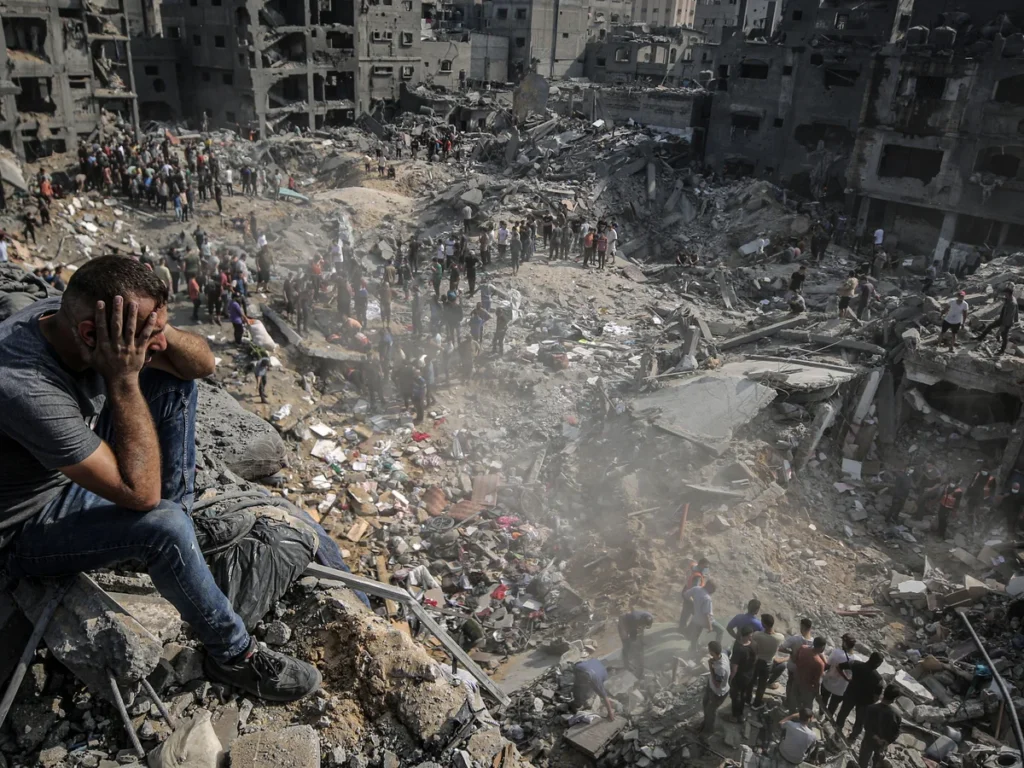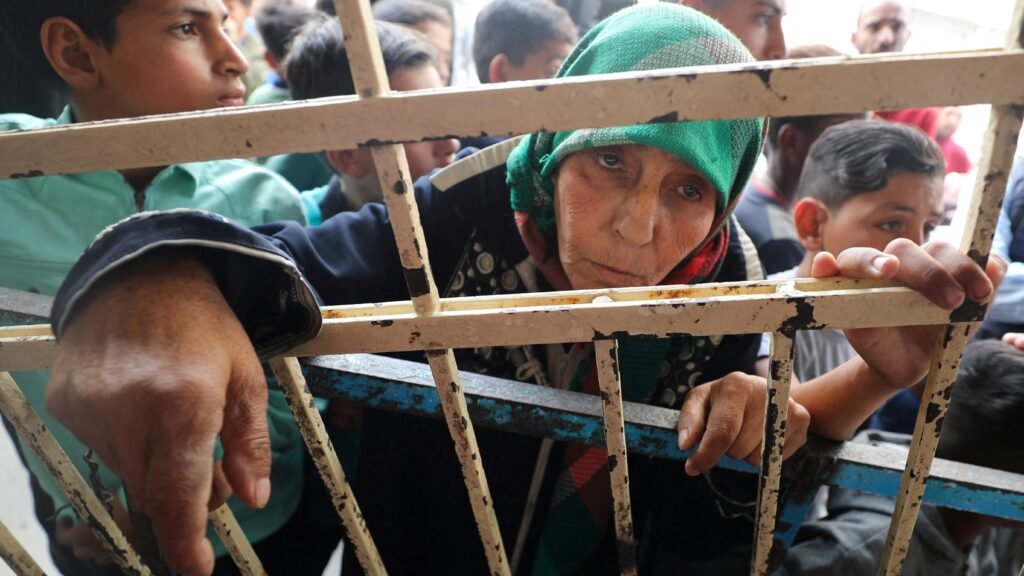
Gaza Herald- Under Israel’s total blockade, food has become a weapon, and starvation a silent executioner. Families are wasting away, children cry themselves to sleep on empty stomachs, and elderly parents collapse in the streets. This is not a natural famine. It is a calculated policy of deprivation, inflicted on over two million Palestinians trapped in an open-air prison, with the world watching and doing nothing.
A Father’s Empty Promise
In Gaza, a father’s words to his children are no longer tied to dreams or future ambitions. They are bound to hunger.
Akram Basheer holds his crying children close and whispers a promise he knows he cannot keep: “One day, when the siege ends, you’ll eat whatever you want.”
But day after day, the promise fades with the sound of empty stomachs and the absence of food.
“I just support them psychologically,” Akram told Middle East Eye. “There is absolutely nothing else I can do.”
Living Off Nothing
Like over two million Palestinians trapped in Gaza, Akram and his family are being systematically starved under Israel’s blockade. Since March, the total closure of crossings has cut off even the most basic necessities: food, water, medicine.
He lives in Deir al-Balah, in the central Gaza Strip, and spends his days scavenging for scraps, a meal here, a few calories there, for his children and his elderly parents. But even when a meal is found, it lacks the basic nutrients the body needs to survive.
“They’re losing weight, they sleep too much, and they can’t concentrate. All day, they think about food.”
The children obsess over candy and sweets, normal cravings for any child, now symbols of survival. But the starvation isn’t limited to them. Adults, too, have wasted away under the weight of this man-made famine. Even small efforts like walking or standing are draining.
Akram’s father, who suffers from diabetes and hypertension, has collapsed multiple times from dizziness and weakness. A recent fall left him with a broken hand. Without milk, eggs, or vitamins, there’s little hope of proper recovery.
“We have to watch him all the time,” Akram said. “His body can’t heal.”
Hunger as a Weapon
This is not a famine of nature. It is the result of state policy.
On 2 March, Israel completely sealed off Gaza’s borders. The blockade has blocked almost all humanitarian aid and food from entering the Strip. As early as May, the UN’s food security agency estimated that half a million Palestinians were in IPC Phase 5, classified as catastrophic hunger. That number has since skyrocketed.
“We are a whole family with children who constantly need food. But the longer the siege lasts, the less there is left,” Akram said.
Bread Every Five Days or None at All
For Basem Munir al-Hinnawi, who now supports two families after his father was killed in the war, the struggle is constant. In Jabalia refugee camp, food has vanished.
“Some days, we get bread once every four or five days. On others, I buy the children one small cookie just to stop their crying.”
Lentil soup, when possible, is the only warm meal they get. The physical effects have been brutal. Basem has lost 39 kilograms. His siblings have lost between 15 and 20.
“My sister faints every few days. My wife is breastfeeding and can’t even handle basic housework. We are simply wasting away.”
When food is available, it is saved for the children. Adults survive on water mixed with salt. Basem says he has gone four days straight without food. On each attempt to reach aid points, he has been met with danger, including Israeli tanks, drones, and gunfire.
“I tried five times to get food. I came back empty-handed every time.”
A City of Collapsing Bodies
The scenes are now familiar in Gaza’s streets: people collapsing from hunger. In Sheikh Radwan, a woman in her 40s dropped to the ground from exhaustion. Someone brought her a spoonful of sugar, a rare commodity, and slowly, she returned to consciousness.
“People are simply exhausted,” Basem said. “Enough.”
This Is Intentional
At least 113 Palestinians, including 81 children, have already died of starvation. Over 28,000 cases of malnutrition have been documented, though the real number is likely much higher. These are not figures from a natural disaster. This is a war tactic, deliberately imposed by an occupying power.
“We adults might endure hunger,” Basem added. “But how can a child understand that they are being starved by design, not by accident?”
The Cries of the Starving Force Western Media to Acknowledge Gaza’s Humanitarian Catastrophe
For months, most Western media outlets turned a blind eye to the genocide being committed by Israel in Gaza a disturbing contradiction to the principles they claim to uphold: human rights, justice, and protection of the vulnerable.
But in recent weeks, this silence has begun to crack, even within right-leaning news organizations once described by observers as overtly hostile to anything Palestinian.
In this report, we examine several prominent newspapers that have recently begun to cover the dire situation in Gaza, particularly Israel’s systematic starvation campaign against the besieged population a policy met with both Arab and international silence that is no less painful than the hunger itself.
This late yet noticeable shift in coverage comes amid the growing visibility of Gaza’s suffering and the exposure of Israel’s deliberate starvation policy. In recent weeks, that policy has come under fierce criticism from the United Nations, international humanitarian organizations, and even a number of Western governments.
On Monday, the European Union and 28 Western countries, including the UK and France, issued a joint statement calling on Israel to end the war immediately. The statement condemned what it described as the “erratic flow of aid” into Gaza and called it “horrific” that more than 800 civilians were killed while attempting to access humanitarian aid.
We begin with The Telegraph, a British newspaper with a traditionally right-wing editorial stance that has long aligned itself with the Israeli narrative, even when it was riddled with distortions and falsehoods.
“Her body grows weaker by the day”
The paper published a report today titled: “Her body grows weaker by the day… Gaza’s children are starving to death”. The report featured footage of children suffering from acute malnutrition in one of the few remaining medical facilities in the Gaza Strip.
The Telegraph also cited a statement issued Wednesday by more than 100 humanitarian and human rights organizations warning of mass starvation in Gaza. Signatories included Médecins Sans Frontières (Doctors Without Borders), Oxfam, and Save the Children.
The Times: Starvation buried in the Middle East section
The Times, another British newspaper with a conservative outlook, published a short article on Gaza not on its front page but within its Middle East section. The piece was headlined: “‘Mass starvation’ in Gaza as US envoy begins ceasefire talks”.
It noted that humanitarian groups were sounding the alarm, and cited the UN as saying that over a thousand Palestinians have been killed in the past two months while waiting in food lines.
The Independent highlights Gaza’s food crisis
The Independent, known for its liberal, progressive editorial line and consistent defense of human rights, has shown deeper interest in Gaza’s humanitarian crisis.
It featured a video on its front page titled: “Starving Palestinians trade gold for flour and risk death for aid as Gaza’s food crisis deepens.”
The accompanying report described infants reduced to “skin and bone,” dying because their mothers, weakened by hunger, could no longer produce breast milk. Even those seeking aid are risking their lives in the process.
Washington Times: Reluctant reporting, pro-Israel framing
Across the Atlantic, the conservative Washington Times was compelled to report on the humanitarian organizations’ warning. The headline read: “Over 100 aid groups warn of famine in Gaza after Israeli airstrikes kill 29, officials say.”
However, the report notably omitted any images of starving children and instead made space for Israel’s official narrative, stating: “Israel says it is allowing enough aid into Gaza and blames UN agencies for distribution failures.”
The Washington Times, like many outlets aligned with U.S. conservative politics, tends to support Republican-aligned views and traditional religious perspectives, often echoing pro-Israel policy lines.
Wall Street Journal and French Press Confront Gaza’s Starvation
The Wall Street Journal also published a report in its Middle East section not on the front page titled: “Children Starve in Gaza as Hunger Crisis Deepens.” Absent were any images capturing the scale of the famine. The article cited UN data stating that at least 10 children have died of hunger this month, with malnutrition worsening rapidly.
Meanwhile, French-language media has begun to break its silence. Switzerland’s Le Temps, a centrist liberal outlet, ran a powerful headline: “Hunger Grips Gaza.” The report included a searing plea from Palestinian journalist Fadwa al-Hourd:
“If you can’t stop the bombs, at least stop the hunger… Dying under bombs no longer scares us it’s quick. But to die from hunger, to feel your body fading slowly, that is the real horror,” she said.
Her words echoed those of Dr. Fadi al-Barai, a surgeon who worked at the now-evacuated al-Quds and al-Awda hospitals in Gaza, cleared under Israeli military orders.
Western Press: From Reluctant Acknowledgment to Explicit Condemnation of Gaza’s Starvation
Even Le Figaro known for its alignment with far-right ideologies and firm support for Israel dedicated a blog post yesterday to the famine unfolding in Gaza. The post, titled “War in Gaza: Around 100 NGOs Warn of Onset of ‘Mass Famine’,” cited statements from the UN Secretary-General, the French Foreign Ministry, and various humanitarian organizations. French Foreign Trade Minister Jean-Noël Barrot condemned what he called “the horrific situation” in Gaza, even as Israeli forces continue their deadly airstrikes.
Le Monde, which positions itself as a centrist publication, also featured Gaza’s famine on the front page, with a powerful editorial headlined: “Outrage at Gaza’s Genocide Is No Longer Enough.” The piece stressed that beyond violence, famine, and thirst, the long-standing Israeli blockade on Gaza demands a response proportionate to the ongoing massacre namely, the imposition of political, diplomatic, economic, and cultural sanctions on Israel.
The Guardian: A Different Kind of Coverage
Among Western newspapers attempting to meaningfully report on the deliberate starvation and genocide in Gaza is the UK’s The Guardian. Known for its focus on human rights, equality, and justice, The Guardian has launched a live blog providing real-time updates on the devastated Strip. One headline read:
“People in Gaza Are Walking Corpses – UNRWA Says It Has 6,000 Aid Trucks Ready, Waiting for Entry Clearance.”
In addition to its live coverage, The Guardian devoted its editorial to Gaza yesterday, boldly titled: “It Will Take More Than Words to Stop the Genocide Being Committed by Israel.”
The piece declared:
“Behind the visible deaths lies the horror of an engineered famine precisely designed, tightly monitored, and intentionally implemented,” quoting Professor Alex de Waal, an expert in humanitarian crises.
The editorial concluded with a stark warning: unless the international community collectively confronts the systematic destruction of Palestinian life in Gaza with a coordinated, urgent, and tangible response, the erosion of international humanitarian law will have global repercussions for years to come.
Credit
Based on original reporting by Middle East Eye and western sources