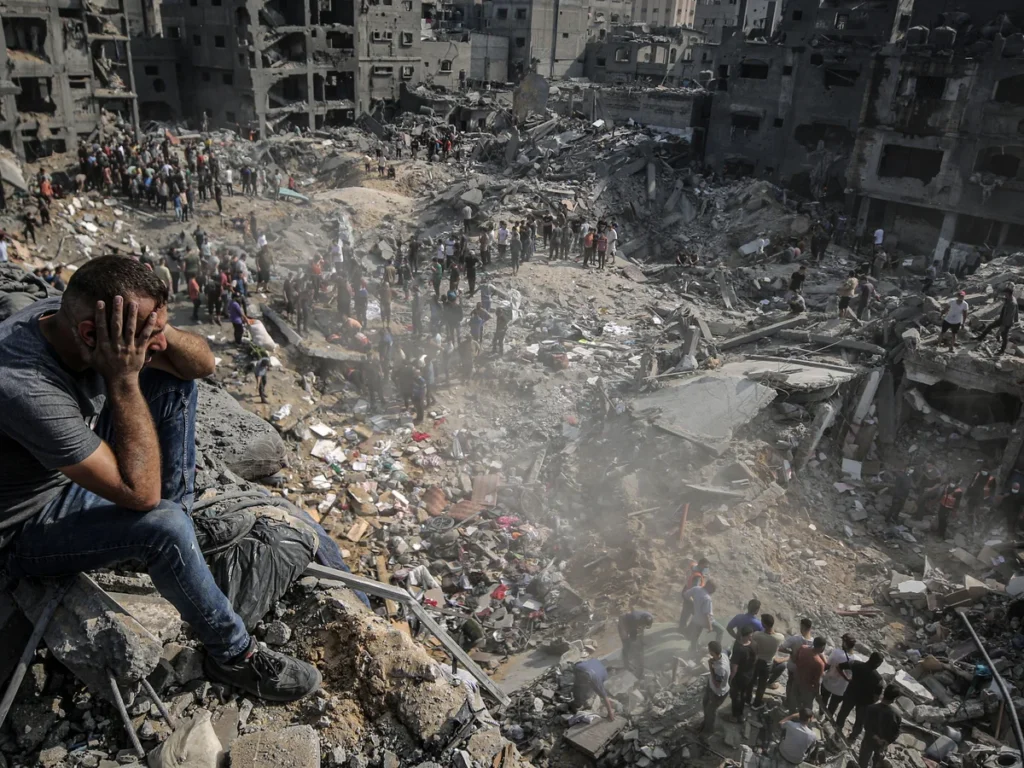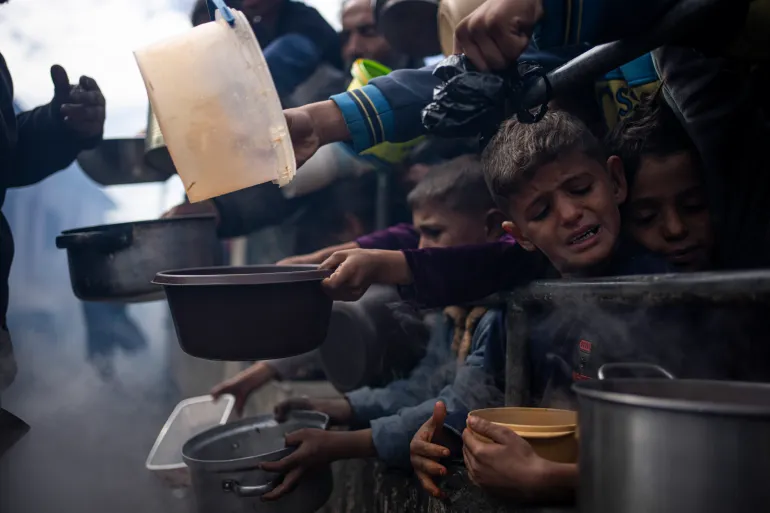
Gaza Herald – In Gaza today, hunger is not a looming threat; it is a daily agony. What used to be a child’s right to a piece of bread, a glass of milk, a spoon of baby formula, has turned into a desperate hope. With Israel’s suffocating blockade, backed by American power, more than two million Palestinians are being starved with intent. Children are dying of hunger. Mothers cradle empty arms. And as the world scrolls past in silence, Gaza is being stripped of life not by nature, but by human hands.
The hashtag #GazaStarving is gaining massive traction across social media as Palestinians in the besieged Gaza Strip raise their voices in a desperate cry for help. Posts and videos flooding platforms like X, Facebook, and Instagram expose the stark reality: children, women, and the elderly are starving under a relentless war, backed by the United States and carried out by Israel.
The images are harrowing. Malnourished children with visible bones, elderly people too weak to stand, mothers pleading for bread. Behind every frame is a deadly blockade and a global silence.
Since the start of Israel’s genocidal assault, at least 70 children and infants have died of hunger and malnutrition, with baby formula and supplements blocked from entry. Gaza’s Government Media Office reports that 650,000 children face severe hunger, while 60,000 pregnant women are at critical risk due to the lack of food and medical care.
An estimated two million people are living in famine conditions. For many, a full meal hasn’t come in days. Israel continues to seal border crossings, denying food, medicine, and aid trucks. Even the security teams guarding aid deliveries have been targeted.
One video captures a girl standing in front of rubble, crying: “Enough talk about patience, as if we’re not human. We are hungry. We miss bread… and life.” In another clip, a boy in a hospital bed is asked how he feels. His voice cracks as he answers, “Hungry.”
In the streets, a woman waiting outside a charity kitchen says, “We’re exhausted. We move from one kitchen to another, searching for a piece of bread. We find nothing. What did we do to deserve this?”
Dr. Munir Al-Bursh, Gaza’s Director-General of Health, shared the image of a child who died of starvation. He appealed to the world: “Don’t stay silent. Gaza is being killed by hunger. Wherever you are, whatever language you speak, if your heart is still beating, do something. Children are dying at the gates of flour distribution. Mothers are shedding tears that can’t feed their babies. We are not asking for the impossible. We are asking not to be ignored.”
In another post, he wrote, “In Gaza, food is no longer a right. It is a whispered wish on the lips of hungry mothers. It’s the treasure children dream of as they fall asleep hugging empty air instead of milk.” He added, “Hunger doesn’t knock anymore in Gaza. It lives here. It consumes dignity and life in equal measure.”
The economic collapse is deepening. Prices have skyrocketed more than 500 percent. A kilo of flour now costs 170 shekels—a 240 percent jump in just one week. Rice is selling for 110 shekels per kilo, up 175 percent. Before the war, these items were only a few shekels each.
Gaza needs at least 800 trucks of aid every day to meet basic needs. Israel is allowing in less than 5 percent of that. The blockade has wrecked the local economy and left the population starving.
Even artists and journalists are raising the alarm. Cartoonist Mahmoud Abbas posted an image of a man with a Gaza-shaped stomach — empty and hollow, symbolizing the collapse of food security. Egyptian Al Jazeera anchor Zein El Abidin Tawfiq wrote, “Shame on a nation that owns most of the earth’s wealth and counts two billion people, yet can’t send flour to two million starving souls.”
Euro-Med Monitor chief Ramy Abdu shared a photo of a donkey cart carrying the bodies of Palestinians killed while trying to collect aid from the so-called US humanitarian zone. “They went out looking for food. Israel killed them,” he wrote.
Dr. Ahmad Mousa Al-Arabi reposted a clip of a woman recalling the justice of Caliph Omar Ibn Abdulaziz, who once ordered wheat scattered for the birds so none would go hungry in Muslim lands. She said, “If only you knew, Omar, who is hungry today. Hunger in Gaza has reached an extreme. The pain is unbearable.”
What Gaza is experiencing is not a natural disaster, but rather a man-made famine. It is an engineered starvation—a weapon of war. And the world is watching.
This is not a natural famine; it is a famine of politics, power, and global apathy. Gaza does not lack food; it is denied it. As flour becomes more valuable than gold and a bottle of milk becomes a symbol of survival, the silence of the international community grows louder. The people of Gaza are not asking for charity; they are demanding justice, the right to eat, the right to live. To look away now is to become complicit. Gaza is starving, and the world must choose whether to feed its conscience or let it rot in the ruins of indifference.