
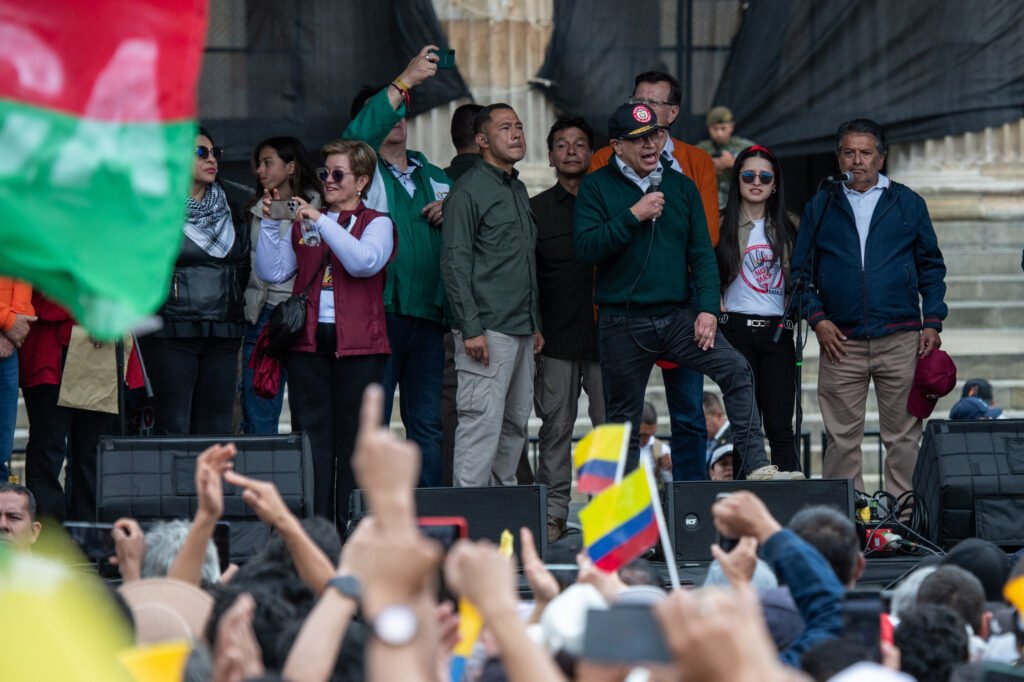
GazaHerald – In a historic gathering in Colombia’s capital, a coalition of over 30 states from across the Global South and beyond declared a unified commitment to ending Israel’s genocide against the Palestinian people.
Hosted jointly by Colombia and South Africa, the emergency summit of The Hague Group culminated in a sweeping diplomatic initiative aimed at enforcing international law and confronting the longstanding culture of impunity that has allowed the war on Gaza to continue unabated.
The summit, held on Wednesday, was the first of its kind since The Hague Group was formed earlier this year in the Netherlands with the aim of holding Israel accountable under international law. Since its launch on January 31, the bloc, now comprising eight founding states, has gained growing support. In Bogotá, the momentum was clear: delegations from countries as diverse as Brazil, Ireland, Algeria, China, Iraq, and Mexico joined the call, reflecting a groundswell of frustration over global inaction.
Colombian President Gustavo Petro opened the conference with a powerful declaration:
“We came to Bogotá to make history, and we did. We have begun the work of ending the era of impunity. These measures show that we will no longer allow international law to be treated as optional or Palestinian life as disposable.”
At the heart of the summit’s outcome was a bold package of legal and diplomatic measures designed to sever the structural support for Israel’s occupation and war machinery. In a joint statement, the participating countries affirmed that international law must be enforced “without fear or favor,” with several states already pledging immediate action through their own legal systems.
Twelve countries, among them South Africa, Colombia, Malaysia, and Libya, committed to implementing the measures without delay. These include bans on arms and dual-use equipment transfers to Israel, restrictions on the use of national flags and ports for arms shipments, reviews of all public contracts that could support the occupation, and full support for international justice mechanisms such as universal jurisdiction and war crimes investigations.
In a region where legal declarations have often been outpaced by political caution, the measures were striking for their clarity and immediacy. More than symbolic, they were designed to disrupt real networks of complicity, from arms trades to financial flows, and to offer states practical tools to intervene in the machinery of occupation and war.
UN Special Rapporteur Francesca Albanese, a key speaker at the event, described the summit’s outcome as a lifeline:
“These aren’t just measures; they are lifelines for a people under relentless assault and for a world that has been paralyzed for too long.”
She praised the twelve countries that stepped forward, calling their action a “momentous step forward” and a challenge to other regions, particularly Europe and the Arab world, to match their courage.
A date has now been set, September 20, 2025, for more states to join the initiative, coinciding with the 80th United Nations General Assembly. The timeline reflects the deadline set by UN General Assembly Resolution A/RES/ES-10/24, passed in September 2024, which called on all member states to take “effective measures” against Israel’s violations within one year.
Ronald Lamola, South Africa’s Minister of International Relations and Cooperation, emphasized the wider significance of the summit:
“What we have achieved here is a collective affirmation that no state is above the law. The Hague Group was born to advance international law in an era of impunity. The measures adopted in Bogotá show that we are serious and that coordinated state action is possible.”
The human cost driving this push for accountability was never far from the minds of participants. Since October 7, 2023, Israel’s military campaign in Gaza, backed militarily and diplomatically by the United States, has left over 195,000 Palestinians killed or wounded, with tens of thousands of others missing beneath the rubble. The overwhelming majority of victims have been children and women, with entire neighborhoods flattened and vital infrastructure destroyed.
Varsha Gandikota-Nellutla, executive secretary of The Hague Group, closed the conference with a message that captured the gravity of the moment:
“This marks a turning point, not only for Palestine, but for the future of international law itself. For decades, the Global South has paid the price of a broken international system. In Bogotá, we began the work of reclaiming it, not with words, but with action.”

