
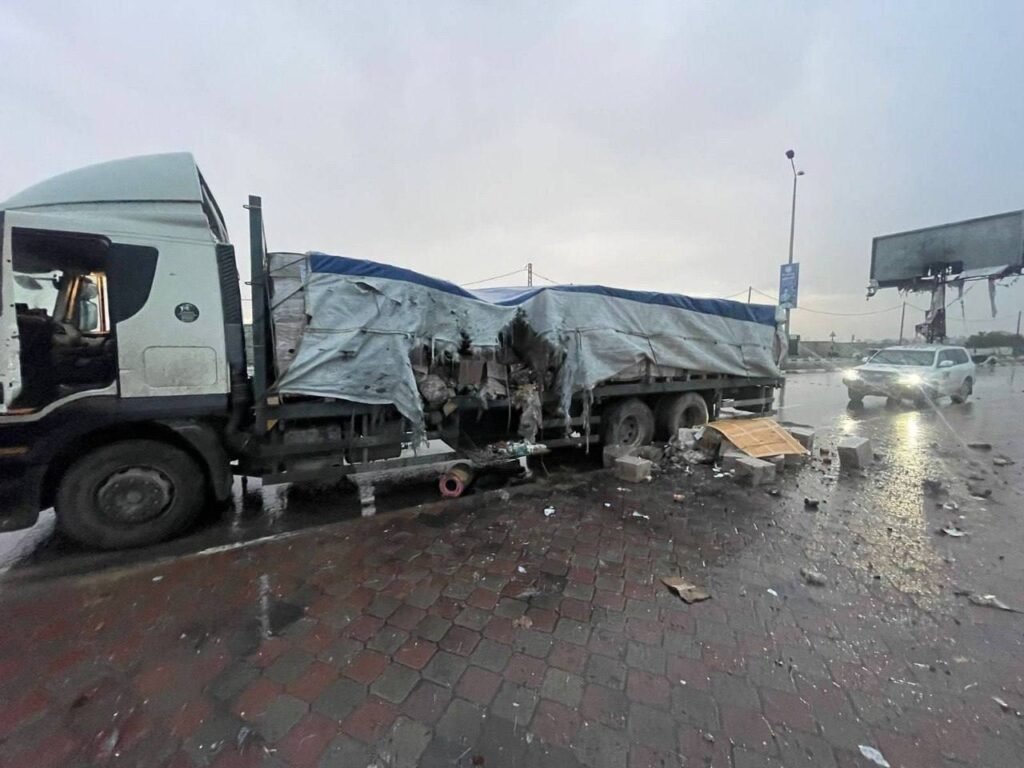
Gaza Herald- Juliette Touma, Director of Communications and Media at the United Nations Relief and Works Agency (UNRWA), reiterates that the Gaza Humanitarian Foundation’s (GHF) aid distribution mechanism is contributing to worsening starvation conditions in Gaza. She called for urgent action to halt Israel’s systematic starvation policy and to allow the entry of aid trucks.
Israel continues to use starvation as a weapon of war, worsening the humanitarian situation in Gaza. Despite the Israeli siege on the West Bank and Gaza, and the blocking of entry visas for international staff, UNRWA continues to provide essential services to Palestinians.
She stated that around 6,000 aid trucks are waiting to enter Gaza to deliver life-saving assistance.
Before the war, people lived in safety, staying in their homes with enough food to eat. Now, they are surrounded by destruction, have very limited access to food, and are suffering from the loss of their loved ones, Touma explained in an interview with Al Jazeera.
Juliette Touma has served in several roles over the past 20 years. She was appointed as the spokeswoman for the UN mission in Syria during the conflict and later served as Head of Communications for the UN Development Programme in Iraq. According to UNRWA’s website, she has visited Gaza multiple times both before and during the current brutal war.
GHF collapse
Touma clarified that the GHF aid distribution mechanism is ineffective, saying it is worsening the humanitarian situation in Gaza rather than alleviating it. She noted that GHF operates mainly in southern Gaza, providing only four distribution points—compared to over 400 that were functioning effectively under UNRWA’s efforts before the war.
The GHF is a company based in Geneva, Switzerland. It was established in February 2025, reportedly under an Israeli initiative to continue its campaign against civilians in Gaza. Reports indicate that the GHF aims to undermine Hamas’s control and prevent the group from accessing humanitarian aid.
According to Israel’s Yedioth Ahronoth newspaper, the main goal behind founding the GHF was to disconnect Gazans from Hamas commanders.
Touma, who has pursued a master’s degree in media and communications from the University of London, said “life in Gaza before the war, despite over 15 years of blockade, was more adaptable: people could fish, farm, and UNRWA was supporting one million people with food aid”.
Israel continues to send relentless evacuation orders in an effort to force displacement, declaring the northern area a conflict zone. Civilians have no safe places to go, not even UNRWA shelters. They are surrounded by destruction and constant threat and the entire food security system has been rendered out of service.
Touma emphasized that the needs of Gazans today go far beyond food. They urgently require security, medical supplies, hygiene products, fuel, clean water, and essential nutrition for children.
UNRWA Operations Remain Ongoing
Responding to claims that UNRWA had halted its operations in Gaza, Juliette Touma firmly stated that the agency has never stopped working, despite the extremely difficult circumstances. Over 10,000 Palestinian staff members continue to provide essential services on the ground.
Touma, who has a background in civil society work in the fields of culture, arts, and music, highlighted that UNRWA health teams in Gaza are conducting approximately 15,000 medical consultations each day. Meanwhile, hundreds of thousands of Palestinians are visiting UNRWA clinics in the West Bank.
She further revealed that one in every ten children assessed in UNRWA clinics in Gaza is suffering from malnutrition. UNRWA teams are continuing efforts to screen children, provide assistance, manage shelters for displaced families, supply clean water to half of Gaza’s population, and carry out regular waste and sewage removal.
Touma also noted that, despite the current challenges, the academic year recently concluded in the West Bank, with around 40,000 students completing their education at UNRWA schools.
However, one of the most pressing obstacles the agency faces, she explained, is Israel’s ongoing refusal to issue entry visas for international UNRWA staff, hindering their ability to support local colleagues and maintain service delivery amid the ongoing crisis.
6,000 Trucks Stranded at Gaza Border
Since October 2023, Israel has escalated efforts to dismantle UNRWA’s presence, culminating in a sweeping Knesset decision to ban the agency from operating in the occupied Palestinian territories. The legislation, passed with overwhelming support, revoked UNRWA’s privileges and diplomatic immunity and ordered the expulsion of itsinternational staff from East Jerusalem, Gaza, and the West Bank, an unprecedented measure against the UN’s largest humanitarian agency, which supports more than 6 million Palestinian refugees.
Juliette Touma emphasized that approximately 6,000 aid trucks carrying vital supplies, including medicine, food, and other essentials, remain stranded just outside Gaza’s borders, primarily in Egypt and Jordan. She urged the immediate entry of these supplies to prevent further loss of life.
Despite the accumulation of aid at border crossings, Touma warned that nearly one million children in Gaza are in urgent need of assistance. She called for restoring the pre-war and ceasefire-era volume of humanitarian deliveries, between 500 and 600 trucks per day, under UN coordination, especially through UNRWA.
In her remarks to Al Jazeera, Touma reiterated that UNRWA remains the largest humanitarian actor on the ground in Gaza and is fully capable of managing large-scale relief efforts, if permitted to operate. She stressed that lifting the blockade and rebuilding the humanitarian system are essential to safeguarding the lives of Gaza’s civilians, particularly children.
Her comments come amid a nearly two-year-long Israeli military campaign during which many UN agencies have ceased operations in Gaza. A recent US-backed proposal to shift aid coordination to the newly formed “Gaza Humanitarian Foundation” has been met with widespread skepticism from international humanitarian actors, who point to the foundation’s limited experience and lack of infrastructure compared to UNRWA’s long-established presence.
Gaza’s humanitarian system is now on the brink of collapse, with tens of thousands of tons of aid and medical supplies barred from entry. As the blockade continues and conditions worsen, global calls are growing for the restoration of UN-led aid operations, an immediate ceasefire, and the facilitation of consistent and structured flows of humanitarian and commercial assistance into the Strip.

