
Gaza Herald – Gone are the days when a ten-year-old girl, Sarah Al-Borsh, could be seen walking joyfully through the streets of Gaza. She used to run around with her friends, dreaming of becoming an engineer and constructing homes overflowing with light, safety, and vibrant colors. Unfortunately, her dreams now seem impossible to achieve, as war has brought catastrophic destruction to her life.
While on a stroll with her father around a school for displaced people in the northern Gaza Strip, Israeli aircraft targeting a nearby house detonated a bomb. An explosion like that would likely obliterate any semblance of infrastructure in its vicinity and subsequently shatter the dreams of countless innocent children, just as it did to Sarah in that split second.
“I awoke in a hospital only to realize I was waking up in a place filled with machines, pain, and suffering.” To her horror, both her arms had been amputated, and her father, Musab Al-Borsh, had died in the brutal attack.
The extensive trauma leaves her questioning her reality. “I kept asking, ‘Where are my hands? Why don’t I feel them?’” she shares. One can only imagine hearing such words and knowing there’s not one answer that a child like Sarah could understand.
Sarah’s tale is just one of thousands in Gaza, a youthful existence snatched away with an endless embrace of devastation and a destiny altered by the hardships endured. In the span of just over two weeks, Israeli airstrikes have led to the deaths of over 17,000 Palestinian children.
The number of children amputated or irreversibly injured has skyrocketed into the thousands. It is now safe to say that Sarah is among the ‘lucky’ few who survived. The narrative she weaves now reflects an entire generation that is mourning the incessant decimation of their homeland.
A Child of War, A Spirit of Defiance
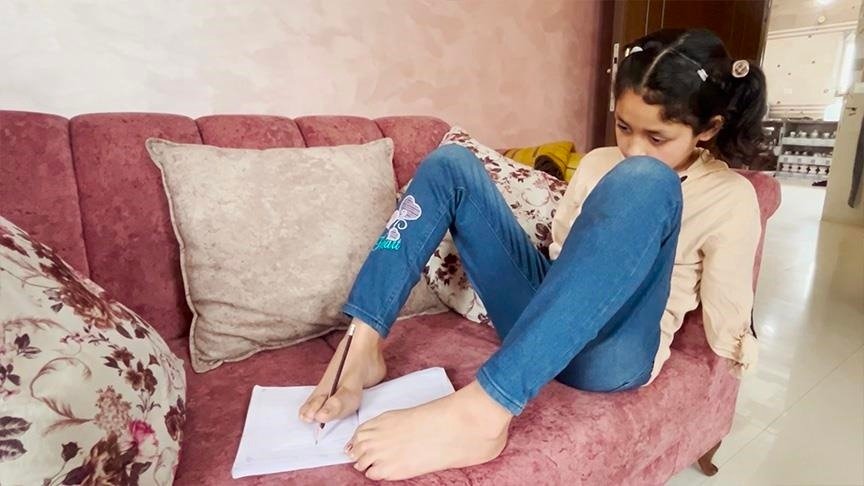
Despite the unimaginable trauma, Sarah refuses to let her injuries define her. From the day she left the hospital, she began to teach herself how to write, draw, and eat using her feet.
“I wanted to become an engineer,” she says in a soft but determined voice. “But after I lost my arms, I decided I wanted to become a prosthetist. I want to help injured children like me so they can live normally without feeling any lack or crisis.”
In her family’s tent in the Sheikh Radwan neighborhood of northern Gaza City, Sarah sits with a pencil clutched between her toes, practicing her name in shaky lines. She draws the faces of those she’s lost and tries to rebuild, on paper, what was taken from her on the streets.
Some things she still cannot do alone. She relies on her mother, Amani Al-Borsh, for daily tasks like dressing, bathing, and combing her hair. But her independence is growing day by day, shaped by a will stronger than the concrete walls that once stood around her home.
Sarah’s mother, Amani, 35, remembers the moment she saw her daughter in the hospital, her tiny body wrapped in blood-stained bandages, her arms gone.
“She was just a child with hands like every other child,” Amani says. “She used to run, play, and laugh with her friends. After the injury, everything changed. She could no longer play or eat without help.”
Transferred between overwhelmed hospitals, Sarah eventually underwent a double amputation and had shrapnel removed from her abdomen and head. After five days, she was released, not to recovery, but to a tent, where her treatment continues in the midst of displacement and suffering.
When Sarah awoke after surgery, she looked up at her mother with innocent eyes and asked, “When will my arms grow back, Mom?”
Amani had no easy answer. She gently told her daughter that her arms wouldn’t grow back, but that one day, after the war, she would receive artificial limbs.
That was the moment Sarah’s dream changed.
She no longer wanted to build houses. She wanted to build arms, to become a prosthetist and help others like her regain what the war had taken.
Sarah now awaits a second surgery, one to correct the way her limbs were hastily amputated due to the overwhelmed and collapsing medical system in Gaza. Only then can she be fitted for prosthetics, a step she looks forward to with a mix of hope and urgency.
But for now, everything is on hold. Her healing, her education, and her prosthetic limbs are all paused by a war that shows no sign of stopping.
Sarah’s story is not just one of pain, but of perseverance. In her defiance of despair, in every letter she traces with her toes, she speaks for the thousands of wounded children in Gaza who are learning how to live again. Her dream may have changed, but her determination remains to build again, not houses, but lives.

