
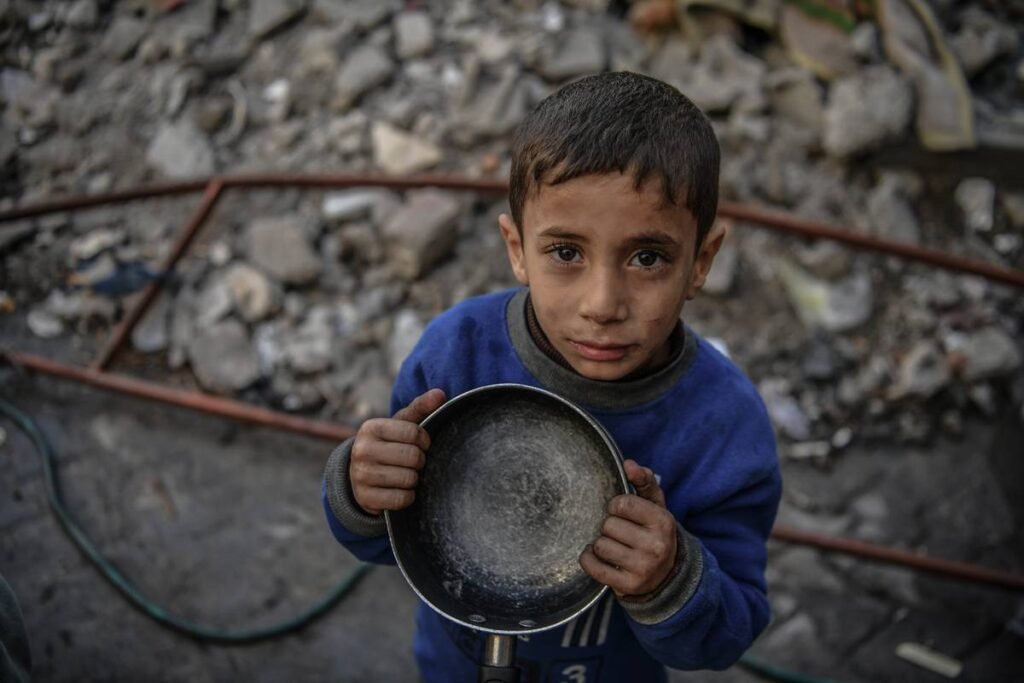
Gaza Herald – Ahmad Abu Zubaida’s phone rang at two in the morning with a text: help had finally come. Like so many others starving under Israel’s months-long siege of Gaza, he set out in the darkness toward the Gaza Humanitarian Foundation (GHF) distribution point in the central Strip.
Backed by the US and Israel, the GHF had taken over food distribution in Gaza after Israeli forces dismantled the UN’s network of over 400 aid points. The GHF’s handful of new centers, accessible only on foot, now draw thousands each day, desperate parents, widows, and orphans, all risking their lives just to secure bread.
For Abu Zubaida, it was a journey made not by choice but by necessity. He had lost three brothers to Israeli attacks and now had to feed not just his own children but also his orphaned nephews.
But as he neared the aid center in Wadi Gaza, he was met with a barrage of gunfire.
“It was as if it were the Day of Judgment,” he told Middle East Eye. “Shrapnel flying in every direction, the cries of the injured, and the relentless crack of gunfire.”
Amid the chaos, he suddenly plunged into a deep pit. “Suddenly, I fell and remembered nothing.”
Friends scrambled to find a way to rescue him in the darkness, fashioning ropes out of discarded electrical wires. One of them climbed into the pit to secure him, while Israeli snipers and drones loomed overhead.
“They pulled me out with electrical cables. After that, I remember nothing… I woke up in a hospital bed, my clothes reeking of the decomposing bodies that were beneath me.”
Abu Zubaida was taken to Al-Aqsa Martyrs Hospital in Deir al-Balah, where staff were already overwhelmed by the carnage from the same aid point.
“Bread,” she said, and he went
Mohammed Awidat, 35, is another father who made the same deadly journey.
His youngest child, just 18 months old, had uttered her first word: bread.
That night, driven by despair, Awidat joined the masses headed toward the GHF site. Like Abu Zubaida, he fell into a pit during the chaos.
Next to him lay a man with a chest wound. Two bodies lay nearby, killed by Israeli forces.
Then the shrapnel hit.
A tank shell tore into his right thigh, nearly severing his leg. In panic, and fearing scavenging dogs, Awidat buried his bleeding leg in the sand.
“I would have preferred to be shot rather than attacked by dogs,” he said.
“Every minute felt like the agony of death, a torment known only to God.”
Ambulances weren’t allowed near the area. Instead, civilians rescued him, carefully carrying his nearly detached leg on foot for four hours. He lost consciousness twice. By the time he reached the hospital, his hemoglobin had dropped dangerously low. Doctors are still fighting to save his leg.
Aid Points Become Kill Zones
Since late May, when the GHF began its limited food distributions, Israeli forces have killed at least 600 Palestinians at these sites and wounded over 4,000. Some die from gunfire. Others, like Abu Zubaida and Awidat, fall into exposed wells created or damaged by Israeli bombardments.
“Injuries from falls into these wells mostly affect the head and abdomen,” said Dr. Bara’ al-Attar, who works in the ICU at Al-Aqsa Martyrs Hospital.
“Eighty to ninety percent of such cases result in instant death.”
At least two people have died after falling into exposed wells in Wadi Gaza alone.
A Gaza government spokesperson, Dr. Ismail Al-Thawabta, said a three-stage response plan was drafted to address the growing danger. But most wells are located in high-risk zones. Without prior coordination with Israeli forces, rescue efforts risk becoming targets themselves.
For Palestinians in Gaza, even the simple act of seeking food has become an ordeal of death, injury, and impossible choices.
“There is no safety,” Abu Zubaida said. “Not when you’re sleeping. Not when you’re walking. Not even when you’re trying to eat.”

