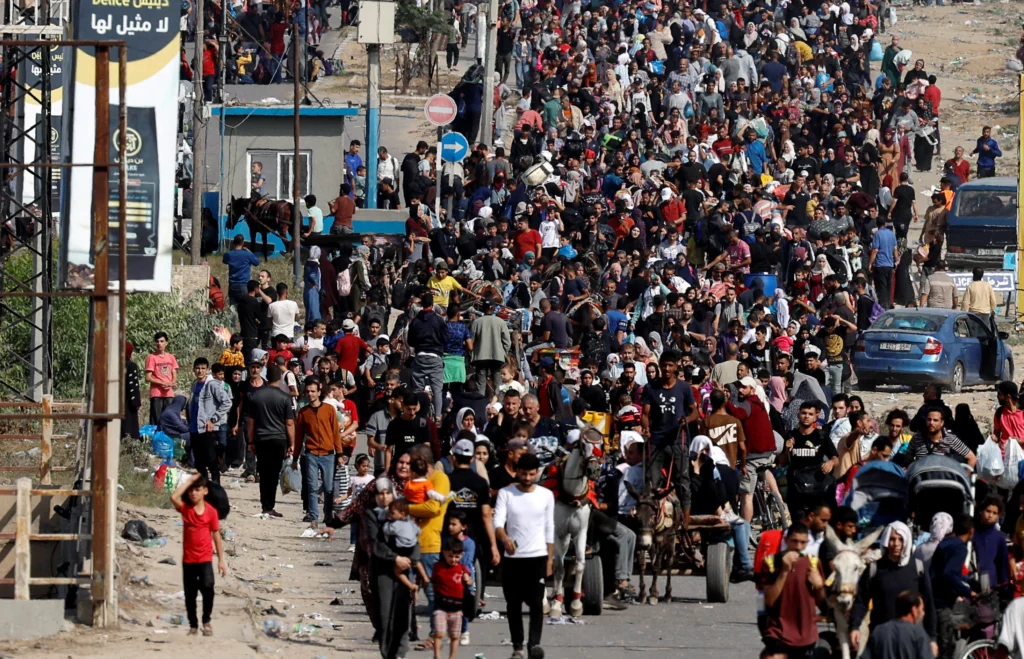
GAZA- Amid the ongoing Israeli military aggression on the Gaza Strip, a suspicious organization has emerged, offering what appears to be a lifeline to desperate Palestinians. Promising immigration to countries like Indonesia in exchange for 5,000 USD, Al-Majd Europe organization is led by unknown team members.
On the surface, it advertises “humanitarian relocation.” But a deeper investigation reveals a far more sinister possibility: a coordinated digital effort to accelerate the ethnic cleansing of Gaza under the humanitarian cover.
Al-Majd’s Online Presence
In early 2024, as humanitarian conditions in Gaza collapsed under siege and bombardment, social media platforms like Facebook, Instagram, and Telegram saw a spike in sponsored ads in Arabic, offering Gazans “safe immigration pathways” to Southeast Asia, most notably Indonesia. The ads, placed by the Al-Majd Europe, featured professionally designed graphics showing peaceful scenes of Jakarta and smiling Palestinian families boarding planes.
The ads directed users to a sleek website (https://www.almajdeurope.org/) that asked users to register for “immigration support services,” listing the cost per applicant as between $1,000 and $2,500, depending on the destination.
Yet, the website itself raised immediate red flags, such a no verifiable physical address, team member names listed as “Omar,” “Tamer,” and “Salah” with AI-generated profile photos, no registration with any known humanitarian, NGO, or migration oversight body, and no contact phone number or legal disclaimers
Cybersecurity analysts consulted for this report confirmed that the domain was registered anonymously and hosted on offshore servers. Attempts to trace the web infrastructure showed temporary IP routing, a common method used to obscure ownership.
While direct evidence linking the foundation to any state actor is elusive, multiple indicators suggest the group may be an Israeli-run digital operation designed to encourage mass Palestinian emigration under false humanitarian pretenses, normalize the idea of permanent displacement from Gaza, and gather sensitive data on applicants for future intelligence use.
Testimonies Confirm It’s Real and Dangerous
Unlike typical scams that vanish upon payment, Al-Majd has actually arranged travel for some families. In interviews with six Palestinians from Gaza, several confirmed they had already left—including a large family that reached Indonesia for just $5,000. One relative explained: “It was too cheap—only because we are so many, they gave us a discount.”
While that may seem like a success story, it is in fact evidence of something far more dangerous: a functioning pipeline of displacement, being sold as salvation.
A Strategic Ethnic Cleansing Operation?
Though no state connection has been conclusively proven, patterns point strongly to Israeli psychological operations. Analysts from Citizen Lab (University of Toronto) and Middle East digital security experts note that Al-Majd mirrors previous Israeli disinformation campaigns—especially in its use of fake NGO fronts, vague humanitarian messaging, and AI-enhanced deception.
A senior regional analyst told Gaza Herald:
“This isn’t about relocation—it’s about emptying Gaza. These methods weaponize trauma and despair to manufacture consent for ethnic cleansing.”
This aligns with public statements by Israeli officials. In December 2023, Minister Bezalel Smotrich openly advocated for the “resettlement” of Gazans with international support. Al-Majd Europe appears to be a functional prototype of that vision—one where starvation and airstrikes are followed by quiet migration ads offering “a better life.”
The Illusion of Choice
Perhaps the most disturbing feature of Al-Majd is its ability to cloak coercion in the language of freedom. For starving families watching their children die from malnutrition, “voluntary departure” is not a choice—it’s blackmail.
By creating an “opt-in” route for displacement, Al-Majd gives plausible deniability to its backers. But the psychological and material pressure on Gazans renders this “voluntariness” meaningless. It is, in effect, a humanitarian smokescreen for long-term demographic erasure.
Researchers at the University of Toronto’s Citizen Lab noted that similar operations have emerged during past conflicts, where fake NGO fronts were used to either scam, surveil, or psychologically demoralize occupied populations.
A senior Middle East digital security analyst (speaking on condition of anonymity) told Gaza Herald:
“The use of AI-generated photos, spoofed domains, and vague migration promises closely mirror tactics used in prior Israeli psychological warfare and data-harvesting operations targeting Palestinians.”
A Broader Policy of “Voluntary” Ethnic Cleansing?
Human rights organizations have long warned that Israel’s siege strategy in Gaza is not just military, it is demographic. Statements by Israeli officials have at times openly hinted at plans to encourage “voluntary emigration” from Gaza, a euphemism for forced displacement.
In December 2023, Israeli Minister Bezalel Smotrich called for “resettling Gazans elsewhere with international help.” Since then, several such “offers” of emigration have emerged, but most lacked transparency or follow-through.
What makes Al-Majd particularly dangerous is that it masks coercion as choice. By exploiting starvation, trauma, and hopelessness, it creates a false humanitarian corridor that aligns perfectly with long-term efforts to empty Gaza of its people.
Meta (which owns both Facebook and Instagram) has yet to comment on the Al-Majd ads. Despite community reports and warnings by digital rights groups, the ads remained online for weeks before some were taken down. There is no evidence of proactive moderation or investigation into the group’s legitimacy by platform moderators.
This raises ethical questions: Are social media giants enabling forced displacement by hosting unvetted, harmful migration campaigns in war zones?
Al-Majd Europe is not a humanitarian lifeline. It is a digital trap exploiting the shattered hope of a besieged people.
At best, it is a cruel scam taking money from starving civilians. At worst, it is part of a covert ethnic cleansing apparatus seeking to erase Palestinians from Gaza through manipulation, deceit, and despair.
Either way, it warrants immediate investigation by digital watchdogs, international humanitarian agencies, and legal authorities. As long as such operations go unchallenged, the digital battlefield will remain another front in the war on Palestine.