
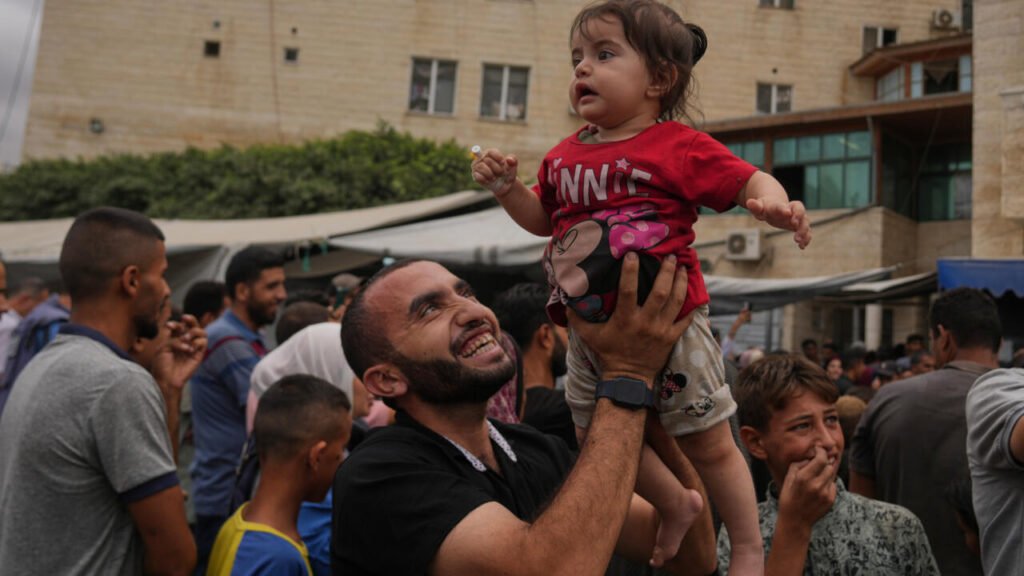
Gaza Herald — For the first time in months, the sound of Israeli drones buzzing over Gaza was met not only with fear but with cautious joy. News spread through the crowded streets and makeshift camps that a long-awaited ceasefire deal between Israel and Hamas was set to take effect within hours, raising a fragile hope that the guns might finally fall silent after two years of genocidal war.
US President Donald Trump announced on Wednesday night that Israel and Hamas had agreed to a ceasefire, a statement that brought a wave of emotion across Gaza’s shattered landscape.
“I swear to God, we have been happy since this morning,” said 24-year-old Bashar Hamed, displaced from Beit Hanoun in northern Gaza. “We’re just waiting for the moment. God willing, the deal begins. We want to go back to our homes.”
The last ceasefire, reached in January, ended abruptly when Israel violated the truce two months later. That memory tempers the celebrations for many Gazans who fear another betrayal.
“I’m happy, but scared,” said Eyad al-Jeish, another displaced resident. “I fear that the war will restart. Israel, especially Netanyahu, sees nothing in its way. There is nothing that restricts them… It’s revenge, nothing else.”
Still, Jeish insists that Palestinians will not be broken or exiled. “I will return and rebuild,” he said. “Even our presence as Palestinians gives life to our homes and neighborhoods, even if none of the buildings remain standing. My whole life is Gaza, even in death.”
Hopes Amid the Ruins
Across the Strip, hope flickers stubbornly in the ruins.
In the central Gaza town of Nuseirat, Bashar Hamed dreams of returning to football, a passion buried beneath the rubble of war. “Now there is no football,” he said quietly. “But I haven’t forgotten. My body remains the same, and my aspirations persist. I told my parents this morning, God willing, when this ends, I’ll go back to playing.”
For children like 13-year-old Itidal Abu Halima, who was displaced from Gaza City’s Zeitoun neighborhood, the truce means a chance to go homeو or what’s left of it. “We left our house with nothing after the Israelis fired missiles at us,” she said. “We love studying and we love school. We wish those days would come back.”
Almost all of Gaza’s 2.2 million residents have been displaced at least once during the genocide. For many, the idea of “home” has become both memory and resistance.
“I would rather die on my land than travel outside, even for a day,” said Um Samer al-Nzeih, who has fled seven times in two years. “My entire street has been wiped out. But this is my land.”
A People Unmoved by Exile
For Palestinians in Gaza, this ceasefire is more than a pause in the bombing — it is a reaffirmation of identity and belonging. After two years of starvation, siege, and devastation, the people of Gaza remain defiant.
As one man told Gaza Herald amid the noise of drones and distant gunfire:
“They can destroy the buildings, but not our will. Gaza will breathe again with us in it.”

