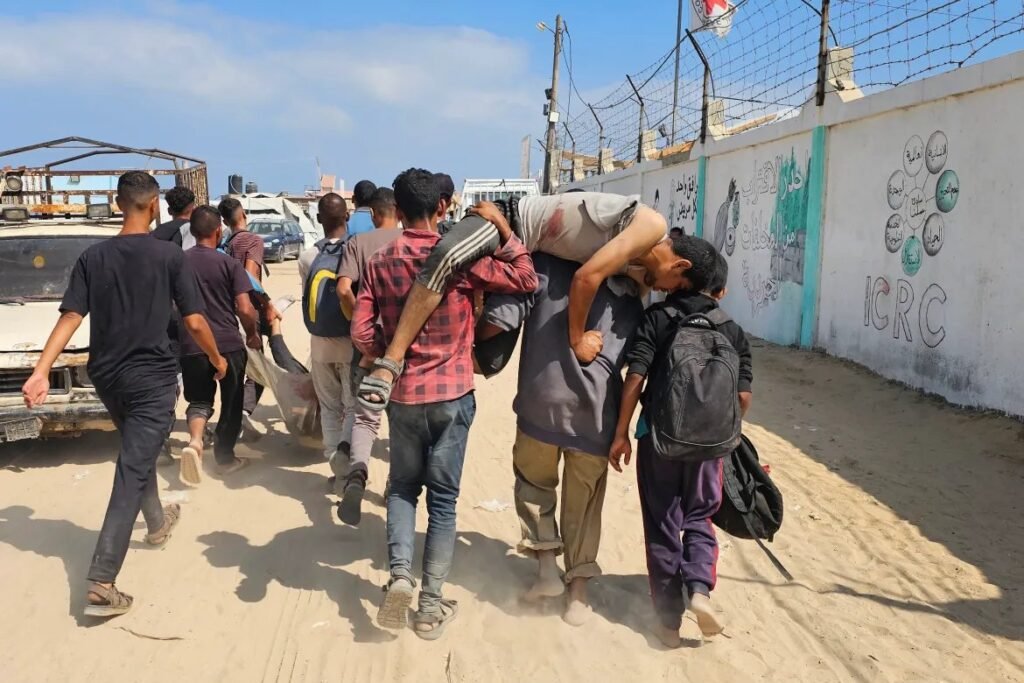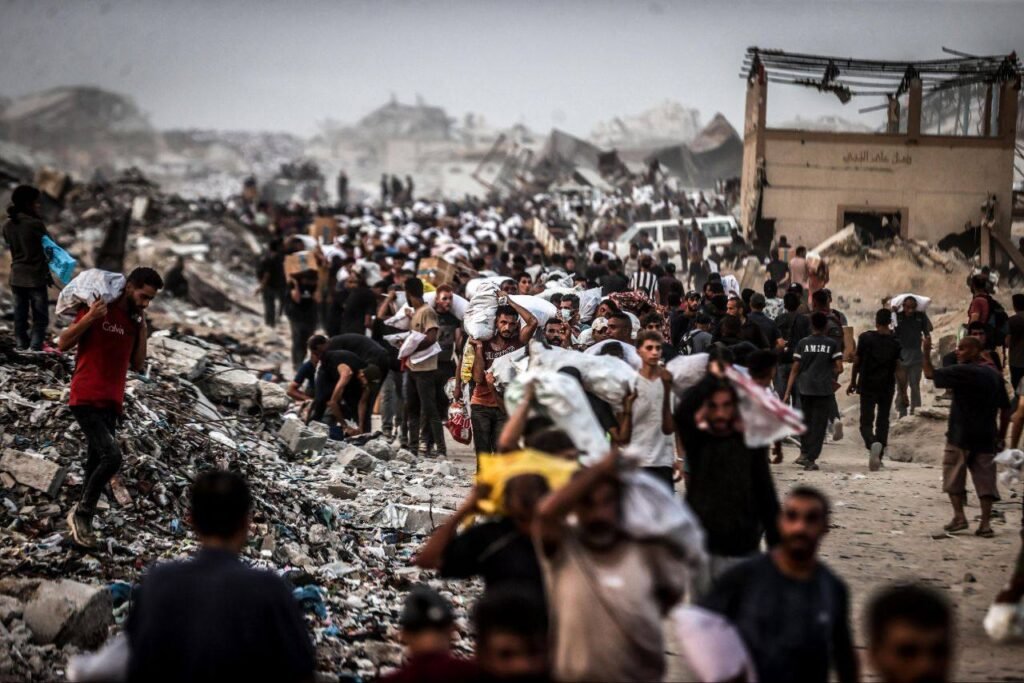
Gaza Herald- In Gaza, where hunger has been weaponized, the Gaza Humanitarian Foundation (GHF) has become the most bitter of names. Marketed as a “lifeline,” it has instead turned into a machine of death and displacement. For many Palestinians, the acronym GHF now means “Graves, Hunger, and Fire.” What was supposed to bring relief has instead delivered chaos, bullets, and humiliation.
Manufactured Starvation
Since October 2023, Israel has restricted humanitarian supplies as a deliberate strategy. Officially, it claims this is to weaken Hamas. In reality, it is a form of collective punishment—ethnic cleansing through famine. For two years, images of starving children threatened Israel’s international image. The solution was not to feed them, but to hide the evidence and outsource “aid” to an organization that functions as a fig leaf.
Layers of Control Through Hunger
The machinery of starvation operates through several overlapping layers. At the most basic level, aid is reduced to a trickle, with Israel allowing only a fraction of the needed trucks to enter. On top of that, parts of the aid are stolen by armed groups who sell them at staggering prices, deepening divisions and desperation inside Gaza.
At the same time, Israel deliberately targets those who try to organize community relief—police officers, municipal workers, volunteers, doctors, and journalists—making local aid impossible to sustain. And finally, the Gaza Humanitarian Foundation itself acts as the deceptive face of this policy, presenting the illusion of aid while pushing Palestinians southward into deadly traps.
The Chaos Strategy
At GHF’s so-called “distribution sites,” survival is reduced to a deadly gamble. The organization announces opening times only on Facebook—sometimes hours before, sometimes after the sites are already closed. Families walk 8–12 kilometers through rubble and sniper zones, only to discover that the site opens for less than 20 minutes.
Palestinians gather by the tens of thousands, waiting in scorching heat. When gates open, crates of flour and rice are thrown into the crowd. Desperation erupts into chaos. People are crushed. Tear gas mixes with the dust. Gunfire cracks overhead. As one displaced father told Gaza Herald: “It is not aid distribution, it is a lottery of death.”
Mercenaries Instead of Humanitarians
The faces behind GHF are not aid workers but contractors. Former CIA officers, US Special Forces veterans, and private mercenaries run the operation. UG Solutions, one of the main security providers, never vetted its guards. Some arrived on tourist visas, carrying automatic rifles. They received no rules of engagement, no training in crowd control, and no interpreters to communicate with desperate civilians.
A guard told Gaza Herald: “We were paid to control the crowd, not to protect them. If that meant opening fire, so be it.”
Data Harvesting and Death
Testimonies from doctors in Khan Younis describe patients arriving with precision bullet wounds to the head and chest. “It looked like training drills on moving targets,” said Dr. Nick Maynard, a British surgeon. Sky News data analysis later confirmed what Palestinians have long said: the more aid distributions announced, the more deaths occurred.
Meanwhile, cameras with facial recognition scan every hungry face. Footage streams directly to Israeli command centers, where profiles are built and names added to target lists. The aid lines, Palestinians say, feel like traps where “you come for food but leave as data—or as a corpse.”
Profits in Blood and Hunger
Behind the humanitarian façade is a massive financial enterprise. GHF claims operating costs of $2 million per day, though insiders say it is higher. Guards earn $1,500–$2,500 daily. Contractors like SRS and Arkel International siphon millions. Israel itself has allocated nearly $500 million to the fund, while Washington considers half a billion more.
Meanwhile, a starving mother in Rafah told Gaza Herald: “We sell half the flour for tomatoes or salt, because no one can eat bread alone. But they make us run, bleed, and beg for even that.”
Masking Ethnic Cleansing
GHF’s deeper purpose is political. By placing aid points far to the south, it forces displacement. By undermining UN agencies, it builds an alternative system loyal only to Israel and the US. International NGOs refuse to cooperate, calling GHF a violation of humanitarian principles. Yet Israel pressures them relentlessly, insisting that “this is the only way.”
The reality, Palestinians say, is that GHF is less about food and more about emptying northern Gaza. “They give us crumbs in Rafah so they can take our homes in Gaza City,” one displaced resident told Gaza Herald.
International Legitimacy Crumbles
Inside Israel, even mainstream media have admitted GHF is a failure. In July, protests erupted outside hotels where its managers stayed. Internationally, 15 organizations have denounced it for ties to war crimes and genocide. The model is increasingly seen not as humanitarian but as profiteering wrapped in propaganda.
Still, Israel and the US present GHF as a blueprint for future conflicts—outsourced aid controlled by private contractors. The danger is not only for Gaza, but for the entire humanitarian system built after World War Two.
Aid as War by Other Means
The Gaza Humanitarian Foundation is not a relief agency. It is a battlefield weapon. By turning hunger into leverage, it has deepened Gaza’s catastrophe and profited from despair. For Palestinians, GHF means not survival but humiliation, displacement, and death.
The lesson is clear: when humanitarian aid is militarized, it ceases to be humanitarian. Instead of saving lives, it becomes an instrument of war. Gaza is starving not because the world cannot feed it, but because feeding it has been turned into a weapon of profit and control.
As one Gazan aid seeker told Gaza Herald with bitter clarity: “They call it food distribution. We call it the daily bloodbath.”