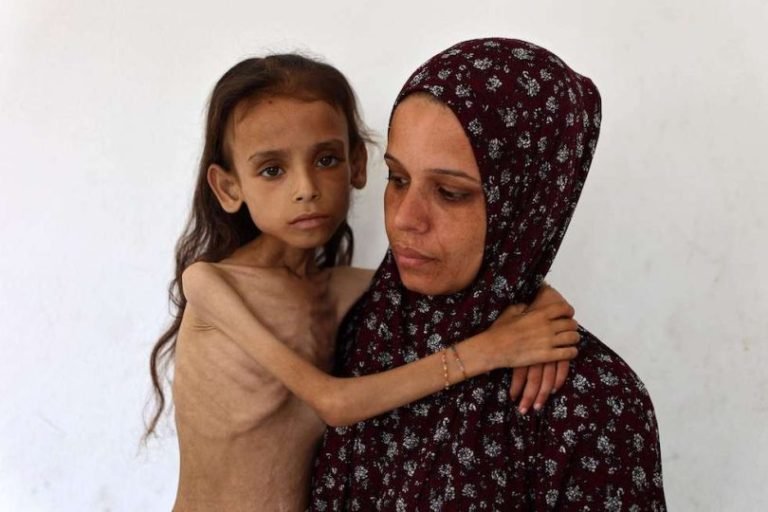
GazaHerald—Seven-year-old Mai Abu Arar, a Palestinian girl fighting for her life in Gaza, is reduced to bones and skin. Once lively and joyous, Mai has now been reduced to consuming liquid food through a syringe, a stark emblem of the deepening man-made famine gripping the besieged enclave.
Her mother, Nadia Abu Arar, recalls the stark transformation. “The doctors told me that she isn’t suffering from any disease or from any past condition. They’re saying it’s all due to malnutrition, and I haven’t seen any improvement in her situation at all,” Nadia said, her voice heavy with despair.
Doctors at Gaza City’s Patient’s Friends Hospital are struggling to treat malnourished patients amid crippling shortages of essential medicines. Hisham Abu Al Oun, pediatric director at the hospital, explained the dire situation:
“Potassium chloride is the easiest medication that any doctor can prescribe. We don’t even have that. We have babies dying because we don’t have it. Sometimes supplies come in, but unfortunately, very little.”
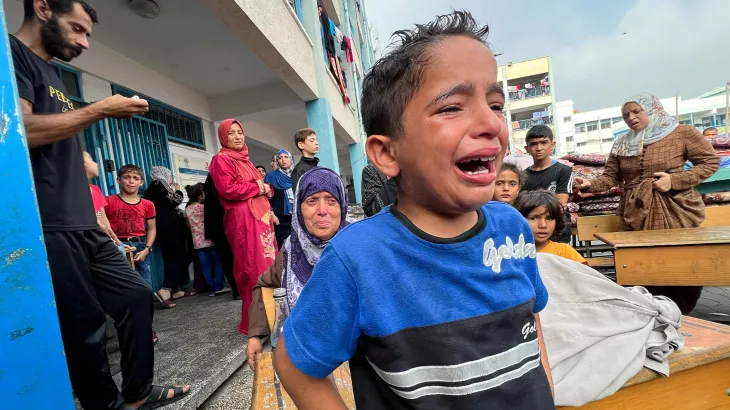
The scale of the crisis is now undeniable. On Friday, the United Nations-backed hunger monitor, the Integrated Food Security Phase Classification (IPC), confirmed that more than half a million people in northern Gaza are experiencing famine. At least 289 people, including 115 children, have already died from starvation.
Israel’s blockade has turned Gaza into a near-total siege, restricting food deliveries and allowing only minimal aid through airdrops and the U.S.-backed Gaza Humanitarian Foundation (GHF).
Palestinians are forced to risk their lives to reach distribution sites located deep inside areas under Israeli military control.
“This will haunt us. Denial is the most obscene expression of dehumanization,” said Philippe Lazzarini, head of the UN Relief and Works Agency for Palestine Refugees (UNRWA).
“It’s time for the Government of Israel to stop promoting a different narrative, to let humanitarian organizations assist without restrictions, and to allow international journalists to report independently of Gaza.”
The IPC report revealed the devastating human impact of the ongoing war, noting that at least 1.9 million people have been displaced twice as the siege triggered widespread famine.
Rights advocates warn that the crisis spares no one. Liz Allcock from Medical Aid for Palestinians (MAP) said, “Hunger is affecting everyone in Gaza. It plays out across the entirety of the Strip daily.
It is not only small children… it is also elderly people, healthcare staff, and aid workers who are fainting on the job because they don’t have enough sustenance to keep them going.”
Despite growing international concern, Israeli Prime Minister Benjamin Netanyahu has denied that people in Gaza are starving, instead blaming aid agencies and Hamas for failing to distribute supplies. The UN has repeatedly stated that even as aid accumulates at crossings near Gaza, Israel has not granted authorization for its delivery and distribution.