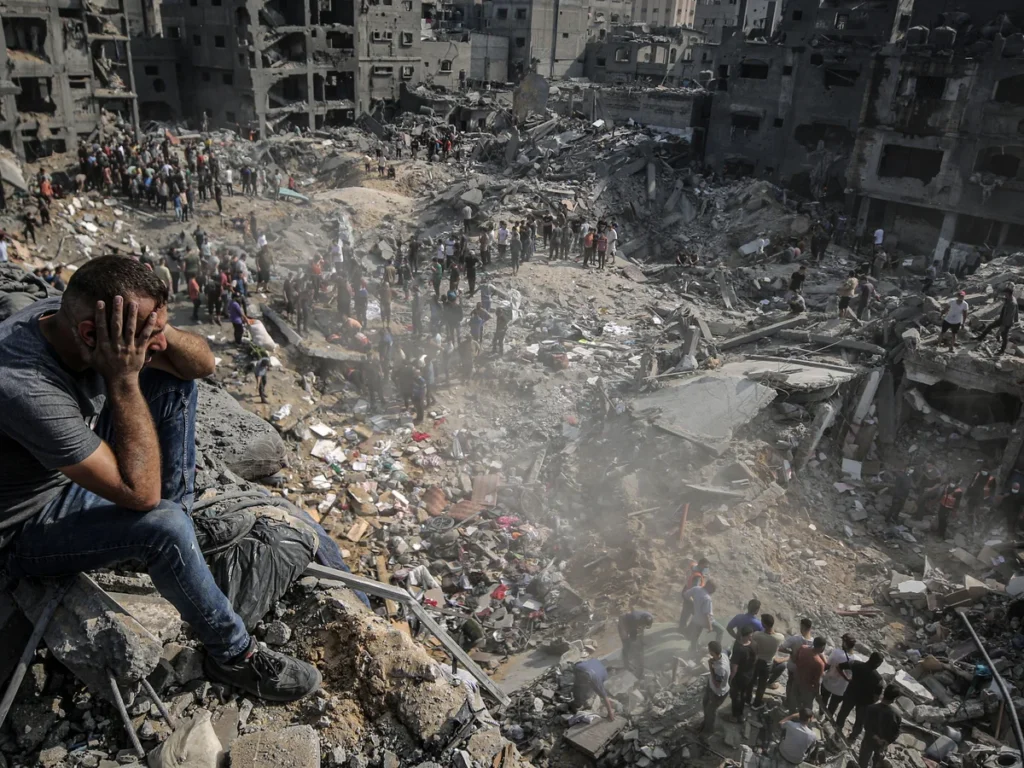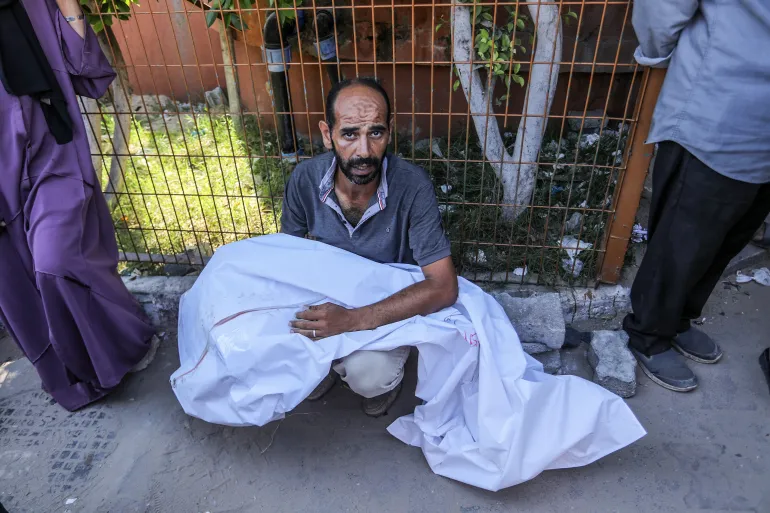
Gaza Herald-The crisis in Gaza has reached a tragic point where basic human needs like food, water, and medicine have become subjects of negotiation rather than guaranteed rights. The recent bombing of Gaza’s only Catholic Church and the ongoing blockade highlight a disturbing reality: Palestinians are being starved and denied essential aid under an occupation that refuses to uphold its legal obligations. Appeals and diplomatic talks have so far failed to stop this deliberate campaign of starvation and suffering.
On July 17, the Israeli army bombed Gaza’s only Catholic Church, killing three people and injuring at least ten. Among the wounded was the parish priest, Gabriele Romanelli, who had maintained near-daily contact with the late Pope Francis. The attack sparked international condemnation. Italian Prime Minister Giorgia Meloni called the strike unacceptable. Pope Leo expressed that he was deeply saddened, though many criticized his words as vague and lacking courage. The Israeli government stated it regretted the incident.
In response to global outrage, the Latin Patriarchate of Jerusalem negotiated access for church officials to reach Gaza’s Christian community. This limited mission delivered modest amounts of food and medicine to Christian and Muslim families alike and evacuated several wounded for treatment outside Gaza. While these acts were welcomed by those in desperate need, they also reveal the broader failure of the international system. The delivery of food, water, and medicine should never require negotiation. These are not privileges to be bargained for but rights protected under international law.
Humanitarian Law Is Not a Bargaining Chip
Palestinians appreciate the efforts of church leaders whose compassion and moral clarity stand in stark contrast to the global silence. However, acts of mercy should not replace legal responsibility. Under international humanitarian law, the occupying power has binding obligations toward the people under its control. Israel controls Gaza’s borders, airspace, infrastructure, and supply chains. As such, it is required to provide access to food, water, and medicine. These are not favors. They are obligations under the 1949 Fourth Geneva Convention and the 1907 Hague Regulations.
Deliberately delaying or obstructing aid constitutes a war crime. The law also prohibits forced displacement or the settlement of an occupier’s population in occupied territories—both of which Israel continues to carry out with no accountability. Instead of being held to account, Israel is rewarded for promising to uphold the bare minimum of humanitarian standards. In exchange for these assurances, it receives diplomatic concessions. Such agreements are later framed as diplomatic victories by the very powers that allow the violations to continue.
At a recent event in Amman, the European Union’s ambassador to Jordan, Pierre-Christophe Chatzisavas, confirmed this logic. He stated that EU pressure on Israel led to Israel’s agreement to increase the flow of aid, restore infrastructure, allow access to UN workers, and reopen corridors through Egypt and Jordan. In return, the EU shelved ten proposed sanctions. Amnesty International described this deal as a cruel and unlawful betrayal of Europe’s declared principles. Yet Israel is already failing to implement the terms. According to European sources, only 80 aid trucks enter Gaza daily, far below the required 500. Even then, much of this aid never reaches the people who need it. Armed gangs frequently hijack convoys, and the Israeli military opens fire on those trying to protect them.
Humanitarian Relief Cannot Be a Substitute for Justice
International aid organizations are sounding alarms about mass malnutrition. Children are dying from hunger every day. Famine is widespread, though the United Nations continues to withhold an official declaration due to political pressure. Meanwhile, Israeli forces and foreign mercenaries continue targeting civilians at aid distribution points operated by the Gaza Humanitarian Foundation. This body was established to replace UNRWA and other UN agencies. Since GHF operations began in late May, nearly 900 Palestinians have been killed while attempting to access aid.
If the European Union as a bloc refuses to act, its individual member states still have legal responsibilities. At the very least, they must halt arms transfers to Israel, ban trade with illegal settlements, and suspend cooperation with Israeli institutions complicit in the occupation. These are not political preferences. They are legal duties under international law. The same principle applies to the rest of the international community.
Appealing to Israel’s conscience has failed. Relying on negotiations instead of imposing consequences sends a dangerous message. It normalizes impunity. It legitimizes starvation as a weapon of war and turns civilians into bargaining chips.
World leaders, including EU officials and church institutions, must continue extending aid to the people of Gaza. But aid alone is not enough. Compassion must be coupled with accountability. Israel must be held to its legal and moral responsibilities. The people of Gaza, whether Christian or Muslim, are not pawns in a political game. They are human beings entitled to dignity, safety, and the right to live.
Humanitarian aid and expressions of sympathy are important, but they cannot replace justice or accountability. The international community must move beyond temporary relief and demand that Israel respect its obligations under international law. Palestinians in Gaza deserve to live with dignity, free from hunger, violence, and fear. The world must no longer accept starvation as a tactic of war or civilians as pawns in political negotiations.