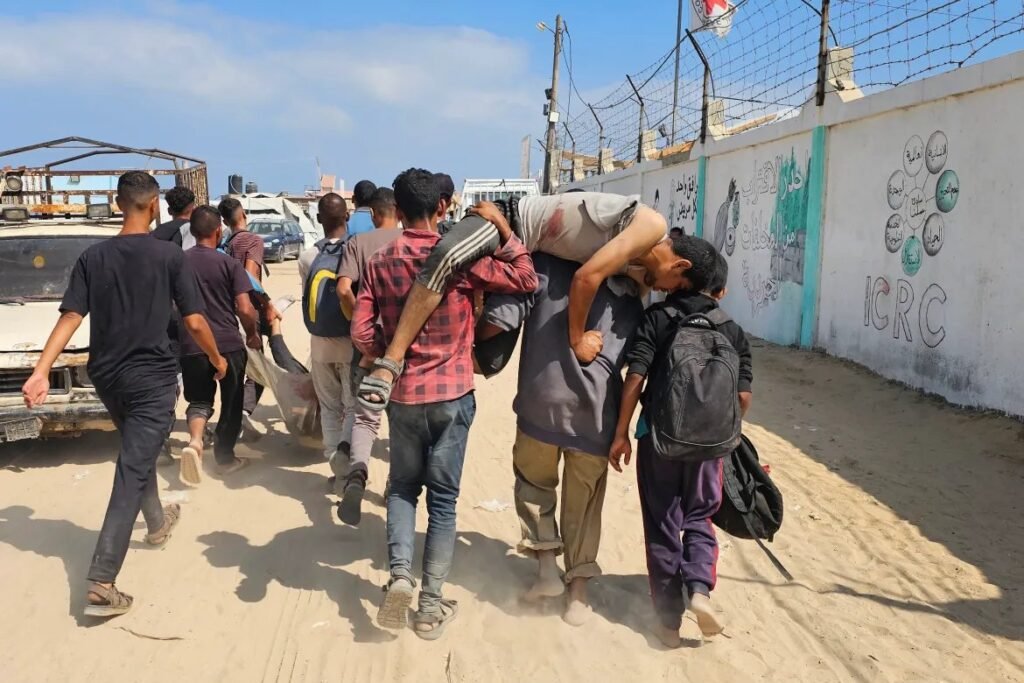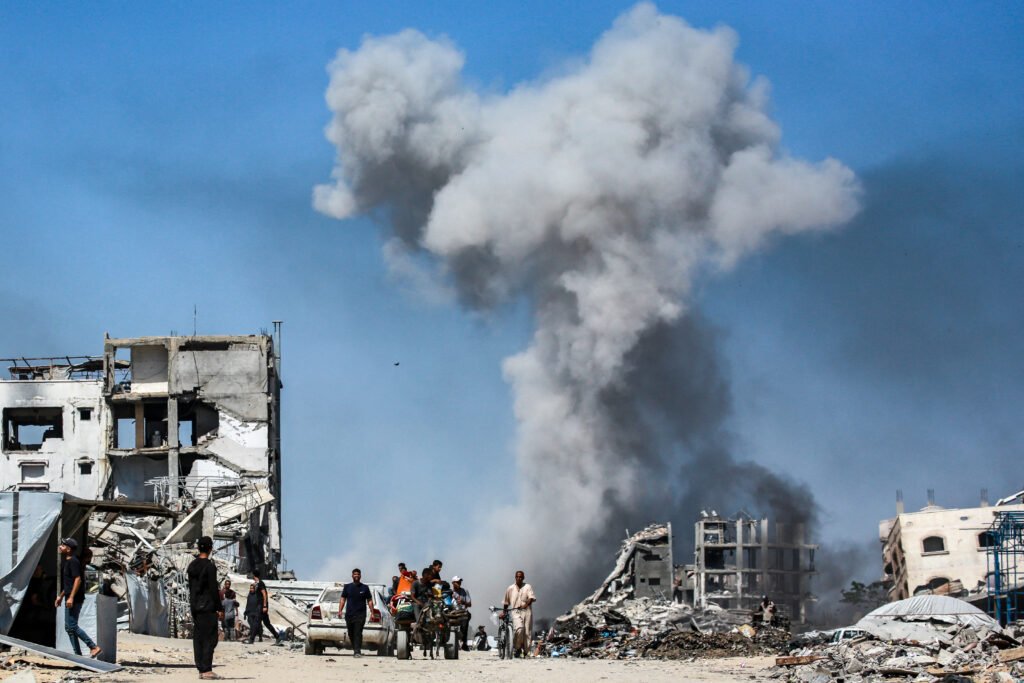
GazaHerald – Nearly two years into the brutal war on Gaza, Israel’s efforts to forcibly or voluntarily empty the Strip of its Palestinian inhabitants have failed. Despite employing a scorched-earth campaign, starvation tactics, and death traps at aid distribution points, with U.S. political cover, Palestinians have largely refused to abandon their land. But these attempts are far from new.
The displacement of Gaza’s population has been a persistent Israeli ambition since the aftermath of the 1967 war. In the wake of its occupation of the Gaza Strip, Israeli ministers began circulating proposals under coded language. “expulsion,” “evacuation,” “transfer,” and “population reduction.” These weren’t isolated voices but consistent official discourse spanning decades.
Documents reveal how Israeli governments considered relocating Palestinians to the West Bank, Jordan, the Sinai Peninsula, or “anywhere else” that would take them. On June 25, 1967, Defense Minister Moshe Dayan bluntly stated, “If we can evacuate 300,000 refugees from the Gaza Strip to other places, we can annex it without any problem.” Though not fully implemented, this vision never disappeared; it simply evolved.
Through successive governments, Israel floated ideas of “quiet emigration,” economic coercion, and demographic engineering. In the 1990s, far-right voices like Rehavam Ze’evi openly called for incentivized exile, proposing to close universities, halt industrial activity, and offer money to those willing to leave. Yet Palestinians remained rooted in their land, resisting with resolve.
After October 7: From Genocide to Ghetto
The war unleashed after October 7, 2023, revived Israel’s displacement fantasies with renewed urgency. A classified intelligence document dated October 13 outlined three stages: first, mass evacuation to Gaza’s south; second, full military occupation; and finally, the transfer of Palestinians into Egyptian territory, permanently denying their return.
Statements from far-right ministers like Itamar Ben-Gvir and Bezalel Smotrich openly advocated for forced or “voluntary” displacement. Even former U.S. President Donald Trump echoed this logic with a surreal vision: transforming Gaza into a tourist “Middle East Riviera,” its people vanishing beneath beach resorts.
But what followed was not a mass exodus. It was resistance.
Despite unprecedented destruction, Palestinians refused to flee. As writer Yara Hawari noted in The Guardian, the people of Gaza showcased what resisting genocide looks like, choosing to live among rubble rather than be erased.
An Israeli investigative report by Nurit Yohanan published on Zman Israel confirmed that the forced displacement plan had failed. Despite months of war and international coordination, Israel was able to convince only a negligible number of people to emigrate, just 600 since the launch of the project. Even during a ceasefire that allowed for medical evacuations, only 4,259 critically ill Palestinians left Gaza between January and March 2025.
These figures, dwarfed by Gaza’s two million-strong population, expose the utter collapse of Israel’s displacement scheme.
The “Humanitarian City”: Ghetto by Another Name
In the face of failure, Israel pivoted. Defense Minister Yisrael Katz introduced a new plan: the so-called “humanitarian city” in Rafah. Ostensibly a safe zone for displaced civilians, the project is in fact a walled-in detention area where residents, screened for Hamas affiliation, would be denied the right to leave.
This wasn’t just an Israeli initiative. A leaked plan by the U.S.-backed Gaza Humanitarian Foundation proposed setting up “transit zones” aimed at replacing Palestinian self-governance with externally controlled camps. The language was humanitarian; the intent, ethnic cleansing.
Former Israeli intelligence officer Michael Milstein called the plan an “illusion,” warning of its infrastructural failure and moral bankruptcy. Even Israel’s army leadership expressed concerns, with Chief of Staff Eyal Zamir calling it a dangerous distraction from the war’s stated goals and criticizing the $3–6 billion price tag amidst rising domestic discontent.
Parallel to the “humanitarian city” was a broader plan to reshape Gaza’s map. In indirect negotiations held in Doha, Israel presented a proposal to seize control of nearly one-third of Gaza, from Jabalia and Beit Lahia in the north to Rafah in the south.
This map envisioned the complete occupation of Rafah, a zone now saturated with displaced civilians, as a staging ground for eventual expulsion, toward Egypt or into the sea. The plan would deny at least 700,000 Palestinians access to their homes and centralize them in displacement camps, a move that has sparked widespread outrage and fears of long-term demographic engineering.
International Outcry: “A Ghetto Before Extermination”
Global condemnation of Israel’s soft-displacement strategy has been fierce. The United Nations, Amnesty International, and multiple human rights bodies described the Rafah plan as a violation of international law, some likening it to a war crime.
British Minister Hamish Falkner said he was “shocked,” reiterating that Palestinian territory must not be reduced, and its people must retain the right to return.
In a scathing article titled “The Jewish state establishes a ghetto, the last stage before extermination,” Israeli journalist Gideon Levy condemned not only the plan but also the chilling silence surrounding it. To even consider such a policy, he warned, was to invite darker horrors.
The People Remain
For all its political maneuvering, international cover, and military might, Israel has failed to achieve its decades-long goal: the erasure of Palestinians from Gaza. Not through bombs, not through bribes, not through blockades disguised as “humanitarian zones.”
Gaza’s people remain.
And in doing so, they have defeated one of the most persistent and perilous ambitions of the occupation: to turn a homeland into a memory and a people into a footnote.