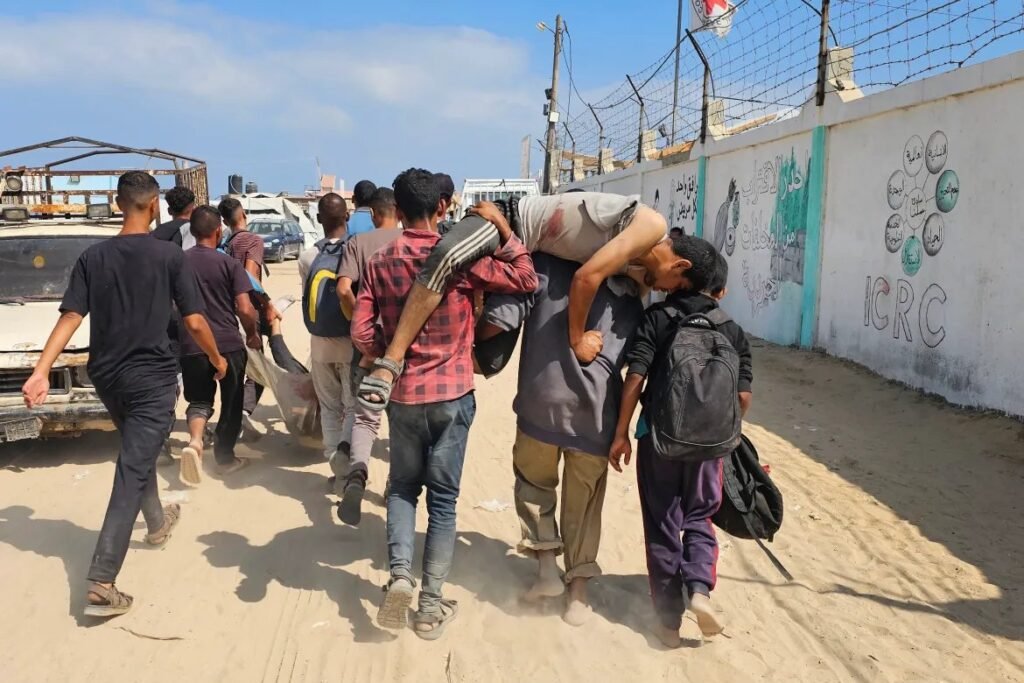
Gaza Herald- Everyone is talking about a near truce in Gaza, but what is the truth? The truce that is expected to be agreed upon is the same one that was reached several months ago and then violated by Netanyahu. Will the genocide resume again after 60 days, just as it did before? Will the guarantees be shaped by Netanyahu’s political manipulation and self-interest? Or will they depend on Trump’s moods?
Optimism vs. Obstruction
U.S. President Donald Trump has extended the timeline for reaching a truce in Gaza, expressing cautious optimism by saying there’s a “very good chance” a deal could be finalized this week or next. However, Hamas has described the ongoing negotiations in Qatar as “difficult,” blaming Israeli intransigence for the lack of progress.
While Trump’s latest comments suggested hope for a breakthrough, his tone was notably more restrained than his previous insistence on achieving a ceasefire—especially before Israeli Prime Minister Benjamin Netanyahu’s recent visit to Washington.
According to Trump’s aides, talks have narrowed down to just one remaining issue. But Hamas disputes that narrative, stating that several critical points remain unresolved. These include whether the ceasefire will be extended beyond 60 days if talks continue, the conditions under which 10 Israeli captives might be released, the scope of Israeli troop withdrawal, and who will oversee the distribution of humanitarian aid. From Hamas’s perspective, the deal is far from complete.
Displacement Disguised as “Choice”
Meanwhile, Netanyahu has also drawn attention over a recent Israeli proposal that raised fears of forced displacement of Palestinians. When questioned, he framed the plan as offering “freedom of choice,” suggesting that Palestinians should be allowed to leave Gaza if they wish—without acknowledging the severe restrictions Israel places on movement and daily life in the territory. Instead, he accused Hamas of coercing civilians to stay in Gaza at gunpoint.
A Ceasefire Without Justice
There appears to be little genuine discussion around achieving a permanent ceasefire, an omission that raises deep concerns about Gaza’s long-term future. A critical question lingers: who is truly steering these negotiations, Donald Trump or Benjamin Netanyahu? Is it Netanyahu, a wanted figure by the International Criminal Court, or Trump, who seems more interested in a media moment to boost his image as a peace enforcer for American audiences?
Legal experts believe Netanyahu’s willingness to participate in negotiations may stem less from a genuine interest in peace and more from the international legal pressure mounting against him, especially following the ICC’s preliminary investigation into war crimes.
This war has become central to Netanyahu’s political survival. Trump has even requested a pardon for Netanyahu and for him not to be held politically accountable.
Despite Israel’s intransigence, American efforts could still impose a truce within 24 hours. Yet, to manipulate the Americans, the Israelis proposed a new military repositioning plan. The political scene now suggests that the entire U.S. administration is focused on appeasing Israel.
Gaza on the Brink
While political leaders debate ceasefire terms, the humanitarian crisis in Gaza deepens. Over 1.8 million Palestinians are displaced, and aid agencies report growing risks of famine, particularly among children and the elderly. Aid distribution remains a contentious issue in the negotiations, with Israel insisting on control, and Hamas demanding a neutral third party.
If no agreement is reached in these negotiations, the situation will only deteriorate further, paving the way for the continuation of the displacement plan to confine Palestinians into a small city.