
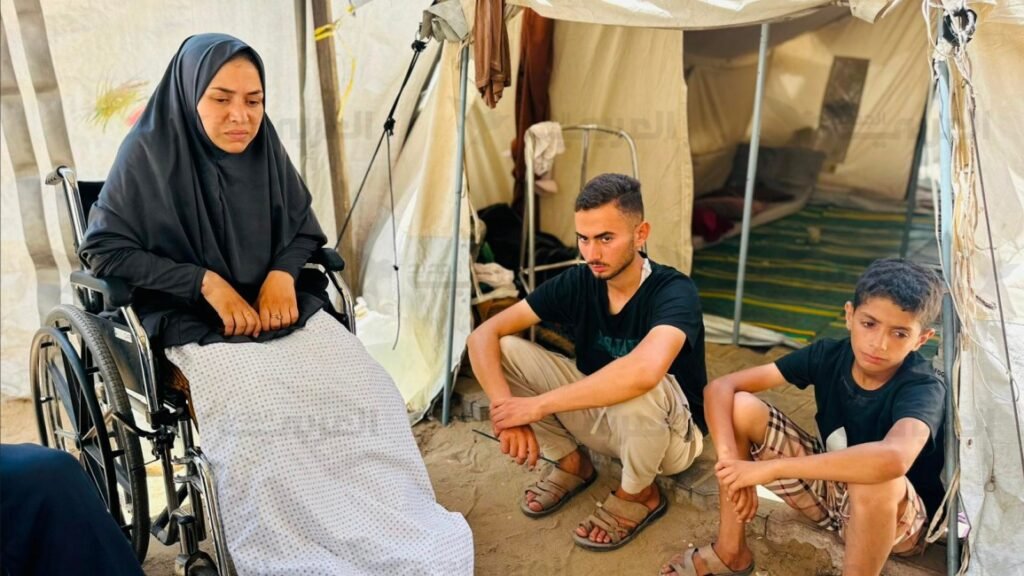
GAZA – In a shredded tent of nylon and dust, pitched somewhere west of Gaza City, Zahraa al-Dahnoun lies in silence. The world beyond her tent is a wasteland of ruin; the world within is one of pain.
For Zahraa al-Dahnoun, life in Gaza has become an unending cycle of pain, displacement, and survival under siege. At only 26 years old, Zahraa has endured more than most could ever bear. She was paralyzed by an Israeli bullet while fleeing violence. Her husband was arrested. Her home was destroyed. Now she raises their toddler alone in a makeshift tent, crippled, hungry, and forgotten.
Zahraa was displaced from Beit Lahiya in the northern Gaza Strip early in the war, which has now dragged on for more than 20 months.
It began on an ordinary day of chaos. Zahraa and her sister were moving essential supplies for their family, cautiously navigating what Israel called a “safe corridor,” already crowded with fleeing civilians. Then came the gunfire. Panic erupted.
“As soon as we arrived, the shooting started. We hid until it calmed down a bit, and then we started running,” Zahraa said. “Then a bullet hit my back. I thought I had been hit by an explosion. I couldn’t feel my legs anymore.”
Paralyzed and terrified, she fell to the ground. “I started screaming. A passerby told me I would be fine. He advised me to try to crawl away from where I was for fear of being injured again. But I couldn’t. I had lost the ability to move and felt severe pain in my neck.”
What she feared most was not just death, but what might come after. “I surrendered to the pain, and I kept imagining I would die there, that stray dogs would maul my body, like what happened in many cases.”
She was rescued by young men who carried her to a hospital. But that was only the start of another kind of suffering: Gaza’s hospitals were already crippled. She was first taken to Al-Ahli Arab (Baptist) Hospital in Gaza City, where an X-ray showed the bullet had exploded her spleen. She was then transferred to the Public Service Hospital, where she underwent surgery to remove the spleen, and later a spinal operation. Since then, she’s required ongoing physical therapy, therapy that is virtually unavailable in Gaza now.
The bullet that hit her remains lodged dangerously close to her spine. And the lack of proper diagnostics, treatment protocols, or even basic medicines has turned Zahraa’s recovery into a daily torment.
“What little medicine is available is either not suitable or extremely expensive. Most of the time, I just endure the pain,” she says.
But physical pain is only one part of Zahraa’s anguish.
She lives in a nylon tent with her son, Imad, who is just two and a half years old. The tent lacks the most basic elements of life: no hygiene, no privacy, and no access to proper food. “There’s no special care, no nutrition. Everything is missing,” she says.
Making things worse is the psychological devastation caused by her husband’s absence. Majdi al-Dahnoun, Zahraa’s husband, was arrested by Israeli forces in the third month of the war, along with his father and brother. It happened on the very day of their son’s first birthday.
“That was a breaking point for me,” Zahraa admits. “My husband was the one who carried the burden with me. Since his arrest, I’ve been completely alone, trying to provide for our child while being disabled myself.”
Zahraa’s journey of displacement did not end after her injury. The family was forced to move repeatedly, fleeing each time Israel issued new evacuation orders or intensified its attacks on populated areas. They moved from shelters to schools to scattered camps, each time with fewer belongings, less support, and more trauma.
Eventually, they settled in a camp west of Gaza City. But life there offers little comfort. The north is cut off from aid, food is almost nonexistent, and clean water is scarce. Basic services have all but collapsed.
Zahraa’s condition remains precarious. The bullet near her spine has still not been removed. She needs a full, professional medical diagnosis and treatment, but there is no capacity left in Gaza’s decimated health system. “There are no diagnostic tools. No proper care. And I live with the fear that this bullet might still cause more damage.”
The destruction of Gaza’s medical infrastructure is not accidental. Since the beginning of its war on Gaza on October 7, 2023, Israel has systematically targeted hospitals, clinics, ambulances, and medical warehouses. The result is a total collapse of the health sector, with patients like Zahraa left to suffer without anesthesia, painkillers, or even sterile conditions.
Still, Zahraa wakes up every morning and tries to care for her son. She speaks quietly, but every word carries weight.
“I never imagined I’d live like this. And I don’t know how much longer I can keep going.”
In her tent, surrounded by dust and silence, Zahraa waits, for medicine, for her husband, for someone to listen, for the war to end.

