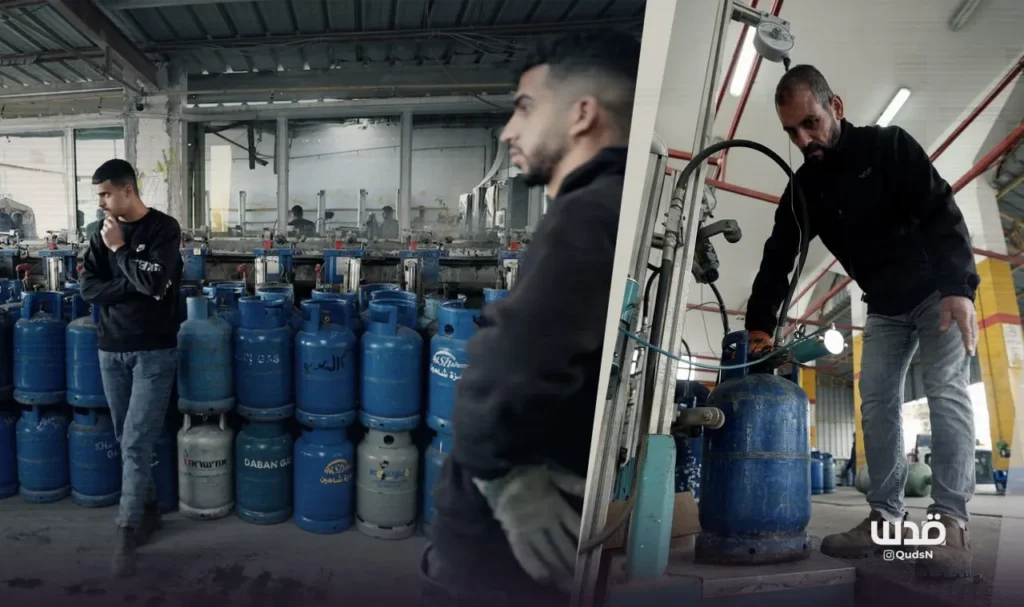
Gaza Herald – The decision by Palestinian authorities to raise the price of domestic gas to 100 shekels has ignited a wave of public outrage and discontent across the occupied territories. Citizens and activists have expressed deep frustration over the sudden increase, questioning the justification for the hike and the mechanism used to calculate the new rates.
There are growing demands for the government in Ramallah to reveal the actual cost of gas, including specific taxes and fees imposed on the product. This call for transparency comes despite official explanations provided by the General Petroleum Authority regarding the reasons behind the price adjustment.
In a clarification statement, the General Petroleum Authority attributed the price increase to rising source prices, regional escalation affecting energy supply disruptions, and higher transportation costs. The authority emphasized that no changes were made to taxes or profit margins for gas stations and distributors.
The authority further noted that the financial crisis caused by the withholding of clearance funds limits its ability to intervene directly in pricing. It stated that it is exploring available options to alleviate the burden on citizens and predicted that prices would decrease once the factors causing the rise are removed.
Regarding proposals to buy and sell oil derivatives without taxes and fees, the authority argued that such measures are not feasible under the customs union agreement, citing Israeli control over crossings and borders as a major constraint on policy flexibility.
On social media platforms, Fadi Halawa challenged the interpretation of the Paris Economic Protocol. He pointed out that Article Three, Clause 12/b, grants the Palestinian Authority the power to set prices for diesel, kerosene, and cooking gas, excluding gasoline which faces special restrictions.
Halawa questioned why prices cannot be lowered and urged relevant authorities to disclose actual costs and potential reductions rather than relying solely on external factors as excuses for the current high prices.
Activist Mohammad Jarar called for the monthly publication of gas purchase invoices from sources, detailing original prices and applied taxes so citizens can understand how final prices are calculated. He also raised questions about price differences with neighboring countries like Jordan and Egypt.
Saad Jaradat criticized the vague language of the authority’s statement, arguing that citizens need clear, data-driven explanations instead of general rhetoric, especially given the perceived lack of clarity and rationality in government decisions.
Khaled Bader warned against imposing additional burdens on citizens to compensate for the financial crisis, stating that deducting money from low-income households would exacerbate social tensions amid worsening living conditions.
Ibrahim Sharqa expressed that citizens no longer trust government justifications blaming the occupation for all crises, though he acknowledged the impact of occupation interventions. He proposed forming a community and legal committee to investigate the reasons behind rising prices of gas, diesel, and meat.
Citizens linked the price hike to their difficult economic situations, with some asking how they can afford gas cylinders amidst withheld pensions for injured individuals and accumulated debts.
Adi Jaafer, residing in Turkey, noted his monthly gas bill was only 7.17 dollars despite inflation there, contrasting this with the 100 shekel price in the West Bank, which rises to between 115 and 120 shekels with delivery in some areas.
Mohammad Awad questioned why cylinder prices remain stable in Jordan despite global increases cited by the authority, while Alaa Areda requested clarification on gas sources and alternatives if current prices are tied to specific suppliers.
Ahmad Al-Nimr described the successive price hikes as illogical, noting that ordinary citizens bear the consequences while families struggle to meet basic daily needs.
This report was produced in the Gaza Herald newsroom.