
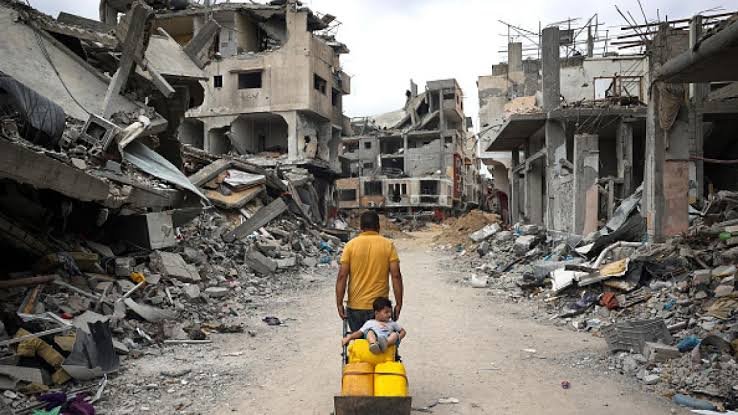
Gaza Herald— More than a year after a ceasefire was declared in the Gaza Strip, Palestinians continue to be killed, wounded, displaced, and deprived of essential supplies, while Israeli military operations persist across the devastated territory.
According to figures released by Gaza’s Government Media Office on Monday, November 2, 2026, 1,593 Palestinians have been killed, 5,748 wounded, and 217 detained since the ceasefire took effect on October 10, 2025.
The office documented 5,989 Israeli ceasefire violations, including 753 in October 2026 alone, exposing a devastating gap between the promise of a ceasefire and the reality facing more than two million Palestinians who have endured years of Israeli bombardment, displacement, and destruction.
Although the agreement reduced the scale of military operations, Israeli occupation forces have continued conducting airstrikes, firing on civilians, carrying out ground incursions, and demolishing homes. Meanwhile, large parts of Gaza remain under Israeli military control, reconstruction has stalled, and humanitarian aid deliveries fall far short of agreed levels.
The Killing Never Stopped
The ceasefire has not protected Palestinian civilians from Israeli airstrikes, artillery fire, or shootings. One of the deadliest escalations occurred on October 28 and 29, 2025, just weeks after the agreement took effect, when Israeli strikes killed 104 Palestinians and wounded 253 others, according to the Palestinian Ministry of Health.
The attacks struck Nuseirat refugee camp and densely populated residential neighborhoods, destroying homes and killing entire families. Israeli authorities said the strikes targeted armed fighters and military positions, accusing the Palestinian side of violating the agreement.
However, the United Nations Independent International Commission of Inquiry documented strikes in or near densely populated residential areas.
Throughout 2026, Palestinian deaths continued to be recorded in airstrikes, artillery attacks, and shootings, including in areas far from Israeli military positions.
The UN Human Rights Office said it had verified the killing of 1,076 Palestinians between the start of the ceasefire and the end of July 2026, including 268 children and 126 women. By the agreement’s first anniversary, the Palestinian Ministry of Health had recorded more than 1,400 deaths.
The latest figures from Gaza’s Government Media Office place the toll at 1,593 as of November 2, underscoring the continued loss of Palestinian lives despite the declared ceasefire.
The Yellow Line: A Deadly Boundary for Civilians
The so-called Yellow Line was established under the ceasefire agreement to mark Israeli military deployment areas. Instead of providing a clear boundary protecting civilians, it has become a dangerous zone marked by shootings, military incursions, and demolitions.
According to the UN Human Rights Office, 331 Palestinians were killed near the Yellow Line through the end of July 2026, including 66 children and 27 women. The office reported that some victims had been engaged in ordinary civilian activities, with no information indicating they posed a threat to Israeli troops.
Among the cases documented was a two-year-old Palestinian child killed on June 14, 2026, while being held in his father’s arms in Wadi al-Salqa. His father was also wounded.
The UN warned that civilians do not lose their protection under international humanitarian law simply because they are near military deployment areas.
The danger has extended beyond individual shootings. According to the UN Independent International Commission of Inquiry, Israeli-controlled territory expanded from approximately 53% of Gaza under the agreement’s initial arrangements to at least 60% by September 2, 2026.
The commission also documented new military bases, fortifications, and the establishment of an additional boundary known as the Orange Line in March 2026.
These developments have raised concerns that temporary military deployment arrangements could become permanent restrictions, further fragmenting Gaza and preventing displaced Palestinians from returning home.
Homes Destroyed Even After the Ceasefire
For families who survived the war, the ceasefire has offered little assurance that what remains of their homes will be spared.
During October 2026, Gaza’s Government Media Office recorded 346 shooting incidents, 310 bombardments, 64 home-demolition incidents, 21 military incursions, and 12 arrest-related incidents, bringing the total to 753 violations during the month.
The continued demolition of homes and destruction of civilian infrastructure have made returning to devastated neighborhoods increasingly difficult, leaving families who have already endured repeated displacement facing the possibility of losing what little remains of their property.
Concerns have also grown over changes to the Yellow Line’s physical markers. In an October 15 report, the UN Office for the Coordination of Humanitarian Affairs noted the movement of markers near the Shuja’iyya intersection, raising fears that areas restricted to Palestinian civilians could expand.
For displaced families, such changes create further uncertainty over where they can safely shelter, travel, or attempt to rebuild their lives.
Hunger and Deprivation Behind the Ceasefire
The humanitarian consequences of the agreement’s incomplete implementation are equally severe. Despite commitments to increase the delivery of food, medical supplies, fuel, and other essentials, Gaza continues to receive only a fraction of the quantities expected under the agreement.
According to the Government Media Office, 77,657 trucks entered Gaza between October 10, 2025, and November 2, 2026, compared with 232,800 expected deliveries. That represents just 33.3% of the agreed total.
The situation deteriorated further in October 2026, when only 3,777 of 18,600 expected trucks entered the territory, representing 20.3% of the agreed quantity.
Fuel deliveries were particularly restricted, with only 247 fuel trucks entering Gaza during October, compared with 1,550 expected, representing 15.9%.
These shortages affect far more than transportation. Hospitals require fuel to operate essential equipment, water facilities depend on electricity and generators, and bakeries need reliable energy supplies to produce bread.
With Gaza’s infrastructure devastated, restrictions on essential deliveries threaten the functioning of services on which civilians depend for survival, deepening an already catastrophic humanitarian crisis.
Rafah Crossing: Thousands Still Unable to Travel
The ceasefire has also failed to restore normal movement through the Rafah crossing, leaving thousands of Palestinians unable to travel for medical treatment, education, or other urgent needs.
According to the Government Media Office, only 14,821 people crossed in both directions between the agreement’s implementation and November 2, 2026, compared with an expected 40,000, representing approximately 37% of planned movement.
In October alone, only 802 travelers crossed out of an expected 4,200, a compliance rate of 19.1%.
The restrictions have left patients, wounded Palestinians, students, and people facing urgent humanitarian circumstances waiting for opportunities to leave Gaza. For those needing specialized medical treatment unavailable inside the territory, continued restrictions can carry life-threatening consequences.
No Full Withdrawal, No Reconstruction
The ceasefire agreement was intended to open the way for broader Israeli withdrawal, new arrangements for governing Gaza, international stabilization measures, and reconstruction. More than a year later, these objectives remain largely unrealized.
The Israeli government has insisted that Hamas disarm before a full withdrawal, while competing proposals have called for withdrawal and security arrangements to proceed together.
An Associated Press report marking the agreement’s first anniversary noted that the first phase had halted large-scale military operations, facilitated the release of remaining Israeli captives, and increased humanitarian deliveries compared with the period of full-scale war.
However, the report also highlighted the failure to end Israeli control over substantial portions of Gaza, establish new governing arrangements, or begin meaningful reconstruction.
Approximately two million Palestinians continued to live in conditions of displacement, sheltering in tents, damaged buildings, and amid the ruins of their former neighborhoods.
For families who have lost homes, livelihoods, and loved ones, the absence of reconstruction means that the devastation of war remains an everyday reality.
A Ceasefire That Has Yet to Deliver Safety
More than a year after the agreement took effect, the figures reveal a fundamental contradiction: while the ceasefire remains formally in place, the conditions it was meant to end continue to shape Palestinian life in Gaza.
Israeli attacks have continued to kill and wound civilians, military control has expanded across large areas, homes have been demolished, movement remains restricted, and essential supplies are entering at levels far below those anticipated under the agreement.
The UN Human Rights Office has warned that continued civilian deaths raise serious concerns under international law and has called for action to halt violations and ensure accountability.
The 5,989 violations documented by Gaza’s Government Media Office represent more than isolated military incidents. They reflect a sustained pattern of military operations, restrictions, and destruction that has continued throughout the ceasefire period.
For Palestinians living amid the ruins of Gaza, a ceasefire cannot be measured solely by the reduction of large-scale bombardment. It must also be measured by whether children can live without fear of being shot, whether families can return to their homes, whether patients can reach medical care, and whether food, water, and essential supplies can reach those who need them.
More than a year after the agreement took effect, those basic conditions remain out of reach for much of Gaza’s population.
The ceasefire may have changed the scale of Israel’s military operations, but according to the Palestinian and UN figures cited in this report, it has not ended the killing, destruction, or humanitarian suffering.

