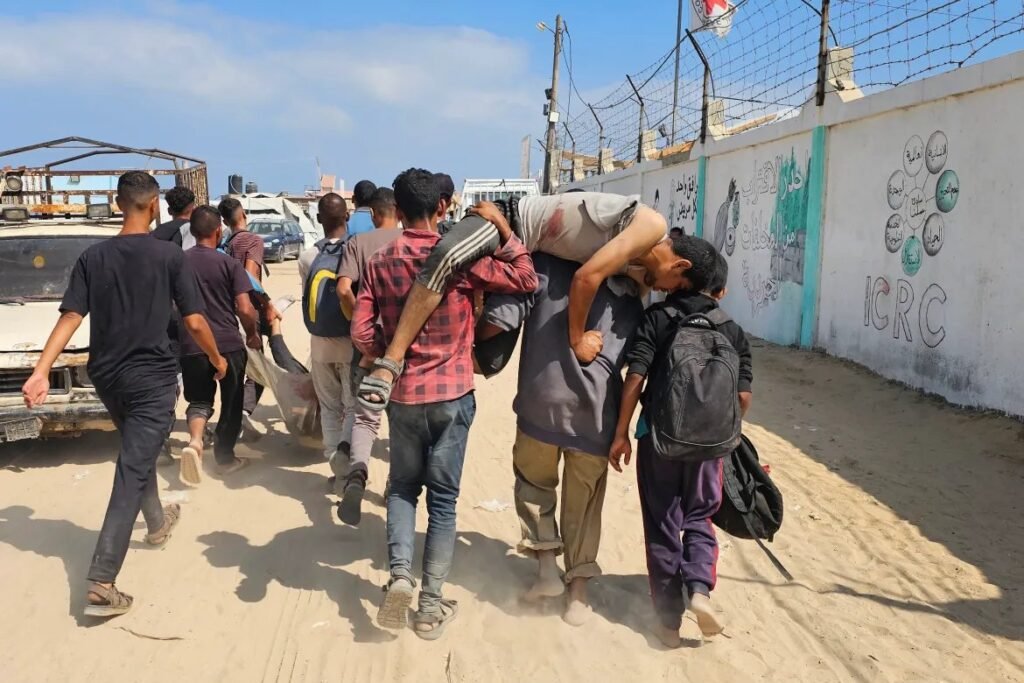
Gaza Herald _Israel is carrying out a large-scale operation to demolish, crush and remove millions of tonnes of rubble from the Gaza Strip, raising concerns among human rights organisations that the process could erase evidence of alleged war crimes and permanently reshape the territory.
The operation is taking place amid the devastating human toll of Israel’s war on Gaza, which has killed at least 73,387 Palestinians, most of them women and children, since October 2023.
The Euro-Mediterranean Human Rights Monitor has warned that the removal of rubble could contribute to demographic engineering and the destruction of evidence documenting the scale of the devastation. In its assessment of damage and reconstruction needs in Gaza, the organization estimated that around 68 million tonnes of rubble are scattered across the enclave.
At least 10 million tonnes have reportedly already been removed, crushed or relocated from their original locations in areas under Israeli military control, which cover roughly two-thirds of Gaza. Around 400 pieces of heavy machinery are reportedly involved in demolishing structures and clearing debris.
Nearly 100 trucks are transporting rubble out of Gaza each day, with the material reportedly being taken to undisclosed locations inside Israel and the occupied West Bank.
Concerns over evidence being destroyed
Human rights researchers have warned that the rubble may contain crucial evidence, including fragments of missiles and ammunition, personal belongings and the remains of Palestinians killed during the war.
The removal and destruction of these materials could make it significantly harder to investigate alleged violations and establish what happened at particular sites.
Mohammed Salha, director of the NGO Network in Gaza, said the relocation and crushing of rubble could destroy crime scenes containing evidence needed for future investigations and accountability.
He also warned that thousands of Palestinians are believed to remain buried beneath destroyed buildings, meaning that moving the debris could result in their remains being lost or scattered.
Such actions could also complicate investigations into the genocide case against Israel currently before the International Court of Justice, which was brought by South Africa.
Reshaping Gaza’s landscape
The large-scale clearance operation could have consequences extending beyond the removal of war debris.
The Euro-Med Human Rights Monitor has warned that crushing rubble and demolishing what remains of buildings could erase property boundaries, house foundations and road networks. These physical markers are important for establishing ownership and documenting the pre-war landscape of Palestinian communities.
Military and strategic analyst Elias Hanna described the destruction and reshaping of Gaza’s urban environment as part of a broader effort to transform the territory.
He said the destruction of buildings and neighbourhoods changes the physical and social environment, potentially making areas difficult or impossible for Palestinians to return to or rebuild.
According to this assessment, the continued demolition could permanently alter parts of Gaza and make the return of displaced residents increasingly difficult.
Missing Palestinians remain under the rubble
The removal of debris is also raising fears for the fate of thousands of Palestinians who remain missing.
Gaza’s Civil Defense estimated in July 2026 that around 8,500 people could still be buried beneath destroyed buildings. Clearing sites with heavy machinery before forensic teams can examine them risks crushing or scattering human remains and depriving families of the ability to recover and identify their relatives.
Abu Asim, whose family members remain beneath the rubble in eastern Gaza, described the pain of losing both access to their remains and the evidence surrounding their deaths.
For families like his, the tragedy did not end with the deaths of their relatives. It has continued through the inability to recover their bodies, give them identifiable graves and preserve evidence that could help establish responsibility for their deaths.
Rescue teams blocked from key areas
Rescue operations remain severely restricted in areas under Israeli military control.
Lawyer Samir al-Mana’ama of the Al Mezan Center for Human Rights said Israeli forces control roughly 70 percent of eastern Gaza and prevent rescue teams from reaching areas where bodies may still be buried.
He warned that the relocation of rubble from one site to another could further complicate the recovery of human remains and violate protections under international humanitarian and human rights law.
Raed al-Dahshan, director of Gaza Civil Defense, said rescue operations are already extremely difficult even in areas where teams can operate. Accessing areas behind the so-called Yellow Line, he explained, would require special equipment, coordination and security arrangements that are currently unavailable.
Cemeteries also affected
The concerns extend beyond destroyed homes and buildings.
Salha said human rights documentation indicates that more than 93 percent of Gaza’s cemeteries have been completely or partially damaged or destroyed.
The destruction of burial sites adds another dimension to the crisis, potentially preventing families from locating graves and recovering the remains of relatives.
For Palestinians in Gaza, the removal of rubble is therefore not simply a reconstruction issue. It also raises urgent questions about the fate of thousands of missing people, the preservation of evidence and the possibility of holding those responsible for alleged crimes accountable.