
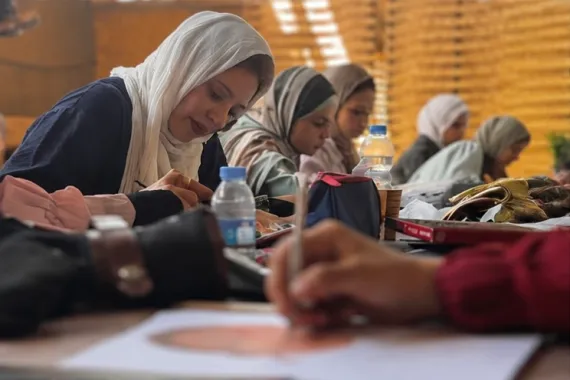
Gaza Herald: Sixteen-year-old Maryam sits quietly over a blank sheet of paper, pencil in hand. As she begins to draw, her attention shifts away from the devastation surrounding her. For a few hours, the paper becomes a different world, one where she can focus, create, and reconnect with something familiar.
Maryam’s family home was destroyed in an Israeli bombing in January 2024. She now lives with her grandmother in Deir el-Balah and has lost friends and relatives, including her uncle, during Israel’s war on Gaza.
An art space inside a beachside café in Deir el-Balah has become a refuge for her.
“The space helped me return to myself and rediscover my passion for drawing,” Maryam says.
For her, drawing is far more than a pastime. It has become a way to express emotions that she struggles to put into words.
She says working on her drawings gives her a sense of psychological relief, allowing her to transfer difficult feelings onto paper rather than keeping them inside. Each drawing, she says, helps her communicate a part of her experience in a way that feels natural to her.
A small space for hope
Maryam has loved drawing since childhood. She began attending the art space shortly after it opened in April, gradually making it part of her daily routine.
Completing each new drawing gives her a sense of accomplishment and offers a brief moment of hope amid the pressures of life in wartime Gaza.
She says the activity gives her something to look forward to each morning and has helped her resist the despair surrounding her.
Without drawing, she believes, she could have become overwhelmed by depression and the circumstances she was facing. Instead, she has continued learning and creating something new each day.
That sense of purpose is exactly what 35-year-old Abdullah al-Ghafri hoped to provide when he established the space.
He says the idea emerged from the destruction of Gaza’s educational and cultural infrastructure. With many cultural and educational centers damaged or destroyed, there were increasingly few places where children and young people could develop their talents.
The project was designed to give them somewhere to step away from the atmosphere of war, release some of the emotional pressure they carry and reconnect with positive experiences.
For al-Ghafri, keeping the space running has become a challenge of its own. High rental costs mean he must continually seek financial support to keep the project open.
Art as a way to cope
Psychologist Asil Abu Shawish says artistic activities can provide children and adolescents with an alternative way to process traumatic experiences.
Drawing, singing and playing music can help children release emotions and psychological pressure that may otherwise remain difficult to express, she says.
A safe and consistent environment is particularly important for children living through displacement and uncertainty. Having a place where they know they can spend time drawing or making music can restore a small sense of control over their lives.
That sense of control can be psychologically significant in an environment where almost everything else is unstable.
Although art cannot erase the psychological consequences of war, Abu Shawish says it can provide an important coping mechanism, particularly when activities are appropriate to children’s ages and supported by people capable of responding to their emotional needs.
She says changes can often be seen during the sessions themselves. Children who initially remain withdrawn may gradually begin interacting with others through their drawings, music or other creative activities.
For some children, art can be easier than spoken language.
A child may not be able to say that they are frightened, grieving or struggling with loss. Instead, they may communicate those emotions through an image, a song or a musical instrument.
When creative activities continue over time, they can become part of a child’s routine and provide an ongoing outlet for difficult emotions.
Music in the middle of displacement
The same approach is being used through music programs in Nuseirat.
At the Palestinian Student Care Association, children participate in activities organized in partnership with the Edward Said National Conservatory of Music. They gather with instruments, learn songs and develop their musical skills despite the destruction around them.
Jabr Thabet, projects and venue coordinator at the conservatory’s Gaza branch, says the goal is not simply to teach children music.
The conservatory is trying to bring music to children wherever they are, even when displacement and damaged facilities force activities to move between different locations.
The conservatory’s Gaza City facility was damaged during the war, prompting instructors to continue their programs in areas including Nuseirat, Deir el-Balah and Gaza City.
Thabet says the children’s enthusiasm is one of the most striking aspects of the sessions. Many arrive eager to learn and leave already looking forward to returning.
Music, he says, can give children another way to communicate emotions when speaking feels difficult.
A child who cannot explain what they are feeling may be able to express it through singing or playing an instrument.
For Thabet, this makes art part of the children’s resilience.
When a child is still able to sing, play music or create something beautiful amid widespread destruction, he says, they are preserving something deeply important: a part of themselves and the life they had before the war.
In Gaza, where children have endured displacement, loss and relentless uncertainty, these small spaces cannot undo what has happened. But for a few hours, a pencil, a drawing, a song or a musical instrument can offer something the war has taken from them, a sense of normality, connection and the freedom to simply be children.

