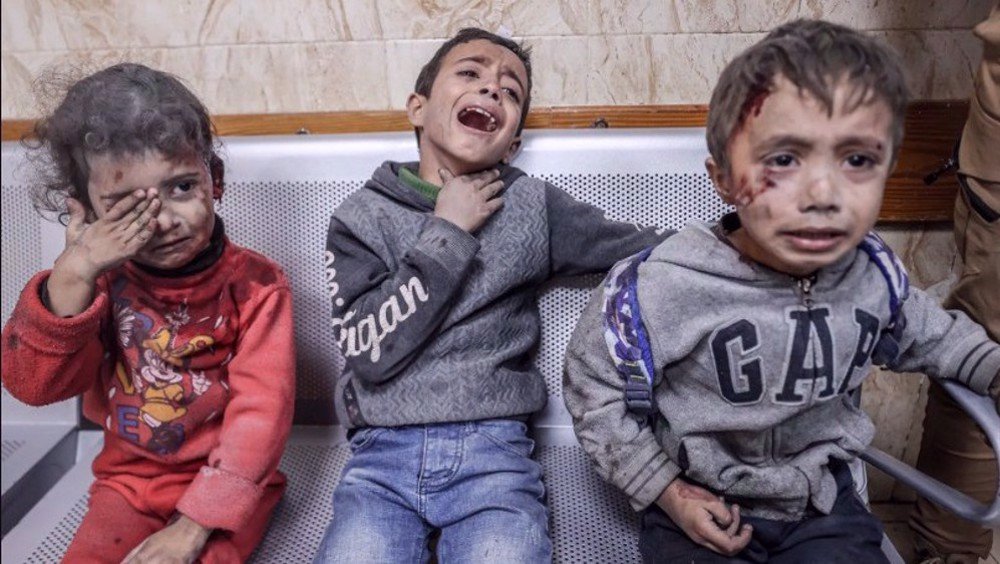
Gaza Herald | Accessing a single container of clean drinking water has become an exhausting daily struggle for Palestinians across the Gaza Strip as Israel’s ongoing restrictions on the entry of industrial oils and operational supplies force more desalination plants to shut down, deepening an already catastrophic humanitarian crisis.
With summer temperatures rising and hundreds of thousands of displaced Palestinians living in overcrowded camps, the collapse of neighborhood desalination facilities has left families walking long distances in search of potable water while the limited remaining supplies struggle to meet soaring demand.
In a displacement camp west of Gaza City, Abdul Rahim Nour begins each morning carrying empty water containers across long distances after the small community-operated desalination plant that once served his neighborhood stopped functioning.
“The search for drinking water is no longer a short trip,” he said. “It has become a daily journey on foot to distant filling stations supplied by water tankers coming from central facilities.”
He explained that the shutdown of the nearby plant about a week earlier, after industrial oils used to operate generators ran out, forced dozens of families to rely on unstable and increasingly scarce alternatives. Long queues, extreme heat, and the burden of carrying heavy containers have turned securing water into one of the hardest parts of daily life.
Summer Conditions Deepen the Crisis
The drinking water emergency is worsening as summer increases demand while the number of operational desalination plants continues to decline.
Health and municipal officials attribute the growing shutdowns primarily to the severe shortage of industrial lubricants required to keep power generators running. Restrictions on the entry of these essential materials have forced dozens of small desalination stations out of service, sharply reducing the volume of drinking water available to residents.
The consequences extend far beyond water shortages. Thousands of displaced families now spend hours every day searching for water while coping with displacement, overcrowding, and the near-total collapse of basic public services.
Families Forced Into Daily Searches for Water
At Al-Samidoun displacement camp west of Gaza City, Umm Mahmoud Mahdawi, a widow raising six children after her husband was killed during the war, described the daily struggle to secure enough water for her family.
“Only weeks ago, we relied on a nearby desalination station,” she said. “After it stopped operating because industrial oils were no longer available, we returned to spending hours every day searching for any available source of drinking water.”
She explained that she and her children often walk long distances to mobile water distribution points, frequently returning with amounts insufficient for the family’s daily needs.
Much of the day is spent waiting under the scorching sun in crowded lines, and some days they return empty-handed, only to repeat the search the following morning.
Her children now help carry heavy water containers despite their young age, while inside the tent she carefully rations every drop between drinking, cooking, and washing dishes because no reliable water source remains.
Community Desalination Plants Falling Silent
In Gaza City’s Al-Nasr neighborhood, Khamis Al-Shawa, manager of a community-funded desalination station capable of producing approximately 600 liters of purified water per hour, said the facility had completely ceased operations after running out of industrial oils.
He explained that the crisis extends beyond lubricants to include shortages of filtration materials and purification supplies essential for keeping the plant operational.
“The price of a single liter of industrial oil has reached around 2,000 shekels,” he said. “That is far beyond what community initiatives can afford. Despite residents’ efforts to support the station, continuing operations has become impossible.”
Al-Shawa warned that prolonged closures of neighborhood desalination plants will further intensify Gaza’s drinking water crisis and called on the international community to facilitate the entry of industrial oils and operational supplies, describing them as essential humanitarian necessities.
Gaza’s Water Infrastructure Nearing Collapse
Officials say Gaza’s water sector is experiencing an accelerating collapse as the war and blockade continue.
According to previous statements by Alaa Al-Batta, Deputy Chairman of the Union of Gaza Strip Municipalities, desalination plants are shutting down one after another because of severe shortages of fuel, generator oils, spare parts, and the deterioration of aging generators operating continuously under emergency conditions.
He noted that one recently closed desalination facility had produced approximately 1,600 cubic meters of drinking water daily, enough to serve nearly 100,000 people. Gaza, however, requires at least 40,000 cubic meters of potable water every day to meet minimum humanitarian needs—far exceeding current production capacity.
Generator oil prices have risen to nearly 2,000 times their pre-war levels, while worn generators consume even larger quantities because of leaks and mechanical deterioration, making continued operation increasingly unsustainable.
Al-Batta also stated that Israeli attacks have destroyed more than 725 water wells across Gaza. Although local authorities, the Coastal Municipalities Water Utility, the Palestinian Water Authority, and the International Committee of the Red Cross have rehabilitated roughly 40 percent of them, most continue operating at only 50 to 60 percent of their original capacity because of damage and shortages of equipment.
As a result, Gaza is currently producing no more than 20 percent of the water it supplied before the war.
He added that wastewater systems face similar challenges, with pumping stations relying on the same generators affected by fuel and lubricant shortages. Municipalities are therefore forced to operate sewage pumps intermittently, raising the risk of worsening environmental contamination and serious public health emergencies throughout the Gaza Strip.