
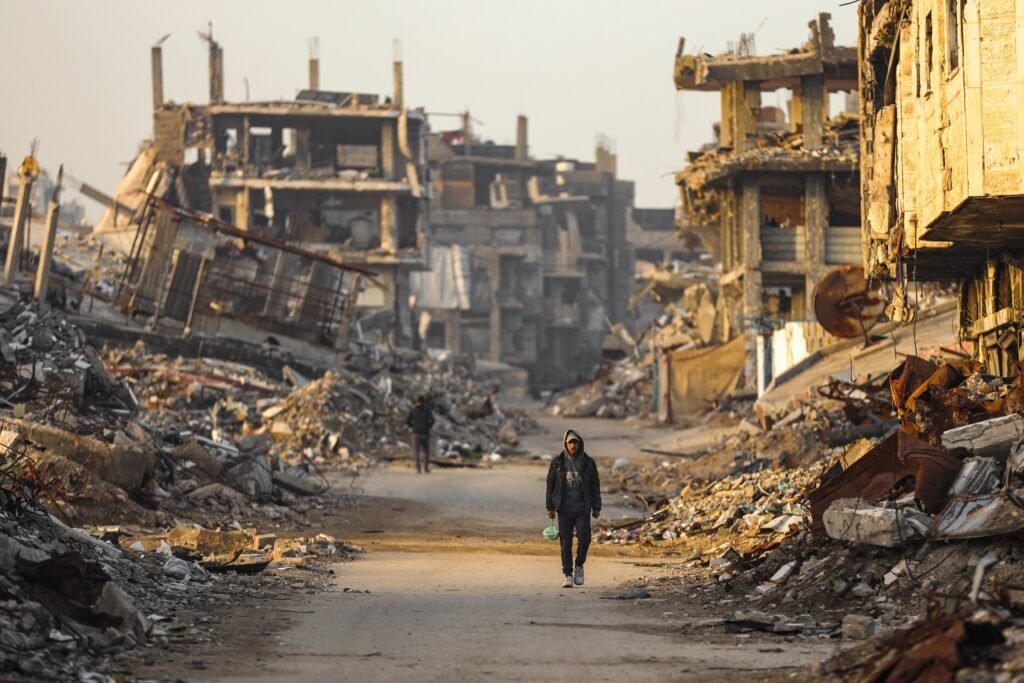
Gaza Herald — Everyone tells you there are ways to leave Gaza. Scholarships. Humanitarian programs. Special permits. But no one hands you an escape.
While applying for a fully funded scholarship for students from Gaza, I reached a question that stopped me cold: Provide official proof that you did not leave Gaza before October 2023.
I paused.
What document could possibly prove that I never left?
Friends suggested I request an official certificate from a government office confirming I had remained in Gaza. I looked at my identity card. It showed that I was born in Gaza, so I photographed it and submitted it. But my ID could only prove where I was born. It could not prove where I had stayed.
Another friend suggested sending a copy of my passport. The absence of travel stamps, she said, would prove I had never left.
The irony was almost unbearable.
I do not even have a passport.
How do you document the absence of something that never existed?
As I searched for paperwork, my thoughts drifted somewhere else entirely.
What if one day I am asked to prove that I survived genocide?
What document could ever certify that I fled my home under relentless bombardment wearing my grandmother’s black sandal on one foot and a gray shoe on the other because there was no time to find a matching pair?
What official paper could verify that I spent nights sleeping on the floor of a UN school without a mattress, without blankets, and without even a sip of water?
Would I have needed to strap a camera to my head every hour of every day so that someone, somewhere, might eventually believe what happened?
I think about all the moments I never recorded—moments that may one day sound too unbelievable to be true.
Who would believe that I spent fifteen minutes searching through a pile of rotten tomatoes just to find one that was slightly less spoiled than the others?
Or that the vendor refused my money because the banknotes were too damaged to accept?
Or that when I returned a few minutes later, even that single rotten tomato had already been sold to someone carrying cleaner cash?
Would anyone believe that people competed over spoiled food?
It sounds absurd.
Yet it happened.
Would anyone outside Gaza believe that I deliberately ignored the worms crawling through flour after kneading the dough because my family had waited days for a single meal, and I could not bear to tell them there was nothing else to eat?
Would anyone believe that an entire city goes to sleep each night unsure whether there will be flour the next morning?
How do I prove the number of times I packed my belongings for another displacement, choosing which fragments of my life were worth carrying and which had to be abandoned forever?
How do I document every impossible decision made beneath bombs and fire?
Can I send someone my heart so they can count every moment it trembled with fear?
Can I send them my eyes so they can see what repeated displacement has carved into them?
The world asks for documents, signatures, certificates and official records.
But genocide does not issue paperwork.
Its evidence lives in shattered memories, broken families, abandoned homes, empty chairs, and lives interrupted forever.
Is our testimony not enough?
Will history remember us as victims, survivors, or simply numbers?
Sometimes I fear that what happened to us is so unimaginable that, even after everything, the world will still struggle to believe it ever happened.

